US-China Strategic Stability and Nuclear Arms Control Frameworks
Source:The Hindu ↗
Why It Matters
The evolving US-China dynamic directly impacts global trade architectures and supply chains, offering both challenges and opportunities for India (such as the 'China Plus One' strategy). The push for a new trilateral nuclear arms framework following the expiration of New START highlights shifting global security paradigms that influence India's strategic calculations in the Indo-Pacific.
Summary
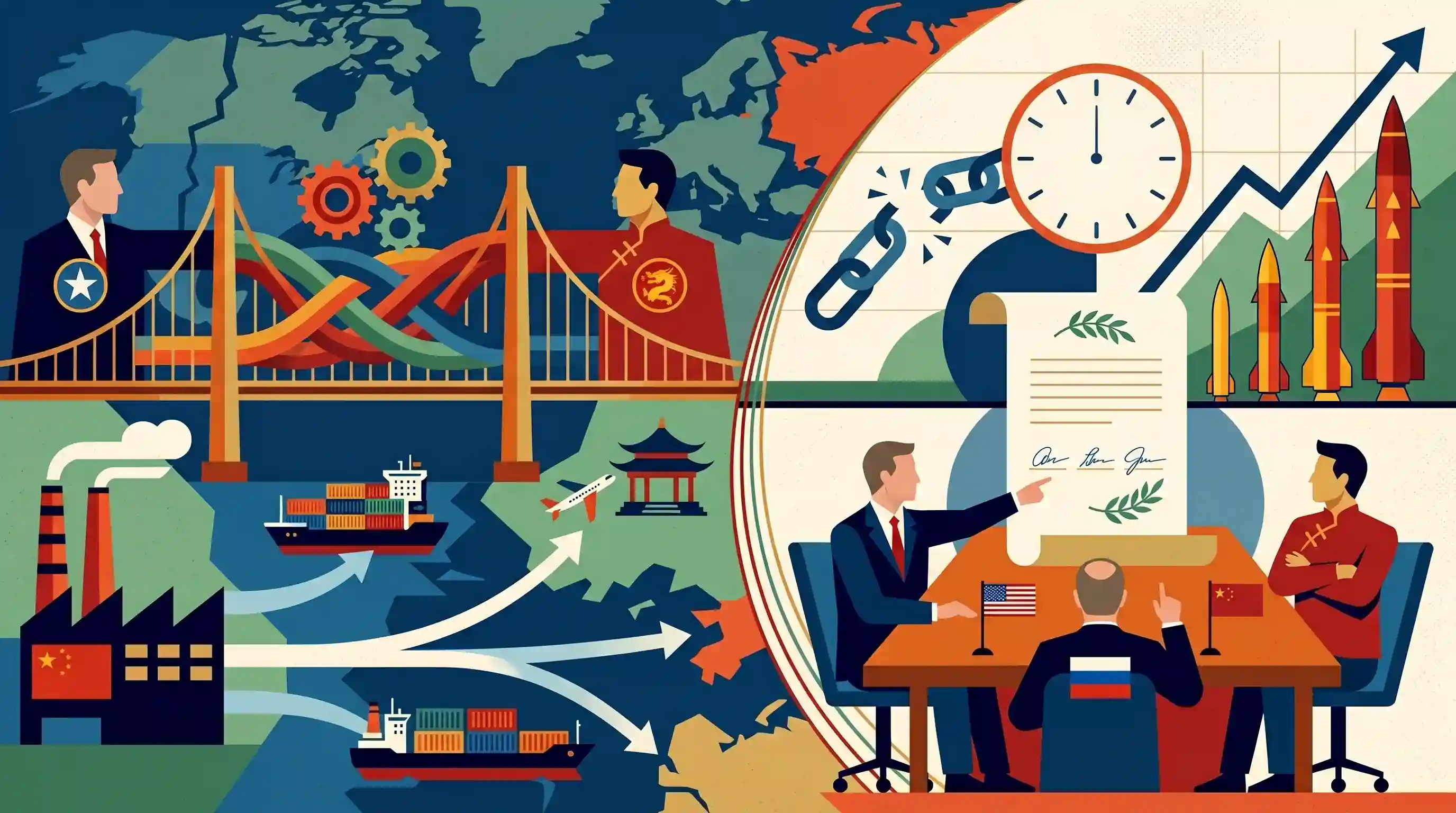
U.S. Secretary of State Marco Rubio stated that the United States and China have achieved 'strategic stability' ahead of President Donald Trump's planned visit to China, aiming to avoid a mutually destructive global trade war. Despite this stabilization, the U.S. intends to continue diversifying away from China's dominance in global supply chains. Furthermore, following the expiration of the New START treaty, the U.S. is pressing for a trilateral nuclear arms control agreement involving Russia and China. However, China remains unwilling to participate as its nuclear arsenal continues to grow rapidly.
Key Points
- U.S. Secretary of State Marco Rubio declared that the U.S. and China have reached 'strategic stability' ahead of President Trump's upcoming visit to China.
- Both nations acknowledge that a full-scale global trade war would be deeply damaging to their economies and the world.
- Despite stability, the U.S. remains committed to diversifying global supply chains away from China's dominance.
- Following the expiration of the New START treaty, the U.S. is pushing for a trilateral nuclear arms control agreement with Russia and China.
- China, whose nuclear arsenal is growing rapidly, is currently unwilling to negotiate a three-way nuclear deal.
- China previously sanctioned Rubio in 2020 over his human rights advocacy for the Uyghur minority and Hong Kong.
Important Terms
New START Treaty

A 2010 bilateral treaty between the U.S. and Russia limiting deployed strategic nuclear warheads and delivery systems; it is the final major arms control pact between them.
UPSC context
GS II (International Relations); tests knowledge of global security architecture and US-Russia nuclear diplomacy.
Strategic Stability
An international condition where nuclear-armed states lack incentives for a first strike or an arms race, ensuring predictable relations and avoiding escalation into conflict.
UPSC context
GS II (International Relations); crucial for understanding nuclear deterrence and the balance of power.
China Plus One Strategy
A strategy where businesses diversify manufacturing and supply chains beyond China to reduce risks from geopolitical tensions, regulatory uncertainty, and over-reliance on a single source.
UPSC context
GS III (Economy) and GS II; relates to India's manufacturing goals and supply chain resilience.
Trilateral Arms Control
A proposed nuclear framework involving the U.S., Russia, and China to address the modern reality of three major nuclear powers rather than the traditional U.S.-Russia bilateralism.
UPSC context
GS II (International Relations); tests understanding of emerging multilateral challenges and China's growing global role.
Supply Chain Resilience
The ability of global trade networks to withstand shocks, typically achieved through 'de-risking' and diversifying production sources to ensure economic security.
UPSC context
GS III (Economy); relevant to global trade disruptions and India’s strategic economic positioning.
Prelims Trap
The New START treaty was a trilateral nuclear arms control agreement between the US, Russia, and China.
New START was strictly bilateral (US-Russia). The US is currently proposing a new trilateral pact, but China consistently rejects participation.
Static Concepts Connected
What was the New START treaty and its primary scope?
- Bilateral framework: Signed in 2010 between the United States and Russia, it succeeded the Strategic Offensive Reductions Treaty (SORT) to control nuclear proliferation.
- Warhead limits: It capped the number of deployed strategic nuclear warheads and bombs at 1,550 for both nations.
- Delivery systems: It limited deployed Intercontinental Ballistic Missiles (ICBMs), Submarine-Launched Ballistic Missiles (SLBMs), and heavy bombers to 700.
What is the 'China Plus One' strategy?
- Core objective: A global business strategy to diversify supply chains and manufacturing investments away from sole reliance on China.
- Key drivers: Driven by rising Chinese labor costs, geopolitical tensions, pandemic-induced supply shocks, and Western 'de-risking' policies.
- Indian context: Creates strategic opportunities for countries like India to attract foreign investment and boost exports through schemes like PLI.
Cross-Topic Patterns
Arms Control & India's NPT Stance
The collapse of US-Russia nuclear treaties and China's unconstrained arsenal expansion directly impacts global non-proliferation debates, highlighting India's continued demand for universal, non-discriminatory disarmament.
De-risking & India's Manufacturing Push
US supply chain diversification efforts perfectly align with India's push for self-reliance and global integration via PLI schemes, testing students on shifts in global value chains (GVCs).

A 2026 prelims multi-statement question will likely test New START's bilateral nature against China's nuclear modernization and expansion.
Linked PYQs · 3
Linked PYQs · 3
- 2024MainsGS2
‘The West is fostering India as an alternative to reduce dependence on China's supply chain and as a strategic ally to counter China's political and economic dominance.’ Explain this statement with examples.
- 2011PrelimsGS1
The "New START" treaty was in the news. What is this treaty?
- 2025MainsGS2
"The reform process in the United Nations remains unresolved, because of the delicate imbalance of East and West and entanglement of the USA vs. Russo-Chinese alliance.” Examine and critically evaluate the East-West policy confrontations in this regard.
