Strait of Hormuz Geopolitics and West Asia Energy Security
Source:Indian Express ↗
Why It Matters
The Strait of Hormuz is a critical chokepoint for global oil transit, directly affecting India's energy security and inflation. Furthermore, Pakistan's role as a primary interlocutor between the US and Iran reflects a strategic alignment that could impact India's regional diplomatic leverage.
Summary
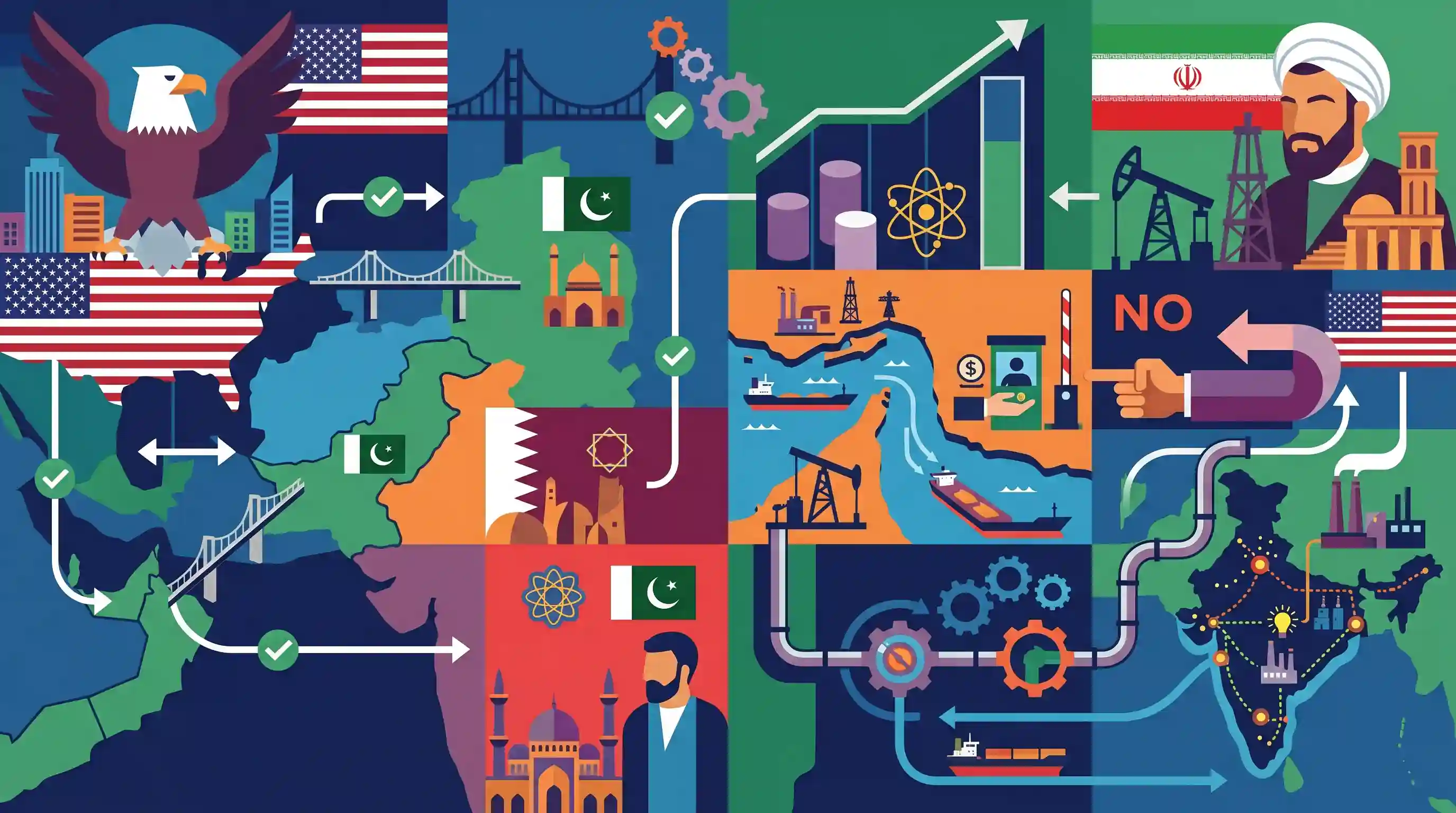
The United States and Iran have reported 'some progress' in ongoing indirect talks mediated primarily by Pakistan, with Qatar also playing a role. The negotiations focus on critical geopolitical issues, including Iran's enriched uranium stockpile and the strategic Strait of Hormuz. The US has firmly opposed Iran's proposed tolling system for the strait, a crucial maritime chokepoint whose stability is vital for global energy security and oil markets.
Key Points
- The United States and Iran are engaged in indirect negotiations, with Pakistan serving as the primary interlocutor and Qatar also mediating.
- Discussions are heavily focused on managing Iran's enriched uranium stockpile and resolving tensions over the Strait of Hormuz.
- US Secretary of State Marco Rubio has explicitly rejected Iran's proposal to impose a tolling system in the Strait of Hormuz, emphasizing the need for free navigation.
- Any disruption or closure of the Strait of Hormuz poses severe risks to global energy security, having already caused volatility in global oil markets.
Important Terms
Strait of Hormuz

A narrow, strategically vital waterway between the Persian Gulf and Gulf of Oman; the world's most significant oil transit chokepoint.
UPSC context
GS Paper I & II: Geography and International Relations. Vital for India's energy imports and West Asia stability.
Enriched Uranium
Uranium with an increased concentration of isotope U-235. Levels of 60% are "highly enriched," nearing the 90% threshold required for nuclear weapons.
UPSC context
GS Paper II & III: International Relations and Security. Relevant for nuclear non-proliferation and global security frameworks.
Primary Interlocutor
The lead diplomat or entity acting as the central bridge in a dialogue between two parties (here, Pakistan for the US and Iran).
UPSC context
GS Paper II: International Relations. Analyzes third-party mediation and neighborhood diplomacy in conflict resolution.
Maritime Chokepoint
A strategic, narrow passage linking larger bodies of water, where maritime traffic can be easily restricted, impacting global trade and naval movement.
UPSC context
GS Paper I: Geography. Key to understanding global trade vulnerabilities and maritime security.
Global Energy Security
The uninterrupted availability of energy sources at an affordable price; essential for maintaining global economic stability and industrial growth.
UPSC context
GS Paper III: Economy. Critical for India's resilience against global price shocks and its energy transition.
JCPOA (Joint Comprehensive Plan of Action)
The 2015 agreement (P5+1 and Iran) to limit Iran's nuclear program for sanctions relief; its status remains a central issue in Middle East diplomacy.
UPSC context
GS Paper II: International Relations. Essential for understanding regional stability and India's strategic projects like Chabahar.
UNCLOS (UN Convention on the Law of the Sea)
The international treaty establishing a legal framework for all marine and maritime activities, including transit passage rights through international straits.
UPSC context
GS Paper II: International Relations. Standard for maritime disputes and international legal regimes.
NATO (North Atlantic Treaty Organization)
A 32-member political and military alliance of North American and European nations focused on collective defense and global security coordination.
UPSC context
GS Paper II: International Relations. Tests knowledge of major global alliances and their influence on extra-regional geopolitics.
Prelims Trap
Under UNCLOS, coastal states like Iran have the sovereign right to impose transit tolls on commercial vessels passing through international straits.
UNCLOS guarantees the right of 'transit passage' through international straits, explicitly prohibiting coastal states from imposing unilateral tolls or suspending transit.
Static Concepts Connected
What are the key geographical features of the Strait of Hormuz?
- Location: It connects the Persian Gulf to the Gulf of Oman and the Arabian Sea.
- Bordering nations: It is bounded by Iran to the north and Oman's Musandam Peninsula to the south.
- Strategic value: It facilitates the transit of roughly 20% of global petroleum consumption and is the primary exit route for Qatari LNG.
How does UNCLOS regulate navigation through international straits?
- Transit Passage: Guarantees freedom of navigation and overflight solely for the purpose of continuous and expeditious transit.
- No suspension: Unlike 'innocent passage' in territorial waters, transit passage through international straits cannot be suspended by coastal states.
- Toll prohibition: Coastal states are legally prevented from imposing tolls or transit fees on foreign vessels.
Cross-Topic Patterns
Pakistan's diplomatic rent-seeking
Pakistan’s role as US-Iran mediator mirrors its Cold War utility (e.g., bridging US-China in 1971), allowing Islamabad to leverage regional crises to extract Western concessions and complicate India's security calculus.
Chokepoints and Energy Security
The tolling threat in the Strait of Hormuz parallels recent disruptions in the Bab-el-Mandeb strait, underscoring India's extreme vulnerability to West Asian maritime chokepoints given its heavy oil import dependency.

Expect a multi-statement map question integrating the Strait of Hormuz, bordering nations (Oman/Iran), and UNCLOS rules of Transit Passage.
Linked PYQs · 3
Linked PYQs · 3
- 2025MainsGS2
"Energy security constitutes the dominant kingpin of India's foreign policy, and is linked with India's overarching influence in Middle Eastern countries.” How would you integrate energy security with India's foreign policy trajectories in the coming years?
- 2017MainsGS2
The question of India's Energy Security constitutes the most important part of India's economic progress. Analyze India's energy policy cooperation with West Asian countries.
- 2018PrelimsGS1
Consider the following pairs: Towns sometimes mentioned in news Country 1. Aleppo Syria 2. Kirkuk Yemen 3. Mosul Palestine 4. Mazar-i-sharif Afghanistan Which of the pairs given above are correctly matched?
