US China Diplomatic Talks and Tariff Standoff Dynamics
Source:The Hindu ↗
Why It Matters
The evolving US-China dynamic affects global economic stability and geopolitical security. For UPSC aspirants, understanding the dual nature of their relationship—engaging in diplomatic and trade dialogues while actively contesting in espionage and strategic intelligence—is crucial for analyzing great power competition.
Summary
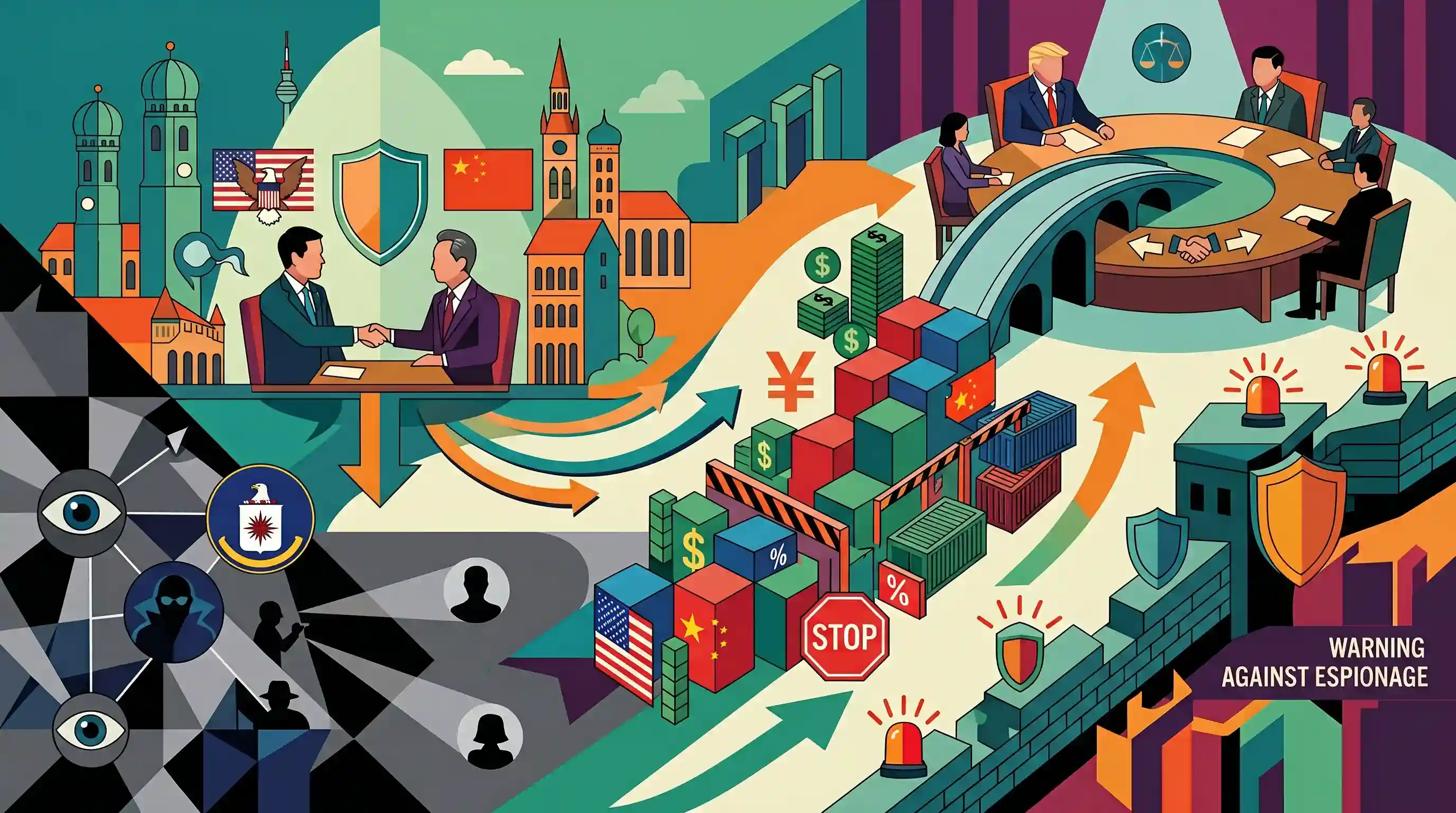
U.S. Secretary of State Marco Rubio met with Chinese Foreign Minister Wang Yi at the Munich Security Conference amid escalating tensions over a U.S.-led tariff standoff. This high-level dialogue serves as a precursor to an anticipated meeting between U.S. President Donald Trump and Chinese President Xi Jinping focused on resolving trade disputes. Additionally, bilateral relations face further friction from a recent CIA campaign targeting Chinese informants, prompting warnings from Beijing against foreign espionage.
Key Points
- U.S. Secretary of State Marco Rubio and Chinese Foreign Minister Wang Yi met on the sidelines of the Munich Security Conference to manage bilateral tensions.
- The diplomatic talks occurred against the backdrop of an ongoing tariff standoff between Washington and Beijing.
- U.S. President Donald Trump is scheduled to host Chinese President Xi Jinping later in the year to discuss trade issues.
- Complicating relations, a new CIA initiative aimed at recruiting Chinese informants drew sharp condemnation from Beijing, which vowed to counter foreign espionage.
Important Terms
Munich Security Conference

The world's leading annual forum for debating international security policy, held in Munich, Germany. It serves as a 'marketplace of ideas' for heads of state and diplomats to discuss global threats.
UPSC context
GS Paper II (International Relations); important for understanding global security architecture and multilateral diplomatic forums.
CIA (Central Intelligence Agency)
The premier foreign intelligence agency of the U.S., responsible for gathering intelligence and conducting covert operations to inform national security and foreign policy decisions.
UPSC context
GS Paper II (International Relations); relevant for 'Intelligence Diplomacy' and the role of non-diplomatic agencies in statecraft.
Tariffs
Taxes imposed by a government on imported goods. In the U.S.-China context, they are used as leverage to address trade deficits, intellectual property theft, and market access issues.
UPSC context
GS Paper II & III; tests understanding of trade wars, economic protectionism, and their impact on global supply chains.
Bilateral Diplomacy
The conduct of political, economic, or cultural relations between two sovereign states. High-level dialogues, such as Rubio-Wang talks, are key mechanisms for conflict resolution.
UPSC context
GS Paper II (International Relations); central to the 'Bilateral relations involving India and/or affecting India’s interests' syllabus topic.
Espionage
The practice of obtaining secret information about a rival country or organization. It often strains trust and triggers retaliatory diplomatic or economic measures between nations.
UPSC context
GS Paper II (International Relations/Security); relevant for analyzing trust deficits in major power rivalries and national security challenges.
Prelims Trap
The Munich Security Conference is a UN-mandated intergovernmental treaty body for global security.
The Munich Security Conference is an independent, non-governmental forum established in 1963. It operates outside UN frameworks to facilitate informal dialogue.
Static Concepts Connected
What is the Munich Security Conference (MSC)?
- Origin: Founded in 1963 in Germany as an independent, non-governmental annual forum.
- Nature: Facilitates informal "Track 1.5" dialogue among global security policymakers, operating outside official UN frameworks.
- Function: It does not produce binding resolutions or treaties; it is often referred to as the "Davos of Defence".
How does the WTO regulate unilateral tariff increases?
- Bound Rates: Members commit to tariff ceilings (bound rates) under GATT Article II. Unilateral hikes above these rates violate standard WTO rules.
- Security Exception: GATT Article XXI allows tariff hikes if deemed necessary for "essential security interests," a loophole frequently invoked in recent US-China trade wars.
Cross-Topic Patterns
China Plus One vs Chinese Dumping
US tariffs push global supply chains toward India via 'China Plus One', but also raise the risk of Chinese excess capacity being dumped into Indian markets, necessitating trade remedies.
Bypassing WTO Multilateralism
Unilateral tariff weaponization by the US and China marginalizes the WTO's dispute settlement mechanism, compounding the ongoing paralysis of its Appellate Body.

Unilateral tariffs bypassing WTO norms and the Munich Security Conference's non-UN nature are highly probable Prelims 2026 targets.
Linked PYQs · 3
Linked PYQs · 3
- 2021MainsGS2
“The USA is facing an existential threat in the form of a China, that is much more challenging than the erstwhile Soviet Union.” Explain.
- 2025MainsGS2
"The reform process in the United Nations remains unresolved, because of the delicate imbalance of East and West and entanglement of the USA vs. Russo-Chinese alliance.” Examine and critically evaluate the East-West policy confrontations in this regard.
- 2023MainsGS3
What are the internal security challenges being faced by India? Give out the role of Central Intelligence and Investigative Agencies tasked to counter such threats.
