BKS opposes NITI Aayog suggestion on agricultural tariff cuts
Source:The Hindu ↗
Why It Matters
This issue highlights the persistent conflict in India's political economy between negotiating international trade deals (like the Indo-U.S. FTA) and protecting domestic agricultural livelihoods. It is highly relevant for UPSC as it intersects trade policy, the edible oil import burden, and the regulatory complexities surrounding Genetically Modified (GM) foods in India.
Summary
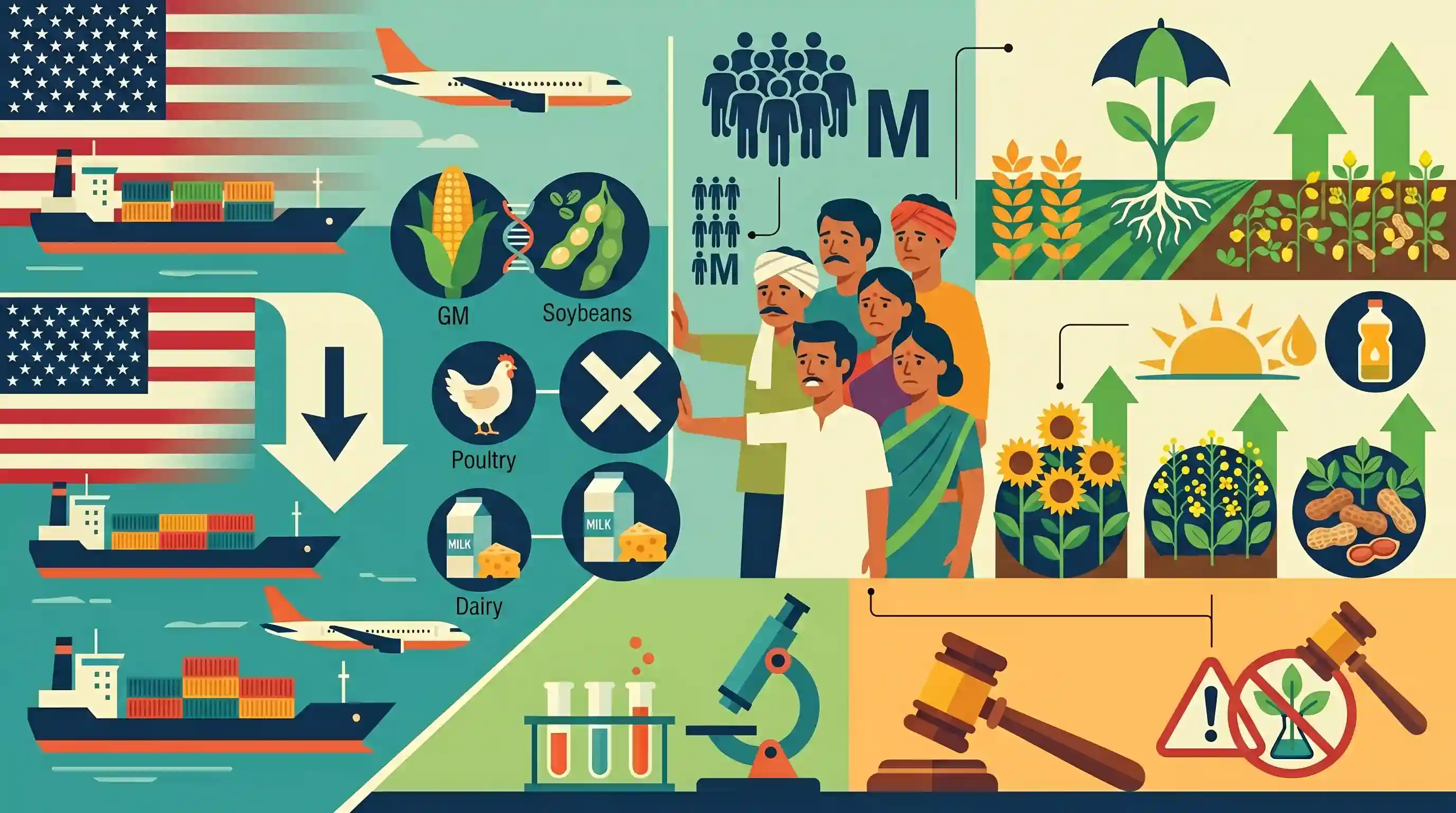
The RSS-affiliated Bharatiya Kisan Sangh (BKS) has strongly criticized NITI Aayog's proposal to lower import tariffs on agricultural products—such as genetically modified (GM) soybean and corn, poultry, and dairy—from the United States under a potential Free Trade Agreement (FTA). The BKS argued that such tariff reductions would devastatingly impact the livelihoods of 70 crore Indians dependent on the farm sector and directly contradict the government's 'Aatmanirbhar Bharat' (self-reliant India) agenda, especially the mission to boost domestic oilseed production. Additionally, the farmers' body raised health and regulatory red flags, noting that these U.S. imports consist of GM crops primarily used as animal fodder, while the commercial cultivation and import of GM food crops remain banned and under judicial scrutiny in India.
Key Points
- The RSS-affiliated Bharatiya Kisan Sangh (BKS) opposed NITI Aayog's recommendation to reduce tariffs on U.S. agricultural imports, including GM soybean, corn, poultry, and dairy.
- The BKS argued that reducing import duties contradicts the government's Aatmanirbhar Bharat goals, particularly the push to achieve self-reliance in oilseed production.
- Importing GM crops raises significant regulatory and health concerns, as GM food crops are banned in India and the matter of their cultivation remains under judicial scrutiny.
- The farmers' body highlighted that opening the market to subsidized U.S. crops (often used as fodder in America) would jeopardize the livelihoods of 70 crore Indians dependent on agriculture.
Important Terms
NITI Aayog

Established in 2015 to replace the Planning Commission, it is India’s premier policy think tank. It fosters cooperative federalism and provides strategic advice to Central and State governments using a bottom-up approach.
UPSC context
GS Paper-II (Governance) and Paper-III (Economy); tests knowledge of planning, federalism, and the shift from centralized to cooperative policy-making.
Aatmanirbhar Bharat
A 2020 vision ("Self-Reliant India") for national development. It focuses on five pillars—Economy, Infrastructure, Systems, Vibrant Demography, and Demand—to reduce import dependency and strengthen domestic manufacturing and global supply chain presence.
UPSC context
GS Paper-III (Economy/Manufacturing); tests understanding of industrial policy, self-sufficiency goals, and post-pandemic economic strategies.
National Mission on Edible Oils – Oilseeds (NMEO-OS)
A 2024 mission (NMEO-OS) aimed at achieving 72% self-sufficiency in edible oils by 2030. It focuses on increasing domestic production of traditional oilseeds like mustard and soybean to reduce heavy import reliance.
UPSC context
GS Paper-III (Agriculture); tests knowledge of cropping patterns, food security, and initiatives to address the edible oil trade deficit.
Genetically Modified (GM) Crops
Crops whose genetic material is altered via engineering for traits like pest resistance or herbicide tolerance. In India, only Bt Cotton is commercialized; GM Mustard remains under judicial and regulatory scrutiny by the GEAC.
UPSC context
GS Paper-III (Science & Technology/Environment/Agriculture); tests awareness of biotechnology regulation, bio-safety, and the legal-ethical debates over food security.
Pressure Groups
Organizations that attempt to influence government policy and decisions to protect specific interests without seeking political power. The Bharatiya Kisan Sangh (BKS) serves as an agrarian pressure group influencing trade and agricultural policies.
UPSC context
GS Paper-II (Polity); tests the role of civil society and interest groups in the democratic process and their impact on legislation.
Trade Policy Forum (TPF)
The primary bilateral platform for resolving trade hurdles between India and the U.S. It facilitates dialogue on market access, tariffs, and regulatory cooperation in agriculture, high-tech trade, and services.
UPSC context
GS Paper-II (International Relations); tests understanding of bilateral trade diplomacy and India’s economic engagement with major global powers like the U.S.
Prelims Trap
"The import of Genetically Modified (GM) food ingredients into India requires the prior approval of the Genetic Engineering Appraisal Committee (GEAC)."
False. While GEAC approves environmental release and cultivation under the EPA 1986, the FSSAI regulates the import and sale of GM food and ingredients.
Static Concepts Connected
How is the regulation of GM crops and GM food imports divided in India?
- Environmental Release: The Genetic Engineering Appraisal Committee (GEAC) under the Environment Protection Act, 1986, appraises and approves the environmental release and cultivation of GM organisms.
- Food Imports: The Food Safety and Standards Authority of India (FSSAI) regulates the import, manufacture, and sale of GM food or ingredients under the FSS Act, 2006.
- Commercial Status: Currently, only Bt Cotton is officially approved for commercial cultivation. The commercial release of GM food crops like GM mustard remains heavily restricted.
What mechanisms protect Indian farmers during Free Trade Agreement (FTA) negotiations?
- Exclusion Lists: Lists of sensitive items (frequently dairy, plantation crops, and cereals) that are kept completely exempt from the tariff reduction commitments agreed upon in an FTA.
- Tariff Rate Quotas: A two-tiered tariff system that allows a specific quantity of imports at a lower tariff rate, beyond which a significantly higher protective tariff is applied.
Cross-Topic Patterns
GM animal fodder vs. human food chain
Permitting GM corn or soybean imports strictly for poultry or dairy fodder risks covert entry into the human food chain, linking trade liberalization directly with national biosafety challenges.
RCEP withdrawal echoes in U.S. FTA talks
The domestic opposition to importing subsidized U.S. dairy mirrors India's 2019 withdrawal from RCEP, where protecting marginal dairy farmers outweighed broader trade market access.

Expect a 2026 Prelims question testing the separate regulatory jurisdictions of GEAC (cultivation) and FSSAI (food imports) regarding GM products.
Linked PYQs · 5
Linked PYQs · 5
- 2023MainsGS3
What are the direct and indirect subsidies provided to farm sector in India? Discuss the issues raised by the World Trade Organization (WTO) in relation to agricultural subsidies.
- 2024MainsGS3
What are the causes of persistent high food inflation in India? Comment on the effectiveness of the monetary policy of the RBI to control this type of inflation.
- 2018PrelimsGS1
Consider the following statements: 1. The quantity of imported edible oils is more than the domestic production of edible oils in the last five years. 2. The Government does not impose any customs duty on all the imported edible oils as a special case. Which of the statements given above is/are correct?
- 2019PrelimsGS1
Among the agricultural commodities imported by India, which one of the following accounts for the highest imports in terms of value in the last five years?
- 2018PrelimsGS1
With reference to the Genetically Modified mustard (GM mustard) developed in India, consider the following statements: 1. GM mustard has the genes of a soil bacterium that give the plant the property of pest-resistance to a wide variety of pests. 2. GM mustard has the genes that allow the plant cross-pollination and hybridization. 3. GM mustard has been developed jointly by the IARI and Punjab Agricultural University. Which of the statements given above is/are correct?
