Bhadla Solar Park to Host Battery Energy Storage System Project
Source:energetica-india ↗
Why It Matters
As India transitions toward clean energy, managing grid stability and reducing curtailment in mega-solar hubs like Bhadla are vital. BESS development marks a crucial technology transition, making this a highly probable area for RPSC RAS Prelims questions focusing on non-conventional energy policy, state nodal agencies, and infrastructural advancements.
Summary
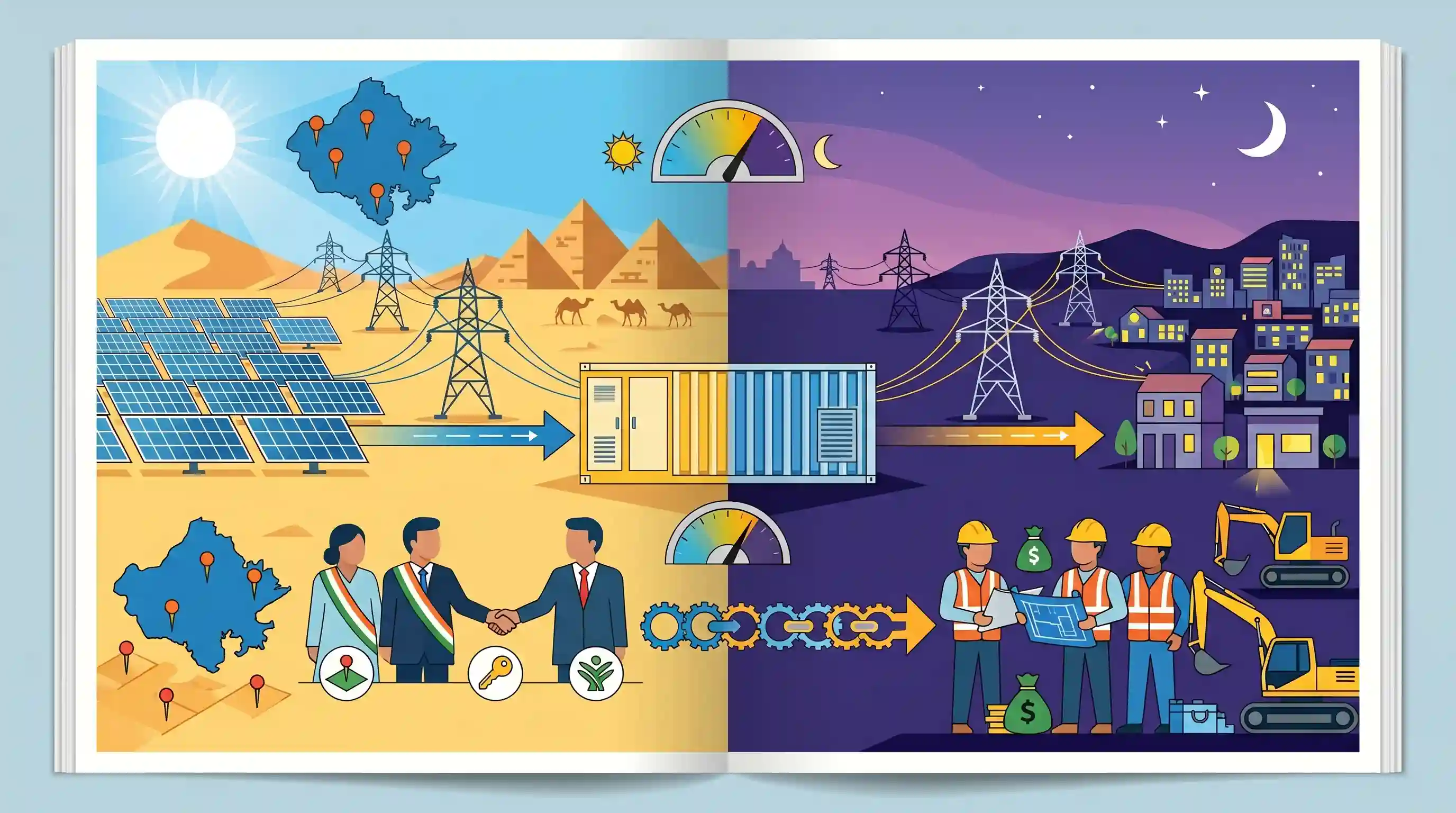
The Rajasthan Solarpark Development Company Ltd. (RSDCL) has invited Expressions of Interest (EoI) to set up a developer-led Battery Energy Storage System (BESS) at the Bhadla Solar Park. The project seeks to utilize 680 MW of available grid transmission capability during non-solar hours, storing surplus daytime renewable generation for distribution during peak night-time demand. RSDCL (a subsidiary of the Rajasthan Renewable Energy Corporation Ltd.) will provide land and facilitate grid connections, while the private developer will take full responsibility for design, financing, and operation under a 15-year concession. This project represents a key operational milestone in addressing renewable energy intermittency and enhancing grid efficiency in Rajasthan.
Key Points
- Rajasthan Solarpark Development Company Ltd. (RSDCL), a wholly-owned subsidiary of RRECL, has invited Expressions of Interest (EoI) for establishing a Battery Energy Storage System (BESS) at the Bhadla Solar Park.
- The initiative aims to optimize 680 MW of available grid connectivity during non-solar hours, utilizing underused transmission infrastructure to store surplus day-time solar power and supply it during peak night-time demand.
- The BESS project will be structured under a developer-led model with a proposed concession period of 15 years, utilizing existing STU network connectivity including 132 kV pooling stations.
- RSDCL will facilitate land and 132 kV level connectivity but will bear no financial or operational responsibility, offering developers options like Build, Own and Operate (BOO) or Build, Own, Operate and Transfer (BOOT).
- Developers will have complete commercial flexibility to monetize the energy storage through multiple channels such as state discoms, open-access, captive users, or the power markets.
Important Terms
PM-KUSUM Scheme

A central initiative launched in 2019 by the Ministry of New and Renewable Energy to provide water and energy security to farmers by solarising agricultural pumps and promoting decentralized grid-connected solar power plants.
UPSC context
GS Paper III (Agriculture & Infrastructure); tests knowledge of decentralized solar energy schemes and sustainable farming solutions.
Rajasthan Solar Energy Policy 2019
A state-level policy launched in 2019 designed to harness Rajasthan’s vast solar potential, targeting 30,000 MW of solar capacity by 2024-25 through utility-scale, rooftop, and decentralized solar energy installations.
UPSC context
GS Paper III (Energy & Infrastructure); tests understanding of sub-national policy frameworks targeting clean energy expansion.
Rajasthan Solarpark Development Company Ltd. (RSDCL)
A Special Purpose Vehicle and wholly owned subsidiary of RRECL established to develop land and infrastructure, and manage solar parks and battery energy storage installations across Rajasthan.
UPSC context
GS Paper III (Infrastructure & PPP); tests knowledge of state-level implementing agencies executing large public-private utility projects.
Rajasthan Renewable Energy Corporation Ltd. (RRECL)
The state nodal agency formed in 2002 to promote non-conventional energy sources and implement energy conservation in Rajasthan, acting as the parent company of RSDCL.
UPSC context
GS Paper III (Energy & Planning); tests understanding of institutional frameworks managing regional renewable energy portfolios.
State Transmission Utility (STU)
A state-level government utility designated under the Electricity Act, 2003, responsible for planning, operating, and coordinating high-voltage intra-state transmission lines to deliver electricity from generators to distribution centers.
UPSC context
GS Paper III (Infrastructure & Grid Management); tests knowledge of inter-state versus intra-state power evacuation systems.
Prelims Trap
The Viability Gap Funding (VGF) scheme for BESS requires 100% domestic battery cell manufacturing to qualify for central financial support.
The scheme actually mandates a minimum 20% domestic local content, with a specific focus on utilizing indigenously developed Energy Management System (EMS) software, rather than complete cell manufacturing.
Static Concepts Connected
Explain the Duck Curve in solar grid integration and the role of BESS.
- The Duck Curve: Defines the deep imbalance between peak solar generation (midday) and peak consumer demand (evening), creating a duck-shaped net load profile.
- Grid Stress: Rapid ramping up of conventional thermal plants is required when solar generation drops at sunset, causing immense grid instability and operational stress.
- BESS Mitigation: BESS stores excess midday solar energy and discharges it during evening peaks, effectively flattening the duck curve and stabilizing grid operations.
Compare the Build-Own-Operate (BOO) and Build-Own-Operate-Transfer (BOOT) models.
- Ownership Transfer: Under BOOT, the asset is transferred to the government after a fixed concession period; under BOO, the developer retains indefinite ownership.
- Risk Allocation: BOOT transfers residual asset risk back to the state, while BOO places long-term operational and decommissioning risks entirely on the private developer.
- Concession Dynamics: BOOT agreements require highly strict hand-back conditions to ensure the asset is transferred in good operational health.
Cross-Topic Patterns
LCRs in Energy vs WTO TRIMs
The 20% domestic content mandate for BESS software mirrors past solar policies, navigating WTO Trade-Related Investment Measures (TRIMs) provisions on local resource usage.
Federal Grid Balancing and Discom Stress
State-led storage deployment minimizes solar power curtailment, directly easing the financial stress of state-owned DISCOMs bound by Renewable Purchase Obligations (RPOs).

With India targeting 236 GWh storage by 2032, UPSC 2026 may frame a question linking BESS grid balancing, VGF norms, and PPP models.
Linked PYQs · 3
Linked PYQs · 3
- 2023RPSC_PRELIMSGS1
Which agency has been given the responsibility of implementing the PM-KUSUM scheme (Component A) in Rajasthan, which involves the establishment of solar power plants with a capacity of 0.5 MW to 2 MW?
- 2021RPSC_PRELIMSGS1
In which year was the Rajasthan Solar Energy Policy announced?
- 2012RPSC_PRELIMSGS1
The first solar energy policy was announced by the Government of Rajasthan in -
