Financial Inclusion Scheme Vulnerabilities and Cyber Fraud Ring
Source:Indian Express ↗
Why It Matters
It highlights the unintended security consequences of mass financial inclusion schemes like PMJDY, directly relevant to GS3 topics on cyber security, money laundering, and inclusive growth. It demonstrates the intersection of socio-economic vulnerability and modern cybercrime.
Summary
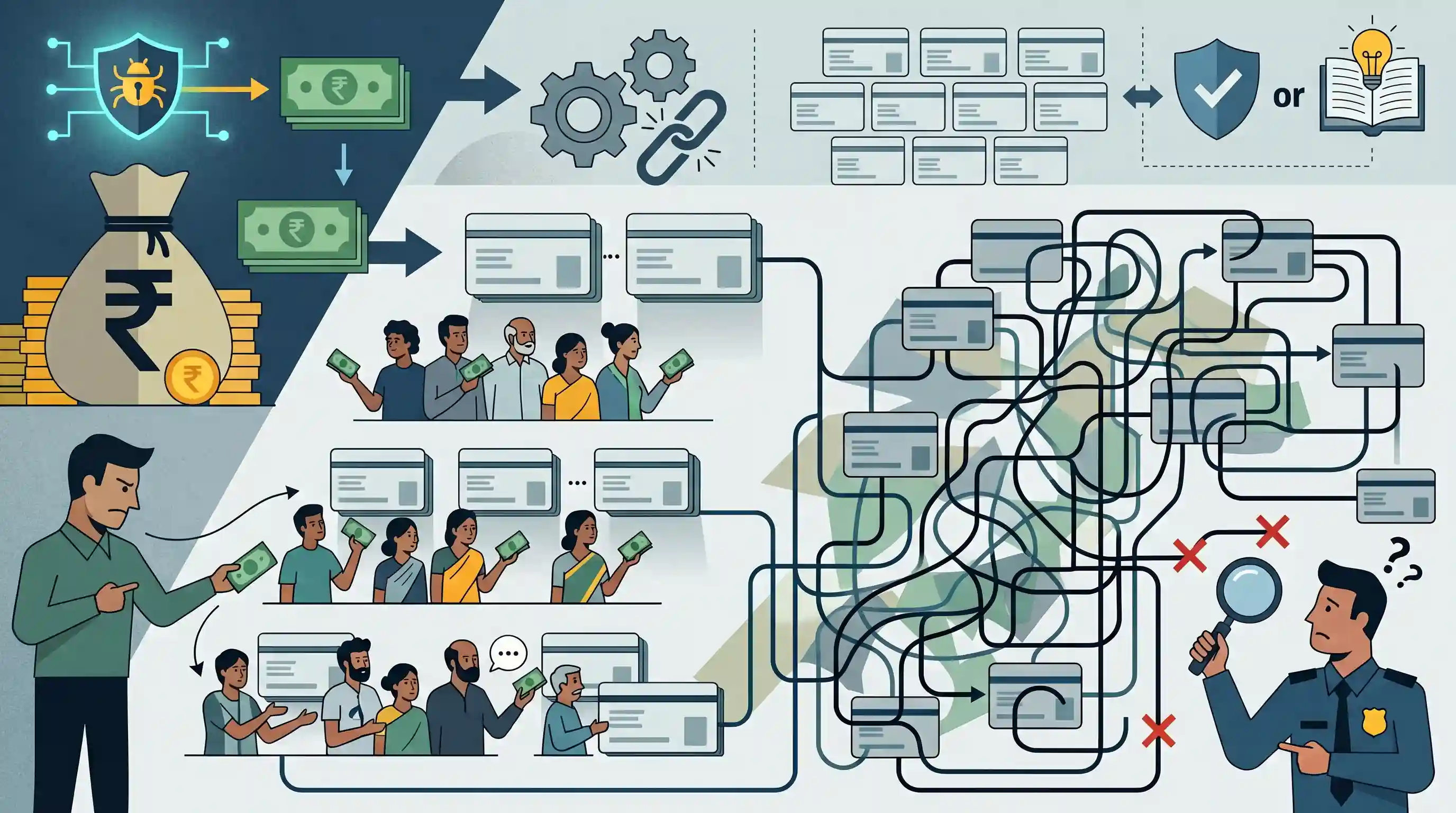
A Rs 22 crore cyber fraud case in Pune has exposed how Pradhan Mantri Jan-Dhan Yojana (PMJDY) accounts are being exploited as 'mule accounts' to launder illicit funds. Fraudsters target these zero-balance accounts, originally designed for financial inclusion, because they often have relaxed monitoring and are held by socio-economically vulnerable individuals who are lured into leasing their accounts for small payouts. This creates complex money trails that complicate law enforcement. The misuse of PMJDY accounts underscores a critical systemic vulnerability where the rapid expansion of banking access has outpaced digital literacy and stringent KYC enforcement, inadvertently aiding cybercrime and money laundering.
Key Points
- A Rs 22 crore cyber fraud in Pune revealed that fraudsters used PMJDY bank accounts as 'mule accounts' to channel illicit funds.
- Cyber criminals exploit these zero-balance accounts because they often lack stringent transaction monitoring and are easier to misuse.
- Marginalized individuals are often lured with small monetary rewards to lease out their PMJDY accounts to fraudsters.
- The incident highlights a critical vulnerability where financial inclusion schemes inadvertently facilitate money laundering and cybercrime due to inadequate KYC enforcement and digital literacy.
Important Terms
Pradhan Mantri Jan-Dhan Yojana (PMJDY)

Launched in 2014, it is India’s National Mission for Financial Inclusion, providing universal access to banking, credit, insurance, and pensions through zero-balance savings accounts.
UPSC context
GS Paper 2 (Welfare schemes) & GS Paper 3 (Inclusive growth). Essential for questions on financial literacy and social security.
Money Mule
A person who allows their bank account to be used by criminals to receive and transfer illicit funds, helping to launder money and distance criminals from the crime.
UPSC context
GS Paper 3 (Internal Security - Cyber Security). Relevant for understanding modern financial fraud and challenges to law enforcement.
Money Laundering
The process of concealing the illegal origin of funds (black money) by passing them through complex financial transactions to make them appear legitimate (clean money).
UPSC context
GS Paper 3 (Internal Security). Tests knowledge of the PMLA 2002 and threats to the national financial system.
Financial Inclusion
The process of ensuring access to appropriate and affordable financial products and services—like savings, credit, and insurance—to all individuals, especially vulnerable and low-income groups.
UPSC context
GS Paper 3 (Indian Economy). A core concept for inclusive growth, poverty alleviation, and developmental economics.
Know Your Customer (KYC)
A mandatory process for financial institutions to verify the identity, address, and suitability of clients to prevent identity theft, fraud, money laundering, and terrorist financing.
UPSC context
GS Paper 3 (Banking/Economy). Important for questions on banking regulations, digital security, and financial sector reforms.
Prelims Trap
"PMJDY zero-balance accounts have no upper limit on deposits or withdrawals to encourage savings."
"Small Accounts" opened under PMJDY with relaxed KYC have strict limits: maximum balance of Rs 50,000 and total annual credits cannot exceed Rs 1 lakh.
Static Concepts Connected
What are the regulatory transaction limits on PMJDY 'Small Accounts'?
- Annual Credit Limit: Total credits in such accounts cannot exceed Rs 1 lakh in a financial year.
- Maximum Balance: The balance at any point in time must not exceed Rs 50,000.
- Withdrawal Limit: Maximum aggregate withdrawals and transfers in a month cannot exceed Rs 10,000.
How do 'mule accounts' fit into the standard stages of money laundering?
- Placement Stage: Mule accounts act as entry nodes, receiving cybercrime proceeds and converting them into formal bank deposits.
- Layering Stage: Funds are rapidly transferred across a decentralized network of leased accounts to obscure the paper trail.
Cross-Topic Patterns
JAM Trinity's dual-edged nature
The rapid expansion of Jan-Dhan and Aadhaar-enabled payments has scaled financial inclusion but simultaneously widened the attack surface for cybercriminals due to poor digital literacy.
PMLA and Money Mules
Even unwitting account holders who lease their accounts for small commissions can face severe prosecution under PMLA for assisting in the "layering" of illicit funds.

Expect a multi-statement Prelims question analyzing the trade-offs between simplified KYC for BSBD accounts and AML/CFT compliance.
Linked PYQs · 5
Linked PYQs · 5
- 2020MainsGS3
Discuss different types of cyber crimes and measures required to be taken to fight the menace.
- 2021MainsGS3
Discuss how emerging technologies and globalisation contribute to money laundering. Elaborate measures to tackle the problem of money laundering both at national and international levels.
- 2016MainsGS3
Pradhan Mantri Jan-Dhan Yojana (PMJDY) is necessary for bringing unbanked to the institutional finance fold. Do you agree with this for financial inclusion of the poorer section of the Indian society? Give arguments to justify your opinion.
- 2015PrelimsGS1
'Pradhan Mantri Jan-Dhan Yojana' has been launched for
- 2024PrelimsGS1
With reference to the Pradhan Mantri Jan Dhan Yojana (PMJDY), which of the following statements is/are correct? 1. The scheme aims to open bank accounts for unbanked households. 2. There is a minimum balance requirement for accounts opened under this scheme. 3. Beneficiaries get a Rupay Debit Card with an inbuilt accident insurance cover. Select the correct answer using the code given below.
