Ladli Behna Scheme Direct Benefit Transfer Disbursal in MP
Source:economictimes ↗
Why It Matters
The Ladli Behna Yojana is MP's premier cash-transfer program for women. Updates to its installment counts, disbursement amounts (now Rs 1,500/month), associated regional developments, and new transport initiatives (Mukhyamantri Sugam Parivahan Seva) are highly relevant for state-level welfare and governance questions in the MPPSC Prelims.
Summary
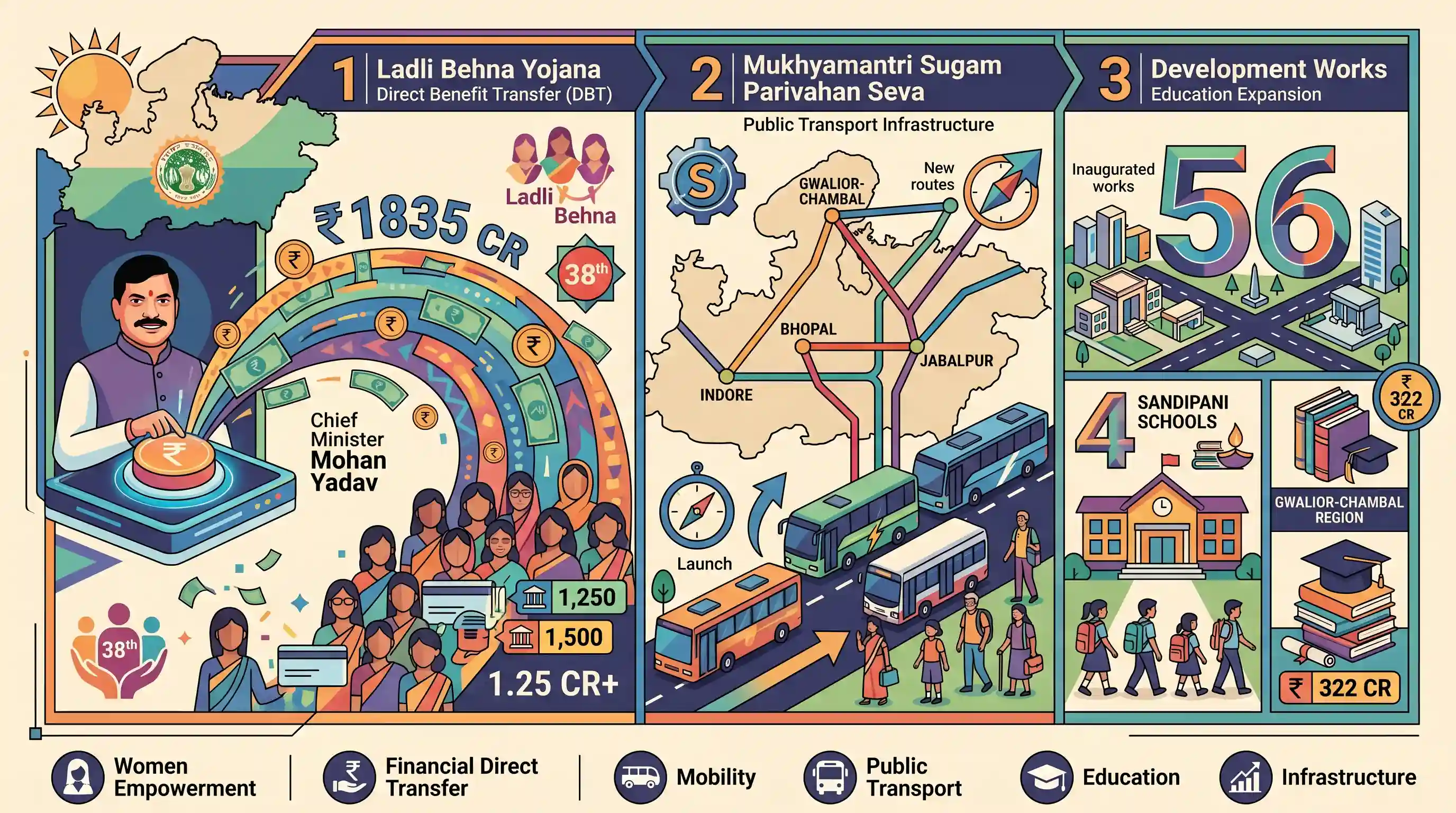
Madhya Pradesh Chief Minister Mohan Yadav transferred Rs 1,835 crore to over 1.25 crore beneficiaries under the 38th installment of the flagship 'Ladli Behna Yojana' at an event in Lahar, Bhind district. The scheme currently provides a monthly financial assistance of Rs 1,500 to women. Additionally, the Chief Minister announced the upcoming 'Mukhyamantri Sugam Parivahan Seva' public transport scheme, inaugurated 56 development works worth Rs 322 crore (including buildings for four Sandipani schools), and announced educational expansions in the Gwalior-Chambal region.
Key Points
- Madhya Pradesh Chief Minister Mohan Yadav transferred the 38th installment of Rs 1,835 crore to over 1.25 crore beneficiaries under the flagship Ladli Behna Yojana.
- The Ladli Behna Yojana currently provides Rs 1,500 monthly financial assistance to eligible women (increased from its initial launch amount of Rs 1,000 per month).
- During the event in Lahar, Bhind district, the Chief Minister announced the upcoming launch of 'Mukhyamantri Sugam Parivahan Seva' to improve public transport facilities across the state.
- The Chief Minister inaugurated or laid foundation stones for 56 development works valued at Rs 322 crore in Bhind district, which includes newly constructed buildings for four Sandipani schools.
- The expansion of postgraduate courses at the government college in Lahar was also announced, emphasizing the government's commitment to youth, women, farmers, and the poor.
Important Terms
Ladli Behna Yojana

A flagship welfare scheme in Madhya Pradesh providing monthly financial assistance of ₹1,500 to eligible married, widowed, or divorced women aged 21–60, promoting economic self-reliance and nutrition.
UPSC context
GS Paper II: Social Justice and Welfare Schemes, testing interventions for women's empowerment and economic autonomy.
Mukhyamantri Sugam Parivahan Seva
A public transport initiative in Madhya Pradesh designed to provide structured, affordable, and safe passenger bus services across urban, rural, and intercity routes via a Public-Private Partnership model.
UPSC context
GS Paper III: Infrastructure and Transport, testing public-private partnerships, state connectivity, and modern urban planning.
Sandipani Schools Scheme
An educational initiative in Madhya Pradesh, formerly CM RISE, aimed at transforming government schools into best-in-class institutions by upgrading infrastructure, training teachers, and integrating value-based Indian pedagogy.
UPSC context
GS Paper II: Social Justice and Education, testing policy shifts in public education and foundational school governance.
Prelims Trap
The Sugam Parivahan scheme directly revives the defunct Madhya Pradesh State Road Transport Corporation to operate state-run public transport.
Rather than resurrecting the closed MPSRTC, the new initiative sets up a modern PPP-based holding company structure that merges existing city-level Special Purpose Vehicles (SPVs).
Static Concepts Connected
What is a Holding Company structure in public sector governance?
- Definition: A parent entity holding controlling shares in subsidiary companies to streamline corporate governance, management, and strategic direction.
- PPP Integration: It allows public-private partnerships to operate under a unified state policy while maintaining commercial and operational autonomy.
- Financial Leverage: Consolidating municipal assets under one holding entity improves creditworthiness and facilitates easier capital acquisition from institutional lenders.
What are the economic arguments for Targeted Direct Benefit Transfers (DBT) for women?
- Targeting vs Universality: Income-capped DBTs reduce the state's fiscal deficit but introduce risks of administrative exclusion errors for marginalized beneficiaries.
- Multiplier Effect: Cash directly in the hands of women correlates with improved household spending on child health, nutrition, and education.
Cross-Topic Patterns
Urban Governance SPVs
Merging municipal-level transit SPVs into a state-level holding company illustrates a shift towards centralized public utility management, impacting 74th Amendment decentralized ideals.
Gender Budgeting & Autonomy
Massive state-level DBT schemes showcase a transition from indirect asset-creation welfare to direct liquidity intervention, enhancing women's intra-household financial decision-making power.

State-level transit PPP holding structures and gender-targeted DBTs will likely feature in GS-3 infrastructure and federal welfare debates.
Linked PYQs · 2
Linked PYQs · 2
- 2025MPPSC_PRELIMSGS1
The objective of "Mukhyamantri Ladli Behna Yojana" implemented in entire Madhya Pradesh, in addition to economic self-reliance is:
- 2022MPPSC_PRELIMSGS1
What amount will be given to eligible women under "Ladli Bahna Yojana" of the Madhya Pradesh Government?
