Hamirpur Power Grid Upgrade Under RDSS Scheme
Source:dtnext ↗
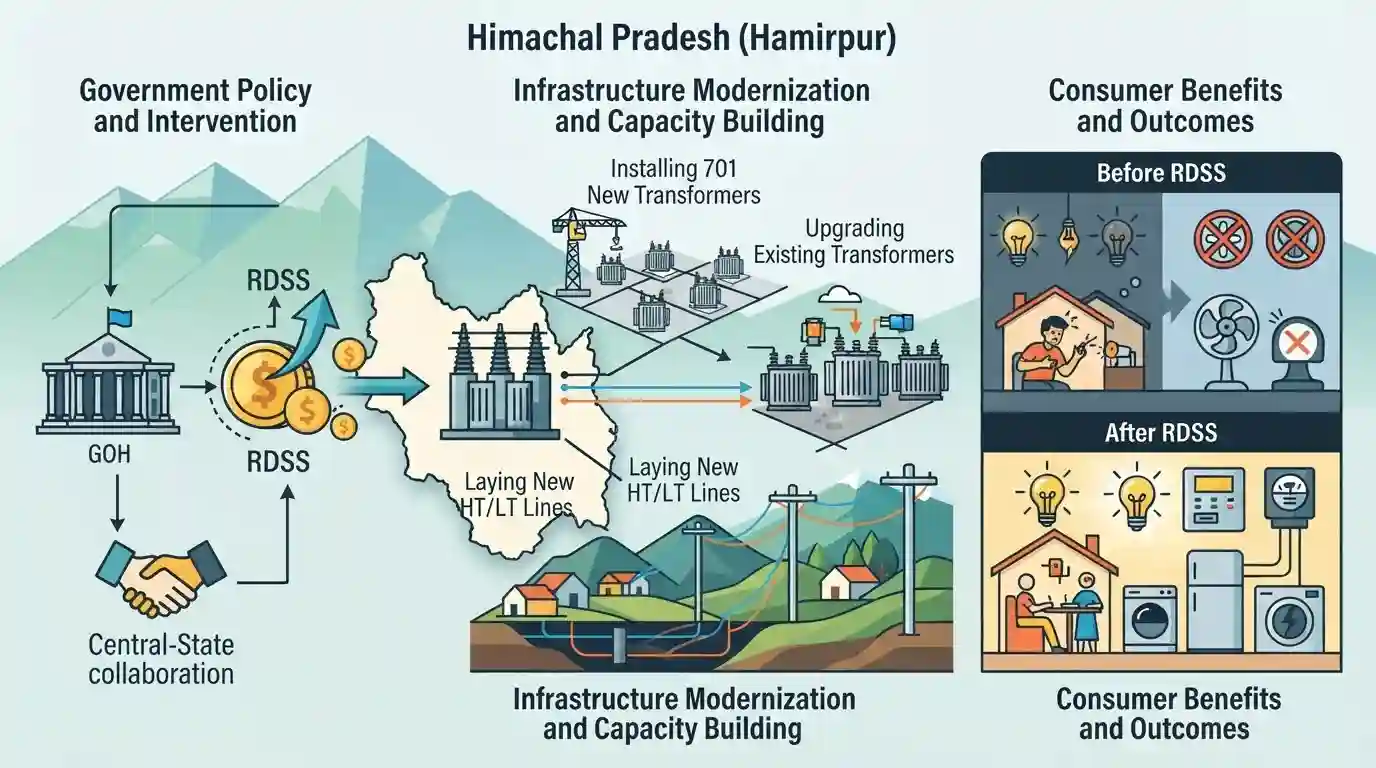
Why It Matters
Highlights the grassroots implementation of the Revamped Distribution Sector Scheme (RDSS) to reduce aggregate technical and commercial (AT&C) losses, upgrade power distribution infrastructure, and improve operational efficiencies in rural and semi-urban districts.
Summary
A Rs 107 crore project is being launched in Himachal Pradesh's Hamirpur district under the Central government's Revamped Distribution Sector Scheme (RDSS). The initiative focuses on making the power infrastructure more robust and reliable by modernizing the distribution network. Key developments include installing 701 new transformers of various capacities, upgrading existing ones, and laying new high-tension and low-tension lines. These upgrades aim to significantly reduce low-voltage issues and ensure an uninterrupted power supply to consumers in the district.
Key Points
- A Rs 107 crore project is being launched in Hamirpur district, Himachal Pradesh, to strengthen power infrastructure.
- The project is implemented under the Revamped Distribution Sector Scheme (RDSS), a Central government initiative aimed at modernizing power distribution.
- Upgrades include the installation of 701 new transformers (ranging from 25 kVA to 250 kVA) and the repair of existing ones.
- New low-tension and high-tension lines will be laid to resolve persistent low voltage issues and ensure reliable power supply.
Important Terms
Revamped Distribution Sector Scheme (RDSS)

A Ministry of Power initiative launched in 2021 to improve the operational efficiency and financial sustainability of state-owned power distribution companies (DISCOMs) through results-linked financial assistance for infrastructure modernization and smart metering.
UPSC context
GS Paper 3 (Energy). Critical for questions on power sector reforms, addressing DISCOM debt, and infrastructure modernization.
Power Distribution Companies (DISCOMs)
Utility companies responsible for purchasing electricity from generators and delivering it to end consumers. They manage the localized distribution network, including transformers and low-tension lines, acting as the final link in the supply chain.
UPSC context
GS Paper 3 (Energy). Frequently tested regarding their financial distress, bailout schemes, and role as the power sector's weakest link.
Aggregate Technical and Commercial (AT&C) Losses
A combined metric measuring technical losses (power dissipated during distribution) and commercial losses (theft, unmetered usage, and poor revenue collection). Reducing these losses to 12-15% is the primary objective of RDSS.
UPSC context
GS Paper 3 (Energy). An essential parameter for evaluating the operational efficiency and financial viability of India's power distribution networks.
Power Distribution Infrastructure
The localized grid network delivering electricity from major transmission lines to end consumers. It comprises substations, step-down transformers, and high-tension or low-tension power lines, forming the critical last-mile connectivity.
UPSC context
GS Paper 3 (Infrastructure). Important for topics covering rural electrification, grid stability, reducing technical losses, and improving consumer supply reliability.
Prelims Trap
RDSS provides unconditional financial assistance to all distribution companies, including private sector DISCOMs, to modernize their power infrastructure.
RDSS funding is strictly conditional on meeting pre-qualifying reform criteria and results, and is targeted exclusively at state-owned DISCOMs (excluding private ones).
Static Concepts Connected
What constitutes Aggregate Technical and Commercial (AT&C) losses in the power sector?
- Technical losses: Energy lost due to physical resistance in transmission/distribution lines and transformers during power flow.
- Commercial losses: Losses caused by illegal pilferage (theft), metering errors, billing inefficiencies, and failure to collect revenue from consumers.
- Holistic metric: Unlike pure transmission losses, AT&C captures both physical power loss and actual realization of revenue.
What is the ACS-ARR gap and why does it matter?
- ACS component: Average Cost of Supply is the total cost incurred by a DISCOM to buy and supply one unit of power.
- ARR component: Average Revenue Realised is the actual revenue earned per unit of electricity, reflecting tariffs and collections.
- Financial health: A persistent positive ACS-ARR gap causes compounding DISCOM debt, forcing state bailouts and choking power infrastructure investments.
Cross-Topic Patterns
Fiscal Federalism & Energy Reforms
Central schemes like RDSS use conditional financial grants to nudge states into implementing politically sensitive power-sector tariff reforms and infrastructure upgrades.
Digital Public Infra + Energy
The deployment of prepaid smart meters via the TOTEX model merges digital governance with resource efficiency, improving utility cash flows.

RDSS operational details (TOTEX model, AT&C criteria, and ACS-ARR targets) are highly probable targets for a multi-statement UPSC 2026 question.
Linked PYQs · 3
Linked PYQs · 3
- 2025HPAS_PRELIMSGS1
Match List I with List II : | List-I (Scheme) | List-II (Ministry) | |---|---| | (a) Atal Pension Yojana | (i) Ministry of Communications | | (b) Startup India Scheme | (ii) Ministry of Finance | | (c) Eco-NIWAS | (iii) Ministry of Commerce and Industry | | (d) BharatNet | (iv) Ministry of Power | Code: (a) (b) (c) (d)
- 2024HPAS_PRELIMSGS1
For the year 2022-23, match the Industry sub-sector in Himachal Pradesh with the percentage of workers employed in them : | List I (Industry Sub-sector) | List II (Percentage of workers employed) | |---|---| | (a) Mining and Quarrying | (i) 2 | | (b) Manufacturing | (ii) 41 | | (c) Electricity and Other Utilities | (iii) 50 | | (d) Construction | (iv) 7 | Choose the correct option : Code: (a) (b) (c) (d)
- 2025HPAS_PRELIMSGS1
According to PLFS 2023-24, share of secondary and tertiary sector in total employment in Himachal Pradesh respectively are :
