Wanted Criminal Killed in Police Encounter in Unnao District
Source:times-of-india ↗
Why It Matters
This event highlights the implementation of the newly enacted Bharatiya Nyaya Sanhita (BNS) provisions, such as Section 103(1) (murder) and Section 3(5) (joint liability), replacing old IPC sections. It also brings into focus the constitutional and administrative aspects of police encounters, human rights, Article 21, and NHRC/Supreme Court guidelines (such as the PUCL v. State of Maharashtra case) on extrajudicial actions, which are highly relevant for UPPSC GS Paper 2 and internal security/polity questions.
Summary
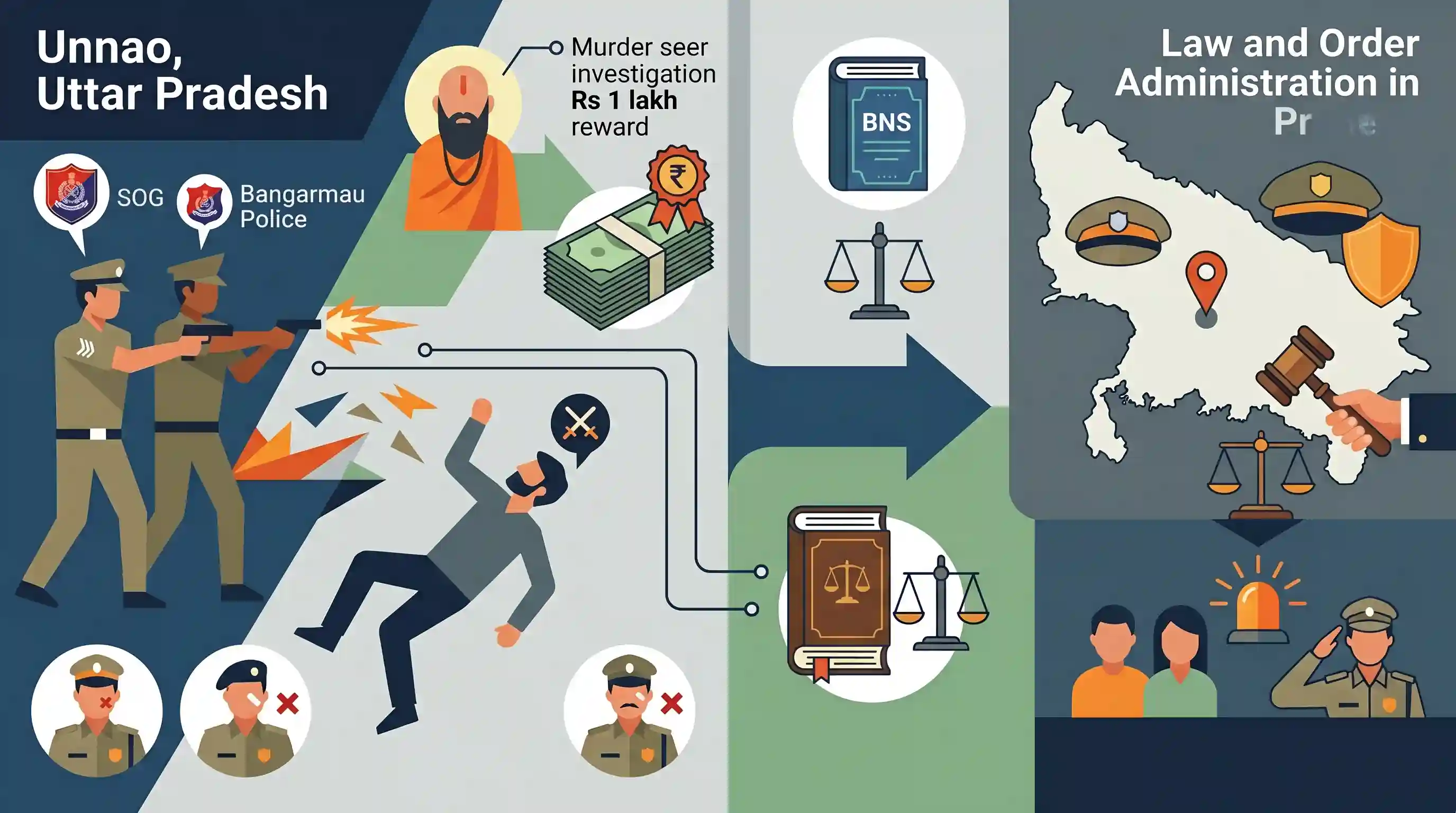
An accused criminal carrying a Rs 1 lakh reward, wanted for the murder of a local seer (Baba Milandas), was shot dead in a joint encounter by the Special Operations Group (SOG) and Bangarmau Police in Unnao, Uttar Pradesh. Two police personnel were injured. The criminal was booked under key provisions of the Bharatiya Nyaya Sanhita (BNS), which replaced the Indian Penal Code (IPC), and the Criminal Law Amendment (CLA) Act.
Key Points
- A criminal carrying a reward of Rs 1 lakh, identified as Israel (alias Izrail), was killed in a joint police encounter by the SOG and Bangarmau Police on the Agra Expressway airstrip service road in Unnao, Uttar Pradesh.
- The accused was wanted for the stabbing and murder of Baba Milandas on June 9, 2026.
- During the exchange of fire, Sub-inspector Newton Kumar Singh and SOG constable Vikas Bhadoria sustained injuries but survived.
- The deceased was booked under Case No. 168/2026 under Sections 103(1) (punishment for murder) and 3(5) (acts done by several persons in furtherance of common intention) of the newly implemented Bharatiya Nyaya Sanhita (BNS), along with Section 7 of the Criminal Law Amendment (CLA) Act.
- A 0.315 bore country-made pistol, cartridges, and a knife used in the murder were recovered from the scene.
Important Terms
Bharatiya Nyaya Sanhita (BNS)

India's substantive criminal code enacted to replace the colonial-era Indian Penal Code, introducing key reforms like community service and codifying modern offenses such as terrorism and mob lynching.
UPSC context
GS Paper II: Criminal justice system reforms, transition from colonial-era laws, and protection of citizen rights.
Criminal Law Amendment (CLA) Act
A statutory framework, primarily utilizing provisions from the 1932 Act, used by law enforcement to address criminal intimidation, public nuisance, and actions threatening public tranquility or commercial activity.
UPSC context
GS Paper II/III: State-level crime prevention tools, maintenance of public order, and balancing state power with civil liberties.
Special Operations Group (SOG)
Specialized tactical units within Indian state police forces trained to counter organized crime, neutralize high-risk criminals, execute complex surveillance, and handle internal security threats.
UPSC context
GS Paper III: Specialized security units, tactical operations management, and police organization in handling organized crime.
Uttar Pradesh Police
The state-level law enforcement agency of Uttar Pradesh, tasked with policing, public safety, and crime control, often analyzed in discussions on police reforms and judicial encounter guidelines.
UPSC context
GS Paper II/IV: State law and order administration, police accountability, and ethical human rights compliance in enforcement actions.
Prelims Trap
BNSS Section 43 grants police absolute statutory immunity to use lethal force against any suspect who actively resists arrest.
Lethal force causing death is strictly restricted to suspects accused of offences punishable by death or life imprisonment, not for all resisting suspects.
Static Concepts Connected
What are the key Supreme Court mandates on encounter deaths under the PUCL v. State of Maharashtra (2014) ruling?
- Mandatory FIR: An immediate FIR must be registered regarding the encounter, followed by a swift forwarding to the jurisdictional court.
- Independent Probe: An independent investigation must be conducted by the State CID or a police team from another station under senior supervision.
- Magisterial Inquiry: A compulsory magisterial inquiry under the procedural law must be held in every case of police encounter death.
How does the BNS, 2023 restructure murder and joint criminal liability from the old IPC?
- Murder transition: Section 302 IPC (murder) has been replaced by Section 103(1) of the BNS, maintaining the standard punishment of death or life imprisonment.
- Hate crime addition: Section 103(2) BNS introduces specific capital punishment for mob lynching/hate murder committed by a group of five or more.
- Common intention: The joint liability principle of 'common intention' has shifted from Section 34 of the IPC to Section 3(5) of the BNS.
Cross-Topic Patterns
Rule of Law vs Public Retribution
Examines how popular support for immediate, extrajudicial justice clashes with constitutional due process, Article 21, and the foundational separation of powers between the executive and judiciary.
Federalism and Criminal Justice Reform
Analyzes how uneven implementation of the new criminal codes (BNS/BNSS) across states highlights the tension between 'Police' as a State subject and criminal law as a Concurrent subject.

The statutory scope of lethal force under BNSS Sec 43 vis-a-vis PUCL (2014) encounter guidelines is highly probable for a GS-II analysis.
Linked PYQs · 1
Linked PYQs · 1
- 2017UPPSC_PRELIMSGS1
Which one of the following does not fall within the purview of Article 21 of the Constitution?
