Delhi Behror RRTS First Phase Cost Sharing Agreement
Source:ilovejaipur-city ↗
Why It Matters
RPSC RAS Prelims frequently asks about mega infrastructure developments in Rajasthan, state-level industrial zones (like those managed by RIICO in Neemrana and Ghiloth), and the financial/cooperative models of regional transit systems within the National Capital Region (NCR).
Summary
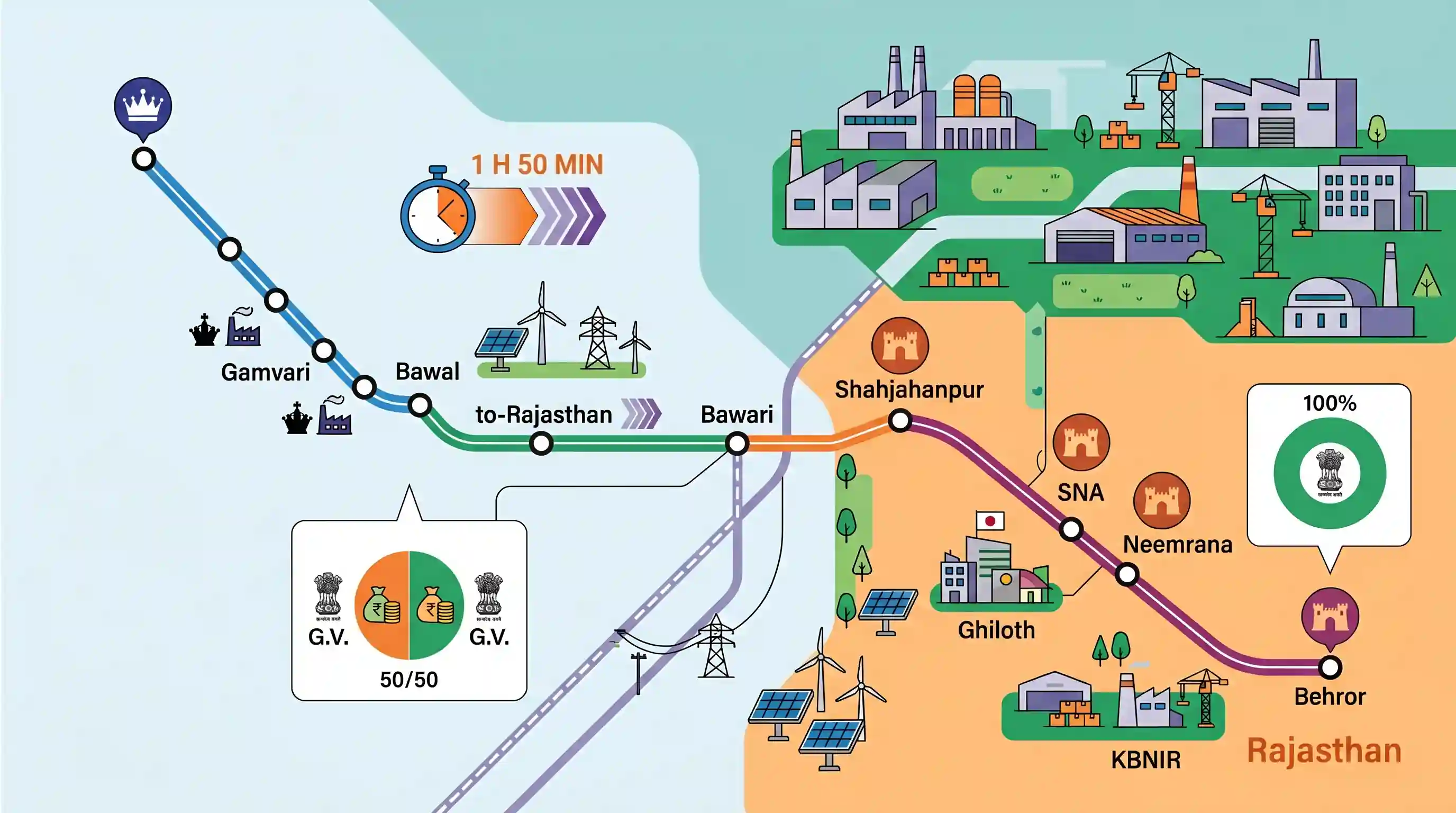
The governments of Rajasthan and Haryana have agreed on a milestone cost-sharing structure for the first phase of the Delhi-Gurugram-Rewari-SNB-Behror Regional Rapid Transit System (RRTS). Spanning 130 km with 19 planned stations, this corridor will feature three stations in Rajasthan (Shahjahanpur, Neemrana, and Behror), reducing travel time from Delhi's Sarai Kale Khan to Behror to 1 hour and 50 minutes. Rajasthan will fund 100% of the section from its border to Behror, while Haryana will bear 50% of the cost for the Bawal-to-Rajasthan-border stretch. The rapid rail project acts as a major infrastructure boost for Rajasthan's key industrial clusters (such as Ghiloth, KBNIR, and the Japanese Zone in Neemrana) under the Delhi-Mumbai Industrial Corridor (DMIC) footprint.
Key Points
- Agreement reached between the governments of Rajasthan and Haryana over the financial model and cost-sharing structure for the first phase of the Delhi-Gurugram-Rewari-SNB-Behror RRTS corridor.
- The proposed high-speed transit corridor spans about 130 km and will feature 19 stations, of which three stations will be located within Rajasthan: Shahjahanpur, Neemrana, and Behror.
- The funding split specifies that Haryana will bear 50% of the cost for the Bawal-to-Rajasthan-border section, while Rajasthan and its institutions will cover 100% of the cost from the Rajasthan border up to Behror.
- Travel time between Sarai Kale Khan (Delhi) and Behror will be reduced to approximately 1 hour 50 minutes once the network is operational.
- The transit network serves as a critical transport and economic backbone for the industrial belt in Rajasthan, connecting key hubs like the Neemrana Japanese Zone, Ghiloth, Shahjahanpur, and the Khushkera-Bhiwadi-Neemrana Investment Region (KBNIR).
Important Terms
Regional Rapid Transit System (RRTS)

A semi-high-speed, dedicated-track rail network designed for fast, high-frequency regional commuting. It connects urban and suburban nodes at speeds up to 180 km/h to ease congestion and lower emissions.
UPSC context
GS Paper 3 (Infrastructure: Transport); tests knowledge of urban mass transit, regional planning, and sustainable transport models.
Delhi-Mumbai Industrial Corridor (DMIC)
A mega infrastructure project spanning 1,483 km, utilizing the Western Dedicated Freight Corridor as its backbone to build smart, sustainable industrial cities and global manufacturing hubs across six Indian states.
UPSC context
GS Paper 3 (Industrial Policy & Infrastructure); tests knowledge of economic corridors, trade competitiveness, and planned urbanization.
National Capital Region Transport Corporation (NCRTC)
A joint-venture company under the Ministry of Housing and Urban Affairs, co-owned by the Centre and participating NCR states, responsible for implementing the Regional Rapid Transit System (RRTS).
UPSC context
GS Paper 3 (Infrastructure); tests understanding of joint-venture institutional mechanisms and cooperative federalism in executing rapid transit.
Rajasthan State Industrial Development and Investment Corporation (RIICO)
An apex enterprise of the Rajasthan government established to spearhead industrialization by developing specialized industrial areas, acquiring land, and providing financial assistance to business projects.
UPSC context
GS Paper 3 (Industrial Infrastructure); tests understanding of regional economic geography and state agencies in facilitating investment.
Prelims Trap
Gujarat holds the longest geographic alignment length under the Delhi-Mumbai Industrial Corridor (DMIC).
Rajasthan actually holds the largest share of the DMIC alignment (approx. 39%), while Gujarat is a close second at 38%.
Static Concepts Connected
What is the Delhi-Mumbai Industrial Corridor (DMIC) and its administrative framework?
- Development Model: Aims to develop smart, sustainable industrial cities leveraging the high-speed connectivity of the Western Dedicated Freight Corridor (DFC).
- Nodal Agency: Monitored and implemented by the National Industrial Corridor Development and Implementation Trust (NICDIT) under the DPIIT, Ministry of Commerce and Industry.
- Funding Structure: Financed through a mix of Government of India equity, bilateral project-tied loans from Japan (including JBIC), and state-level SPVs.
How is the NCRTC structured financially and administratively?
- JV Status: Functions as a joint venture company under the Ministry of Housing and Urban Affairs (MoHUA) to implement regional rapid transit systems.
- Equity Sharing: Split 50:50 between the Centre (22.5% MoHUA, 22.5% Railways, 5% NCRPB) and state governments (12.5% each for Delhi, Haryana, Rajasthan, and UP).
- Federal Synergy: Utilizes a collaborative federal structure where land acquisition and localized clearances are expedited by participating states through dedicated state-level SPVs.
Cross-Topic Patterns
Bilateral investment zones & FDI promotion
The Neemrana Japanese Zone (JETRO-RIICO partnership) demonstrates how dedicated, country-specific spatial zones bypass state-level infrastructural bottlenecks to lock in targeted foreign direct investment.
Rapid transit and regional counter-magnets
High-speed regional rail networks operationalize the NCR master plan by transforming distant industrial clusters into liveable, commutable counter-magnets, reducing urban distress migration.

NCRTC's unique equity-sharing model and DMIC state-wise alignment shares are prime for multi-statement federalism or infrastructure questions.
Linked PYQs · 3
Linked PYQs · 3
- 2025RPSC_PRELIMSGS1
The correct order of decreasing contribution of different sectors in Rajasthan’s Gross Fixed Capital Formation is
- 2025RPSC_PRELIMSGS1
Match List-I with List-II and select the correct answer using the codes given below: List-I – List-II (New industrial areas developed by RIICO in 2023-24) – (Location) A. Nadol – i. Udaipur B. Dharmpura – ii. Jhalawar C. Umaria – iii. Barmer D. Mal Ki Toos – iv. Pali Code : A B C D
- 2024RPSC_PRELIMSGS1
Match List-I with List-II (Place developed by RIICO) and select the correct answer: List-I: A. Nokh, B. Maal Ki Toos, C. Ranpur, D. Maal Ki Toos List-II: i. Udaipur, ii. Jaipur, iii. Bikaner, iv. Pali
