RPCAU Maize Hybrids Impact on Bihar Ethanol Policy and Agriculture
Source:indiatimes ↗
Why It Matters
Maize is a major commercial and food crop in Bihar, with districts like Muzaffarpur leading its production. Introducing specialized dual-use varieties directly complements Bihar's pioneering Ethanol Production Promotion Policy, 2021. Furthermore, post-harvest losses and climatic/soil hazards (such as arsenic contamination) are key concerns in regional agrarian growth, making RPCAU's targeted technology crucial for students tracking Bihar's agricultural development.
Summary
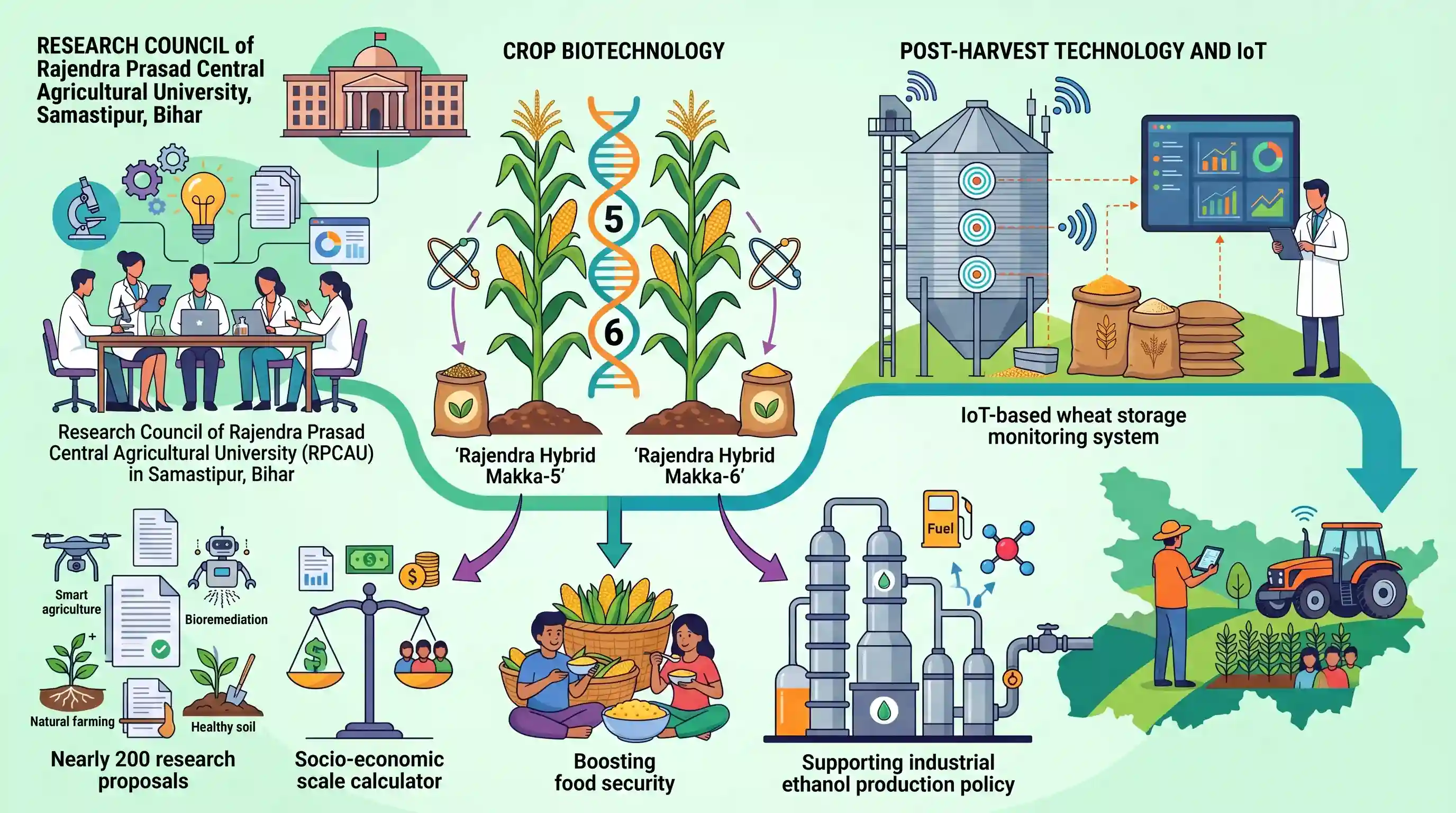
The Research Council of Rajendra Prasad Central Agricultural University (RPCAU), Samastipur, Bihar, approved the release of two high-yielding maize hybrids, Rajendra Hybrid Makka-5 and Rajendra Hybrid Makka-6, which are designed for boosting food security and supporting industrial ethanol production. Additionally, the council endorsed several scientific innovations, including an IoT-based wheat storage monitoring system and a socio-economic scale calculator, along with approving nearly 200 research proposals on smart agriculture, bioremediation, and natural farming.
Key Points
- RPCAU approved two new high-yielding maize hybrids, 'Rajendra Hybrid Makka-5' and 'Rajendra Hybrid Makka-6', for official release.
- Both maize varieties are dual-purpose, developed to boost grain production and serve as industrial feedstock for ethanol production.
- An innovative IoT (Internet of Things)-based real-time storage monitoring system for wheat was introduced to continuously track temperature, moisture, and grain quality to minimize post-harvest losses.
- A new 'scale calculator' computational tool was endorsed for psychometric analysis in socio-economic agricultural research.
- The university research council approved approximately 200 proposals covering cutting-edge themes like AI-based crop yield/price forecasting, remote sensing for drought monitoring, natural farming protocols, bioremediation of arsenic, and sustainable aquaculture.
Important Terms
All-India Coordinated Research Projects (AICRP)

A national network coordinated by the Indian Council of Agricultural Research (ICAR) that links central institutes and state agricultural universities to conduct multi-location, multi-disciplinary research and testing on crop varieties.
UPSC context
GS Paper III (Agriculture). Tests understanding of cooperative agricultural research frameworks, crop diversification, and food security strategies.
Rajendra Prasad Central Agricultural University (RPCAU)
A premier public central agricultural university in Pusa, Bihar, under the Ministry of Agriculture and Farmers Welfare. It facilitates regional agricultural research, extension services, and rural technology.
UPSC context
GS Paper III (Agriculture). Tests knowledge of central educational institutions involved in agricultural extension, biotechnology, and rural upliftment.
First-Generation Ethanol (1G Ethanol)
Biofuel produced directly from food crops rich in starch or sugar, such as sugarcane juice, molasses, maize, and rice, through fermentation and distillation to blend with conventional petrol.
UPSC context
GS Paper III (Energy/Infrastructure). Tests understanding of India's Ethanol Blending Programme (EBP) and food-versus-fuel security challenges.
Bioremediation
An eco-friendly environmental cleanup process that utilizes living organisms—like bacteria, fungi, algae, or plants—to degrade, neutralize, or sequester hazardous pollutants such as pesticides, plastics, and heavy metals.
UPSC context
GS Paper III (Environment). Tests understanding of biotechnology applications for pollution control, conservation, and eco-friendly waste management.
Natural Farming
A chemical-free, low-cost, and sustainable farming method that integrates crops, trees, and livestock, relying strictly on on-farm resource recycling, biomass mulching, and natural formulations.
UPSC context
GS Paper III (Agriculture). Tests knowledge of sustainable agricultural techniques, soil restoration, and the National Mission on Natural Farming.
Climate-Smart Agriculture (CSA)
An integrated agricultural approach aimed at transforming agri-food systems to sustainably increase productivity, enhance resilience to climate change, and reduce greenhouse gas emissions.
UPSC context
GS Paper III (Agriculture). Tests concepts of sustainable food systems, climate adaptation, and technological integration in Indian farming.
Prelims Trap
Fuel-grade ethanol production in India is strictly prohibited from using edible food grains to prevent food security crises.
Aspirants often assume food grains are barred from biofuel production to prevent food insecurity. In reality, the National Policy on Biofuels explicitly permits starch-heavy food grains (like maize and damaged rice) for 1G ethanol.
Static Concepts Connected
What are the key provisions of India's National Policy on Biofuels (with 2022 amendments)?
- E20 Target Advancement: The target of achieving 20% ethanol blending in petrol (E20) was advanced from 2030 to the Ethanol Supply Year (ESY) 2025-26.
- Feedstock Scope: Allows ethanol production from sugarcane juice, B-heavy molasses, C-heavy molasses, sugar beet, sweet sorghum, and starch-containing materials like maize, cassava, and damaged/surplus food grains.
- Biofuel Generations: 1G (sugar/starch-based), 2G (cellulosic crop residues), 3G (algal biofuels), and 4G (genetically engineered feedstocks capturing carbon).
What is the historical origin and evolution of the Pusa Agricultural Institute?
- Colonial Genesis: Established in 1905 at Pusa, Bihar, as the Imperial Agricultural Research Institute (IARI) during the viceroyalty of Lord Curzon, funded partly by American philanthropist Henry Phipps Jr.
- Relocation to Delhi: Following a devastating earthquake in Bihar in 1934, the institute was relocated to New Delhi in 1936, where it retains the popular name 'Pusa Institute'.
- Bihar Legacy: The original Bihar campus was later developed into Bihar's state agricultural university, upgraded in 2016 to the Rajendra Prasad Central Agricultural University (RPCAU).
Cross-Topic Patterns
Food Security vs. Biofuel Mandates
Diverting starch-heavy food crops like maize to meet advanced E20 blending targets creates a policy tension between agrarian income growth and domestic nutritional security.
Colonial Agrarian Policy to Modern S&T
Lord Curzon's institutionalization of agriculture (IARI, 1905) mirrors modern state-led agricultural university research systems trying to address climate vulnerability.

The 2022 Biofuel Policy amendments, specifically feedstock eligibility (maize/broken grains) and the 2025-26 E20 target, are high-probability 2026 targets.
Linked PYQs · 3
Linked PYQs · 3
- 2024-IBPSC_PRELIMSGS1
In which district of Bihar, Maize production is maximum?
- 2024-EBPSC_PRELIMSGS1
What is the contribution of agriculture in the Gross Domestic Product (GDP) of Bihar?
- 2020BPSC_PRELIMSGS1
The Government of India conferred the Krishi Karman Award to Bihar State on 2nd January, 2020. This award was given for
