Legislative Assembly Suspension Over National Song
Source:Indian Express ↗
Why It Matters
The suspension of multiple MLAs underscores ongoing challenges related to parliamentary decorum, the impartiality and disciplinary powers of the Speaker, and the political salience of historical debates surrounding national symbols like Vande Mataram.
Summary
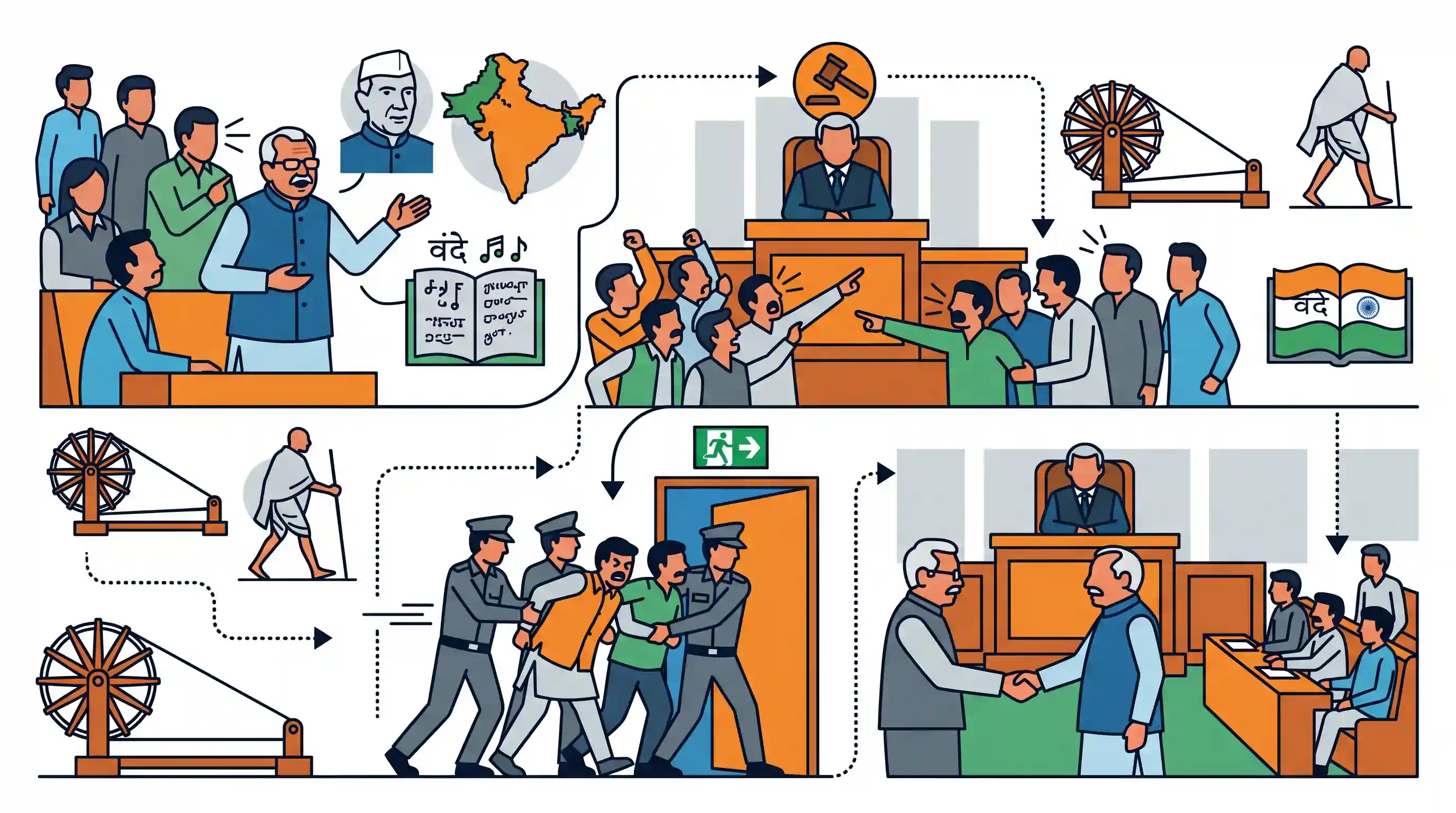
Nine Congress MLAs were suspended and dragged out of the Haryana Assembly following a ruckus over remarks made by Chief Minister Nayab Singh Saini during a discussion marking 150 years of 'Vande Mataram'. The disruption began when Saini accused Jawaharlal Nehru and the Congress of fragmenting the national song to appease the Muslim League. Speaker Harvinder Kalyan suspended the MLAs for unruly behavior, but later revoked the decision following intervention by the Chief Minister and Leader of the Opposition Bhupinder Singh Hooda. The event highlights the Speaker's powers to enforce decorum and the enduring political debates over historical symbols.
Key Points
- Nine Congress MLAs were suspended from the Haryana Assembly for creating a ruckus and were physically removed by marshals.
- The disruption occurred during a discussion commemorating the 150th anniversary of the national song 'Vande Mataram'.
- Protests were triggered by CM Nayab Singh Saini's remarks alleging that Jawaharlal Nehru and the Congress fragmented the national song to appease the Muslim League.
- Speaker Harvinder Kalyan later revoked the suspension after intervention by the Chief Minister and Leader of Opposition Bhupinder Singh Hooda.
- The incident underscores the disciplinary powers of the Speaker in maintaining parliamentary decorum and the continued political sensitivity of historical national symbols.
Important Terms
Vande Mataram

India's National Song, composed by Bankim Chandra Chattopadhyay in 1875. First sung at the 1896 Congress session, it became a rallying cry during the Swadeshi Movement against Bengal's partition.
UPSC context
GS Paper I (History/Culture). Tests knowledge of national symbols and their role in the freedom struggle.
Speaker (State Legislative Assembly)
The constitutional head of the House with powers to maintain order, including suspending members for 'grossly disorderly' conduct under assembly rules and inherent powers under Article 194.
UPSC context
GS Paper II (Polity). Tests understanding of presiding officers' disciplinary powers and legislative decorum.
Leader of the Opposition (LoP)
A statutory post (Act of 1977) held by the leader of the largest opposition party. The role provides democratic checks and influences key appointments like the CBI Director.
UPSC context
GS Paper II (Polity). Tests knowledge of parliamentary offices, accountability mechanisms, and statutory requirements.
Parliamentary Privileges
Special rights and immunities (Articles 105 and 194) granted to legislators to ensure independent functioning. Breach of privilege can lead to suspension or reprimand by the House.
UPSC context
GS Paper II (Polity). Tests understanding of constitutional safeguards for legislative independence and the scope of judicial review.
Muslim League
Political party founded in 1906 in Dhaka to protect Muslim interests. It advocated for separate electorates (1909) and eventually the creation of Pakistan via the 1940 Lahore Resolution.
UPSC context
GS Paper I (Modern History). Tests knowledge of communal politics and constitutional developments leading to Partition.
Prelims Trap
"Article 51A mandates respect for the National Flag, National Anthem, and the National Song."
Article 51A(a) mandates respect for the Constitution, the National Flag, and the National Anthem. It explicitly omits the National Song, a subtle detail UPSC frequently tests.
Static Concepts Connected
How was 'Vande Mataram' integrated into the National Movement?
- Literary Origin: Composed by Bankim Chandra Chattopadhyay (1875); featured in Anandamath (1882) capturing the spirit of the Sanyasi Rebellion.
- 1896 INC Session: First sung publicly by Rabindranath Tagore at the 1896 Calcutta session of the Indian National Congress.
- 1937 Truncation: In 1937, the Congress Working Committee adopted only the first two stanzas to respect minority sensitivities regarding religious imagery in later verses.
What governs the Speaker's power to suspend unruly MLAs?
- Rules of Procedure: The disciplinary power to suspend members derives from the respective Assembly's Rules of Procedure, not a direct constitutional article.
- Process of Suspension: Usually, the Speaker 'names' the unruly member, followed by a motion moved by the government and adopted by the House.
- Revocation Power: The House retains the authority to terminate the suspension at any time via a subsequent motion.
Cross-Topic Patterns
National Symbols + Fundamental Duties
The historical journey of symbols like Vande Mataram connects to exact constitutional phrasing in Art 51A and statutory frameworks like the Prevention of Insults to National Honour Act, 1971.
Speaker's Powers + Rules of Procedure
Recent legislative disruptions frequently test the boundaries between constitutional mandates and the discretionary Rules of Procedure governing the Speaker's disciplinary toolkit in state assemblies.

Expect a 2026 Prelims statement mixing Vande Mataram's timeline (1896 INC, 1937 CWC) with its exact constitutional status in Article 51A.
Linked PYQs · 3
Linked PYQs · 3
- 2003PrelimsGS1
Which one of the following statements is correct?
- 2023MainsGS2
Discuss the role of Presiding Officers of state legislatures in maintaining order and impartiality in conducting legislative work and in facilitating best democratic practices.
- 2020MainsGS2
Once a Speaker, Always a Speaker' ! Do you think this practice should be adopted to impart objectivity to the office of the Speaker of Lok Sabha ? What could be its implications for the robust functioning of parliamentary business in India?
