Political row erupts over cancellation of Rahul student event in UP
Source:ianslive ↗
Why It Matters
The incident highlights the continuous tension between state administration and opposition parties, touching upon the fundamental right to assemble peacefully and freedom of speech (Article 19) as well as the democratic role of the Leader of Opposition.
Summary
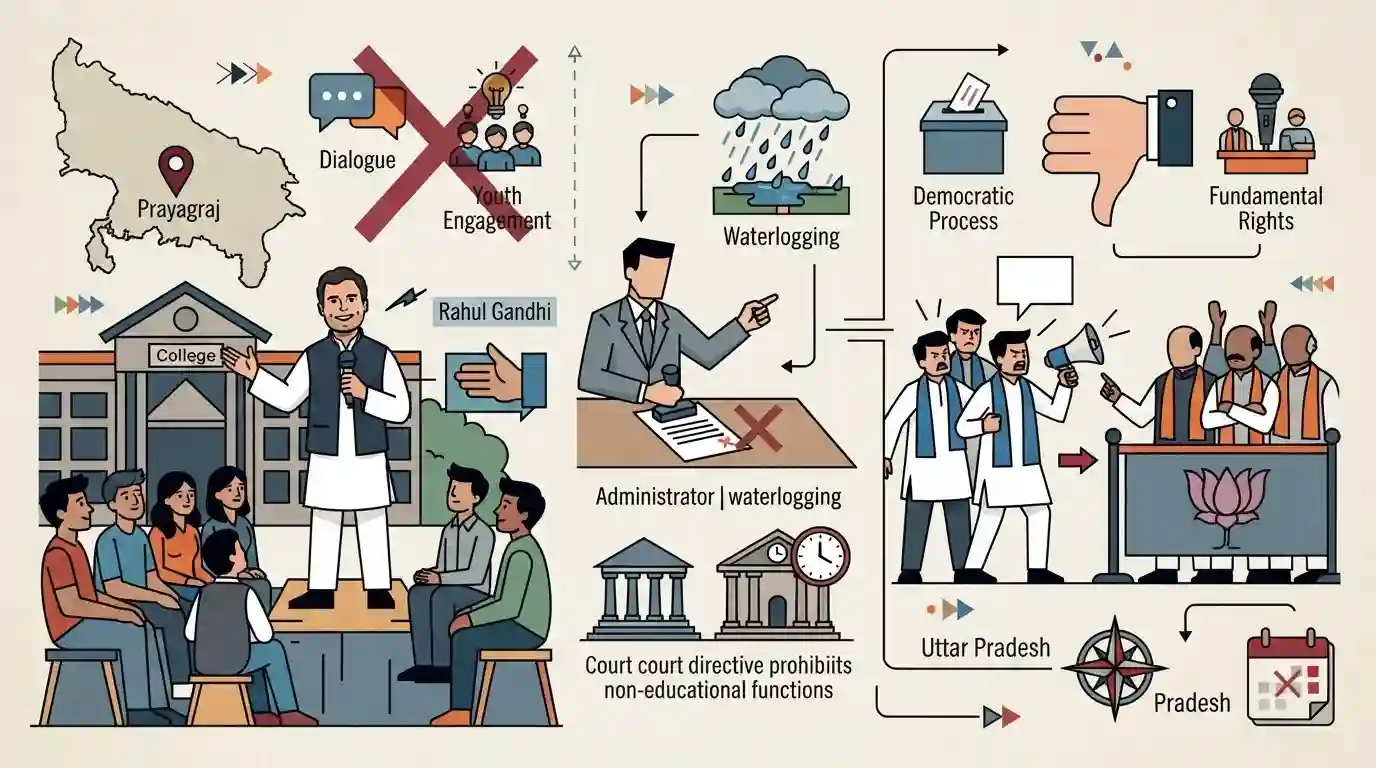
A political controversy has erupted in Uttar Pradesh after the cancellation of Rahul Gandhi's scheduled interactive session with students, 'Chhatron ki Goonj', in Prayagraj. The Kayastha Pathshala Trust revoked its previously granted permission for the event, citing waterlogging caused by heavy rains and compliance with a court directive prohibiting non-educational functions during school hours. Congress has fiercely condemned the cancellation, labeling it an undemocratic move orchestrated by the ruling BJP to silence the Leader of Opposition and prevent his dialogue with the youth.
Key Points
- Permission for Rahul Gandhi's student event 'Chhatron ki Goonj' in Prayagraj was revoked by the Kayastha Pathshala Trust.
- The venue management cited unsafe ground conditions due to continuous rain and a prevailing court order against holding non-educational activities during study hours.
- Congress leaders, including Ajay Rai, alleged that the BJP government pressured the Trust to cancel the event out of fear of Gandhi's interaction with the youth.
- The incident has sparked a political row, with Congress accusing the administration of throttling democratic processes and fundamental rights.
Important Terms
Lok Sabha

The directly elected lower house of India's bicameral Parliament, functioning as the primary legislative body where the government is formed and held accountable.
UPSC context
GS Paper 2 (Polity); essential for understanding parliamentary democracy, legislative procedures, and the Opposition's role.
Congress
A major national political party in India, historically significant in the freedom struggle, and currently functioning as the principal opposition holding the government accountable.
UPSC context
GS Paper 2 (Polity); tests knowledge of India's party system, electoral politics, and the Opposition's democratic role.
Bharatiya Janata Party (BJP)
One of India's two principal political parties, currently forming the ruling government at the Centre, characterized by its right-leaning and nationalist political ideology.
UPSC context
GS Paper 2 (Polity); important for studying the evolution of the national party system and democratic governance.
Kayastha Pathshala Trust
An educational and philanthropic trust in Prayagraj that manages local schools, colleges, and grounds, subject to judicial directives on the usage of its properties.
UPSC context
GS Paper 2 (Governance); highlights the role of civic institutions and the impact of judicial orders on public gatherings.
Prelims Trap
"The Leader of Opposition (LoP) is a constitutional post formally recognised under Article 118 of the Constitution."
The LoP is a statutory post defined under the Salary and Allowances of Leaders of Opposition in Parliament Act, 1977, not a constitutional one.
Static Concepts Connected
What are the constitutional grounds to restrict the right to assemble?
- Fundamental Right: Article 19(1)(b) guarantees citizens the right to assemble peaceably and without arms.
- Reasonable Restrictions: Under Article 19(3), the state can impose restrictions solely on two grounds: the sovereignty and integrity of India, and public order.
- Section 144 CrPC/BNSS: Used by executive magistrates to restrict assembly if there is an imminent danger to peace, public order, or human life.
What are the key statutory powers and privileges of the Leader of Opposition?
- Statutory Status: The LoP is formally recognised under a 1977 Act and enjoys the rank, salary, and allowances equivalent to a Union Cabinet Minister.
- Appointment Collegiums: The LoP is a mandatory member of selection committees for key institutions like the CBI, CVC, Lokpal, and the Election Commission.
- The 10% Rule: By the Mavalankar convention, the opposition party must secure at least 10% of the total seats in the House to claim the LoP post.
Cross-Topic Patterns
Art 19 Assembly vs Art 21A Education
Courts increasingly prioritize academic continuity under Article 21A, restricting political assemblies on school grounds during study hours. This reflects a judicial balancing of political rights against educational primacy.
Executive Appointments & Opposition Check
The LoP acts as an institutional check on executive power, actively participating in the collegium for high-stakes appointments like the CBI Director, Lokpal, and Chief Election Commissioner.

Expect a multi-statement Prelims question testing the statutory basis of the LoP post vs its role in CBI, ECI, and Lokpal appointments.
Linked PYQs · 2
Linked PYQs · 2
- 2024UPPSC_PRELIMSGS1
Which of the following freedoms is not guaranteed by the Indian Constitution under Article 19 ?
- 2024UPPSC_PRELIMSGS1
According to the Lokpal and Lokayuktas Act, 2013 the Lokpal would be appointed by the President after obtaining the recommendations of a Selection Committee, with the Prime Minister as chairperson and consisting, among others, of the following : 1. Chief Justice of India or a Supreme Court Judge nominated by him 2. Chairman of the Rajya Sabha 3. Speaker of the Lok Sabha 4. Leader of Opposition in the Lok Sabha Select the correct answer from the codes given below :
