Rome declaration calls for human ethics in artificial intelligence
Source:The Hindu ↗
Why It Matters
As AI systems are increasingly deployed in administrative, judicial, and military decision-making, understanding the ethical boundaries of technology is a core requirement for modern civil servants. The intersection of human values and AI is a highly probable topic for GS4 (Ethics) and GS3 (Science & Technology).
Summary
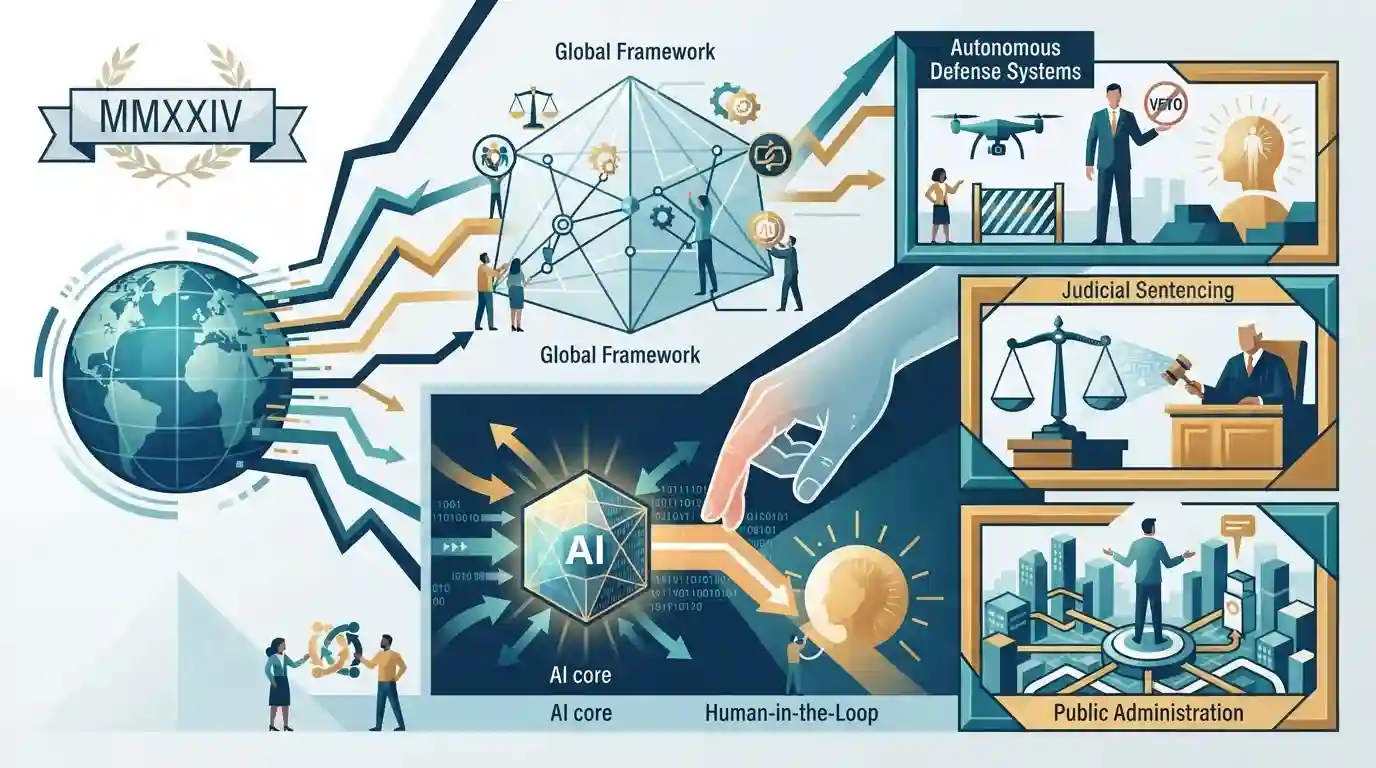
Global luminaries have issued the "Rome Declaration on convergent perils," urgently calling for international frameworks to regulate Artificial Intelligence and prevent the outsourcing of human ethical decision-making to machines. Highlighting that humanity faces interconnected, compounding crises, the declaration argues that AI, while a powerful data-processing tool, inherently lacks empathy, moral reasoning, and true accountability. It emphasizes that critical decisions in high-stakes domains—such as autonomous defense systems, judicial sentencing, and public administration—must always retain a "human-in-the-loop" to safeguard human dignity. The declaration serves as a moral appeal to global governments and technologists to embed human-centric ethical guardrails into AI development.
Key Points
- Global luminaries issued the Rome Declaration to address 'convergent perils'—intersecting global crises exacerbated by rapid, unregulated technological advancements.
- The declaration strongly warns against the outsourcing of human ethical and moral decision-making to Artificial Intelligence algorithms.
- It asserts that human agency, empathy, and accountability are irreplaceable and must remain central to critical decisions in defense, justice, and administration.
- Calls for strict international regulatory frameworks and 'human-in-the-loop' mandates to ensure AI serves human dignity rather than undermining it.
Important Terms
Rome Declaration on Convergent Perils

A 2026 declaration signed by global luminaries calling for an international treaty to ban autonomous systems from nuclear launch decisions and ensure ethical control over AI.
UPSC context
GS Paper II (International Relations) & Paper III (Security); tests awareness of international treaties and technological threat regulation.
Human-in-the-Loop (HITL)
A system design framework requiring human intervention and decision-making at critical stages of automated workflows, ensuring machines do not have complete autonomy in high-stakes actions.
UPSC context
GS Paper IV (Ethics) & GS Paper III (Science & Tech); tests ethical AI governance and administrative accountability in automated decision-making.
Autonomous Weapons Systems (AWS)
Military platforms that use artificial intelligence to independently search for, select, and engage targets without human intervention, presenting severe moral, legal, and humanitarian concerns.
UPSC context
GS Paper III (Security & Defense Technology); tests knowledge of modern warfare challenges, international humanitarian law, and global arms control.
Convergent Perils
The compounding, simultaneous global security and environmental threats arising from the intersection of emerging technologies (like advanced AI) with existing vulnerabilities (like nuclear weapons).
UPSC context
GS Paper III (Science and Technology / Security); tests deep understanding of multi-dimensional global risks and policy interventions.
Prelims Trap
The Rome Declaration on convergent perils is a legally binding UN treaty regulating AI.
It is a moral appeal and declaration by global luminaries calling for future treaties, not a legally binding instrument itself. Do not confuse it with the Rome Statute (ICC).
Static Concepts Connected
What is the "Human-in-the-loop" (HITL) approach in Artificial Intelligence?
- Definition: An AI operational model requiring human interaction, review, or oversight before a final decision is executed.
- Accountability: Crucial for assigning legal and moral responsibility in high-stakes domains like judicial sentencing and defense, where AI lacks empathy.
- Degrees of Autonomy: Contrasts with "human-on-the-loop" (human can override but system acts autonomously) and "human-out-of-the-loop" (fully autonomous).
What is the international status of Lethal Autonomous Weapons Systems (LAWS)?
- LAWS Definition: Weapons that can independently search for, identify, and engage targets without human intervention (often dubbed 'killer robots').
- UN Framework: Discussions on regulating or banning LAWS are primarily held under the UN Convention on Certain Conventional Weapons (CCW).
- Ethical Concerns: Key concerns include the accountability gap for war crimes and the inability of algorithms to distinguish between combatants and civilians (Proportionality).
Cross-Topic Patterns
AI Governance + Nuclear Deterrence
Integrating AI into nuclear command-and-control systems compresses decision windows and removes historical "human hesitation," linking GS3 Emerging Tech directly with GS2 International Security and nuclear deterrence.
Digital Commons vs. Big Tech Monopoly
The declaration's advocacy for a "Digital Commons Model" mirrors India's Digital Public Infrastructure (DPI) philosophy, aiming to democratize AI data access beyond a few global geopolitical or corporate monopolies.

Ethical AI + Autonomous Weapons + Nuclear C2 will likely feature in GS3 Mains or a Prelims multi-statement Q on global AI pacts.
Linked PYQs · 3
Linked PYQs · 3
- 2024MainsGS4
The application of Artificial Intelligence as a dependable source of input for administrative rational decision-making is a debatable issue. Critically examine the statement from the ethical point of view.
- 2023MainsGS3
Introduce the concept of Artificial Intelligence (AI). How does Al help clinical diagnosis? Do you perceive any threat to privacy of the individual in the use of Al in healthcare?
- 2022MainsGS4
It is believed that adherence to ethics in human actions would ensure in smooth functioning of an organization/system. If so, what does ethics seek to promote in human life? How do ethical values assist in the resolution of conflicts faced by him in his day-to-day functioning?
