Role of Philanthropic Capital in Climate Disaster Mitigation
Source:Indian Express ↗
Why It Matters
Provides a critical perspective on how non-state actors and philanthropic capital can bridge the climate finance gap. It touches upon the structural shift needed in disaster management—from reactive relief to proactive resilience—which is a core theme in GS3, while also highlighting the role of civil society relevant to GS2.
Summary
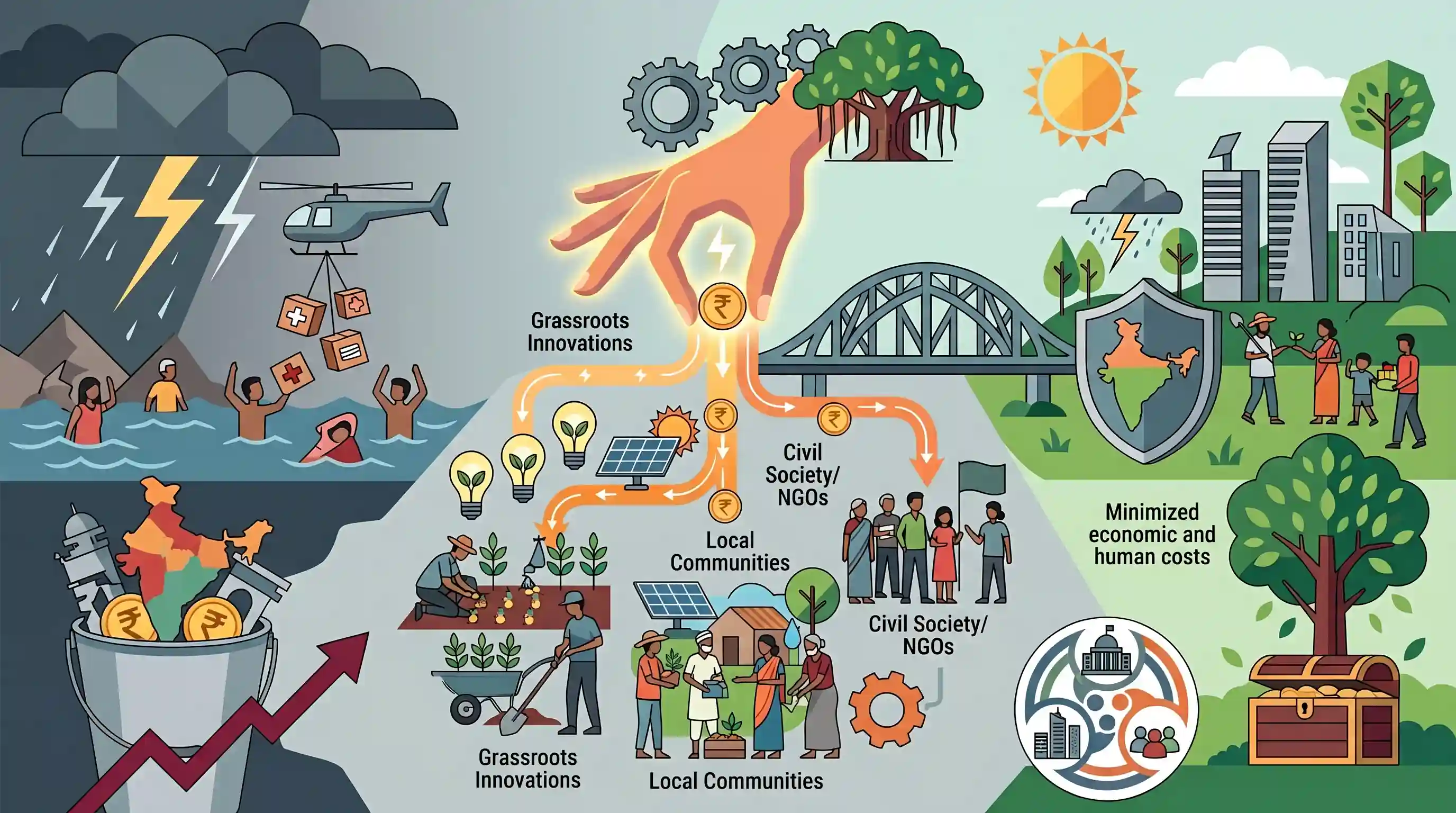
The article highlights the critical role of Indian philanthropy in addressing climate change, advocating for a shift from reactive disaster relief to proactive mitigation and resilience-building. As extreme weather events become more frequent in India, state resources alone are insufficient to manage the escalating costs of climate adaptation. Philanthropic capital, being more risk-tolerant and flexible, is uniquely positioned to bridge the climate finance gap. It can support grassroots innovations, empower local communities, and fund civil society organizations (CSOs). The author emphasizes that a collaborative approach involving the state, markets, and civil society is essential for holistic climate action and minimizing the long-term human and economic costs of disasters.
Key Points
- Climate-induced disasters in India are increasing in frequency and severity, necessitating augmented resources for mitigation and adaptation.
- There is a critical need to transition from reactive post-disaster relief to proactive disaster preparedness and community-level resilience building.
- Indian philanthropy and private capital must play a catalytic role in bridging the significant climate finance gap.
- Philanthropic funds are highly flexible and risk-tolerant, making them ideal for supporting grassroots innovations and capacity-building of local NGOs.
- Effective climate action requires synergetic collaboration between the state, the market, and civil society for holistic disaster management.
Important Terms
Sendai Framework for Disaster Risk Reduction (SFDRR)

A 15-year (2015-2030) voluntary global agreement aimed at reducing disaster risk and losses. It shifts focus from disaster management to 'disaster risk management' and emphasizes shared responsibility among states and stakeholders.
UPSC context
GS-III: Disaster Management. Key for questions on global frameworks, risk reduction targets, and India's National Disaster Management Plan alignment.
Climate Finance
Local, national, or international financing—from public, private, or alternative sources—supporting climate mitigation and adaptation. It includes grants, green bonds, and philanthropic capital for low-carbon transitions and resilience.
UPSC context
GS-III: Environment & Economy. Tested via mechanisms like the Green Climate Fund (GCF) and the '100 billion dollar' pledge.
Disaster Resilience
The ability of a community or system to resist, absorb, and recover from disaster effects while preserving essential functions. It promotes the concept of 'Building Back Better' rather than just returning to pre-disaster states.
UPSC context
GS-III: Disaster Management. Tests understanding of adaptive capacity and sustainable recovery strategies in the face of frequent hazards.
Climate Adaptation
Adjusting ecological, social, or economic systems in response to actual or expected climatic stimuli to moderate harm. Unlike mitigation (reducing emissions), adaptation focuses on managing the unavoidable consequences of climate change.
UPSC context
GS-III: Environment. Crucial for understanding India's National Action Plan on Climate Change (NAPCC) and localized resilience efforts.
Civil Society Organizations (CSOs)
Non-state, non-profit entities that unite individuals to pursue shared ethical or philanthropic goals. In disasters, they fill governance gaps, advocate for vulnerable groups, and facilitate community-led disaster preparedness.
UPSC context
GS-II: Governance. Relevant for the 'Role of NGOs, SHGs, and various groups' syllabus point and participatory democracy questions.
Non-Governmental Organizations (NGOs)
Non-profit entities, often acting as first responders, providing relief, medical aid, and training. They bridge the gap between state authorities and local communities during the 'Golden Hour' and post-disaster rehabilitation.
UPSC context
GS-II & GS-III: Governance/Disaster Management. Evaluates the efficiency of non-state actors in humanitarian assistance and grassroots implementation.
Prelims Trap
The Sendai Framework imposes legally binding financial obligations on private sector entities.
The Sendai Framework (2015-2030) is a voluntary, non-binding agreement. It encourages private and philanthropic investment in resilience but imposes no legal obligations.
Static Concepts Connected
What are the four priorities of the Sendai Framework for Disaster Risk Reduction?
- Understanding Risk: Assessing disaster vulnerability, exposure, capacity, and hazard characteristics to inform policies.
- Strengthening Governance: Mainstreaming and integrating disaster risk management across all sectors and levels of government.
- Investing in Resilience: Promoting public and private investments in structural and non-structural risk reduction measures.
- Build Back Better: Enhancing disaster preparedness for effective response, recovery, rehabilitation, and reconstruction.
What are the three primary pillars of global climate finance?
- Mitigation Finance: Financing aimed at reducing or avoiding greenhouse gas emissions (e.g., renewable energy projects).
- Adaptation Finance: Capital directed at reducing the vulnerability of human and natural systems to climate impacts.
- Loss and Damage: Funding to compensate and rehabilitate vulnerable nations suffering from unavoidable climate disasters (operationalized at COP28).
Cross-Topic Patterns
NGOs + Disaster Management (GS2/GS3)
Philanthropy and CSOs provide risk-tolerant capital for local adaptation, bridging the governance gap between rigid state disaster-relief machinery and profit-driven market forces.
Mandated CSR vs Voluntary Philanthropy
India's estimated $170B annual climate finance gap requires mobilizing both legally mandated CSR funds (Companies Act) and flexible, voluntary philanthropic capital to seed grassroots resilience.

Expect a GS3 Mains question linking the climate finance gap to Sendai Framework's priority of private investment in disaster resilience.
Linked PYQs · 4
Linked PYQs · 4
- 2024MainsGS3
What is disaster resilience? How is it determined? Describe various elements of a resilience framework. Also mention the global targets of Sendai Framework for Disaster Risk Reduction (2015–2030).
- 2020MainsGS3
Discuss the recent measures initiated in disaster management by the Government of India departing from the earlier reactive approach.
- 2021MainsGS2
Can Civil Society and Non-Governmental Organizations present an alternative model of public service delivery to benefit the common citizen? Discuss the challenges of this alternative model.
- 2025MainsGS2
Civil Society Organizations are often perceived as being anti-State actors than non-State actors. Do you agree? Justify.
