Israeli military strikes on Iran escalate West Asian tensions
Source:The Hindu ↗
Why It Matters
The ongoing Israel-Iran conflict and the fate of the nuclear deal are highly relevant for GS2 (International Relations) and GS3 (Energy Security). The article clearly outlines the direct geopolitical and economic ramifications for India, addressing frequent UPSC themes regarding Middle Eastern stability, the Indian diaspora, and energy diplomacy.
Summary
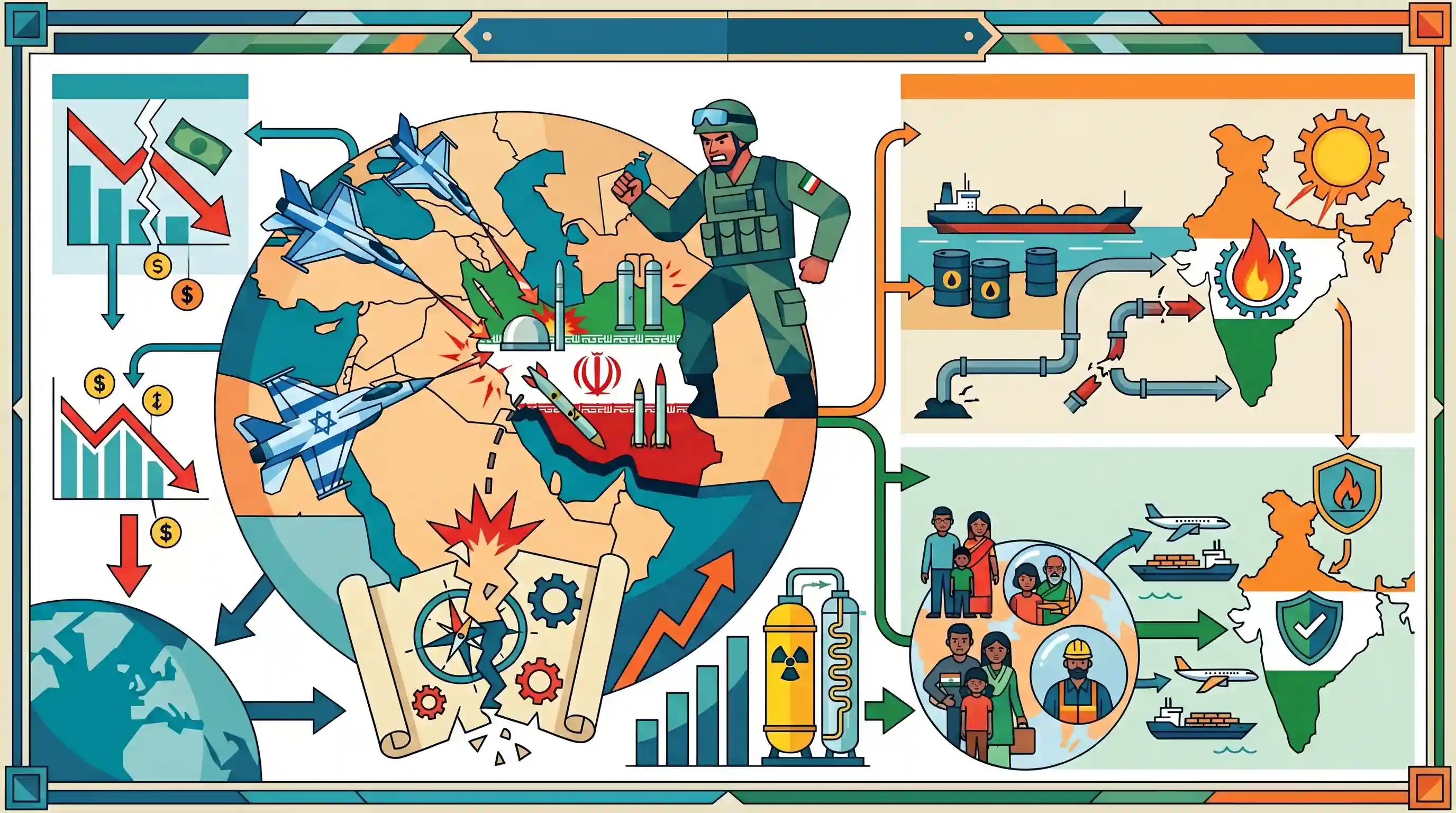
The article critically analyzes Israel's military strikes on Iran's nuclear and missile facilities, highlighting the severe destabilization of the West Asian region. It traces the roots of the current nuclear tensions to the collapse of the 2015 Iran nuclear deal, which led Iran to aggressively resume uranium enrichment. The editorial warns of Israel's unchecked regional militarism and emphasizes the grave implications of a broader conflict on the global economy. For India, the stakes are particularly high, given its critical dependence on the Gulf for energy security and the safety of its vast diaspora in the region.
Key Points
- Israel launched direct military strikes on Iran's nuclear enrichment and ballistic missile facilities, escalating regional tensions and prompting threats of retaliation.
- The 2015 multilateral nuclear agreement was derailed during Donald Trump's first presidency, leading Iran to enrich uranium up to 60%.
- Israel's unchecked militarism across Gaza, Lebanon, Syria, and now Iran is fueling a broader destabilization of West Asia.
- A wider regional conflict poses severe risks to the global economy, particularly affecting energy markets.
- India faces high stakes in the conflict due to its heavy reliance on the Gulf region for energy security and the presence of millions of Indian citizens working there.
Important Terms
Joint Comprehensive Plan of Action (JCPOA)

A 2015 agreement between Iran and the P5+1 powers (US, UK, France, Russia, China, and Germany) to limit Iran's nuclear program in exchange for global sanctions relief.
UPSC context
GS Paper II: Important for International Relations, bilateral agreements, and West Asian geopolitics affecting India's strategic interests.
International Atomic Energy Agency (IAEA)
An autonomous international organization within the UN system that promotes peaceful nuclear energy use and monitors global nuclear facilities to prevent weaponization.
UPSC context
GS Paper II: International Institutions. Relevant for global nuclear governance and India's compliance with non-proliferation norms.
Uranium Enrichment
The process of increasing the concentration of the fissile U-235 isotope to make uranium suitable for nuclear reactors (3-5%) or nuclear weapons (~90%).
UPSC context
GS Paper III: Science & Technology and Security. Tests knowledge of nuclear technology and proliferation risks in West Asia.
Indian Diaspora (West Asia)
Over 9 million Indian nationals residing in the Gulf region, providing vital remittances ($100B+ annually) but vulnerable to regional military escalations.
UPSC context
GS Paper II: Effect of politics of developed and developing countries on India’s interests and the Indian diaspora.
Energy Security
The uninterrupted availability of energy sources at an affordable price; for India, this is highly dependent on crude oil and LNG imports from the Gulf.
UPSC context
GS Paper III: Indian Economy and Security. Focuses on India's import dependency (85% oil) and strategic petroleum reserves.
Strait of Hormuz
A critical maritime chokepoint between the Persian Gulf and Gulf of Oman through which approximately 20% of the world’s petroleum and 90% of India's LPG imports pass.
UPSC context
GS Paper I/II: Geography and International Relations. A strategic geographic flashpoint impacting global trade and India's energy supply.
Strategic Autonomy
India’s foreign policy principle of making independent decisions based on national interests while maintaining balanced relations with rival powers like Israel and Iran.
UPSC context
GS Paper II: Indian Foreign Policy. Tests India’s ability to navigate polarized global conflicts without joining formal military blocs.
Prelims Trap
"Uranium enriched to 60% by Iran is considered weapons-grade highly enriched uranium."
Weapons-grade HEU requires approximately 90% U-235 enrichment. While 60% is a dangerous threshold that drastically reduces breakout time, it is strictly not weapons-grade.
Static Concepts Connected
What are the standard grades of uranium enrichment?
- Natural Uranium: Contains only 0.7% of the fissile U-235 isotope, requiring concentration for most reactor designs.
- LEU (Low Enriched): Enriched between 3% to 20%; the standard threshold for civilian nuclear power generation.
- Weapons-Grade HEU: Enriched to approximately 90% U-235; the critical threshold required to manufacture nuclear warheads.
How do Gulf remittances structurally stabilize India's external sector?
- CAD Cushion: Remittances from the 8.5+ million Gulf diaspora act as a crucial, non-debt-creating buffer offsetting India's massive structural trade deficit.
- Oil-Remittance Loop: The region India pays for crude oil (draining forex) is the primary source of remittance inflows, creating a highly vulnerable macroeconomic dependency loop.
Cross-Topic Patterns
West Asian Chokepoints & Energy Transit
Escalations threaten critical transit routes like the Strait of Hormuz, linking IR directly to Prelims Geography mapping and India's Strategic Petroleum Reserves (SPR) policy.
Diaspora Evacuation Diplomacy
Widespread conflict triggers non-combat evacuation operations (like Ops Rahat, Ajay), a recurring GS2 theme highlighting India's evolving diplomatic and logistical capabilities.

Expect a 2026 multi-statement Prelims question merging nuclear enrichment thresholds (LEU vs HEU) with IAEA safeguards and JCPOA.
Linked PYQs · 3
Linked PYQs · 3
- 2018MainsGS2
In what ways would the ongoing US-Iran Nuclear Pact Controversy affect the national interest of India? How should India respond to this situation?
- 2025MainsGS2
"Energy security constitutes the dominant kingpin of India's foreign policy, and is linked with India's overarching influence in Middle Eastern countries.” How would you integrate energy security with India's foreign policy trajectories in the coming years?
- 2017MainsGS2
The question of India's Energy Security constitutes the most important part of India's economic progress. Analyze India's energy policy cooperation with West Asian countries.
