Farm Mechanization and Natural Farming Technology Integration
Source:The Hindu ↗
Why It Matters
Mechanization combined with natural farming represents a dual approach to increasing agricultural efficiency while maintaining environmental sustainability. Understanding such grassroots case studies provides concrete examples for GS3 answers on e-technology, sustainable agriculture, and the reduction of agrochemical dependency.
Summary
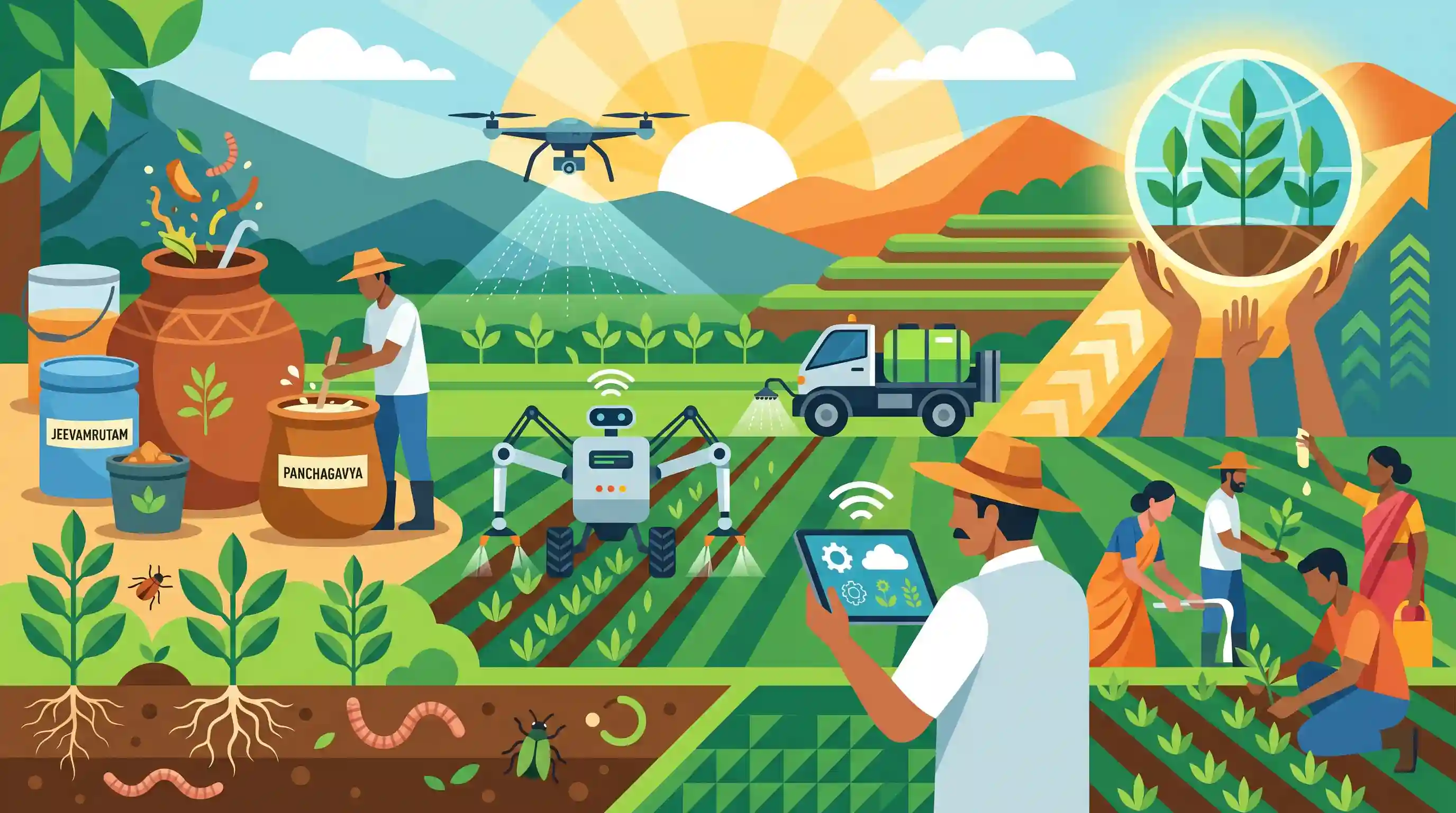
The article highlights the successful integration of modern agricultural technologies—such as drones, farm robots, and mobile sprayers—with natural farming practices by progressive farmers in Andhra Pradesh. G. Venkatarama Raju, an ICAR awardee from Tirupati district, has demonstrated the efficacy of 'Farm Robo' in addressing labor shortages and reducing hazardous human exposure to pesticides. Alongside modern mechanization, he promotes natural farming using sustainable inputs like 'Jeevamrutam' and 'Panchagavya'. He has also appealed to the district administration to include Tirupati in the Government of India's FARM (Financing Agrochemical Reduction and Management) project, which aims to transition one million farmers toward safer, resilient, and sustainable agriculture.
Key Points
- Farm mechanization, including drones and 'Farm Robo', is emerging as a reliable solution to combat severe labor shortages in agriculture.
- Mobile robotic sprayers automate pesticide dosage and significantly reduce hazardous human exposure to agrochemicals while efficiently covering large farming areas.
- Progressive farmers are successfully integrating advanced mechanization with natural farming methods, utilizing sustainable inputs like 'Jeevamrutam' and 'Panchagavya'.
- The Government of India's FARM (Financing Agrochemical Reduction and Management) project aims to support one million farmers in transitioning towards safer, resilient, and sustainable agricultural practices.
Important Terms
FARM Project (Financing Agrochemical Reduction and Management)

A UNEP-led, GEF-funded $379 million initiative aimed at reducing reliance on highly hazardous pesticides (HHPs) and agricultural plastics while promoting sustainable financing for eco-friendly alternatives.
UPSC context
GS Paper III: Environmental Pollution/Agriculture. Tests knowledge of international initiatives to eliminate Persistent Organic Pollutants (POPs) in farming.
Indian Council of Agricultural Research (ICAR)
The apex autonomous body under the Ministry of Agriculture and Farmers Welfare responsible for coordinating, guiding, and managing agricultural research and education across India.
UPSC context
GS Paper III: Agriculture. Relevant for institutional frameworks supporting the Green Revolution and modern agricultural technology.
Natural Farming
A chemical-free farming system rooted in traditional practices that uses on-farm inputs like cow dung and urine to restore soil health and reduce cultivation costs.
UPSC context
GS Paper III: Major crops/cropping patterns. Tests understanding of sustainable agriculture and Zero Budget Natural Farming (ZBNF).
Farm Mechanization
The integration of machinery—ranging from tractors to advanced drones and robots—into agricultural operations to improve productivity, address labor shortages, and enhance resource efficiency.
UPSC context
GS Paper III: E-technology in the aid of farmers. Focuses on technological interventions to reduce drudgery and input costs.
Jeevamrutam
A fermented microbial culture used in natural farming, made from cow dung, urine, jaggery, and pulse flour, to enhance soil microbial activity and nutrient availability.
UPSC context
GS Paper III: Sustainable Agriculture. Specific input used in Bhartiya Prakritik Krishi Paddhati (BPKP) and ZBNF.
Panchagavya
An organic concoction made from five cow-derived products (dung, urine, milk, curd, ghee) used as a bio-fertilizer and growth promoter to improve plant immunity.
UPSC context
GS Paper III: Agriculture. Relevant for traditional knowledge-based sustainable farming practices.
Prelims Trap
The FARM project is an exclusive central sector scheme launched by the Ministry of Agriculture.
While locally implemented by GoI, FARM is a global initiative led by UNEP and funded by the Global Environment Facility (GEF) to phase out Highly Hazardous Pesticides.
Static Concepts Connected
What are the four core pillars of Zero Budget Natural Farming (ZBNF)?
- Jeevamrutam: A microbial culture of cow dung, urine, jaggery, pulse flour, and soil to promote biological activity in the soil.
- Beejamrutam: Seed treatment using local cow dung, urine, and lime to protect young roots from fungus and soil-borne diseases.
- Acchadana: Mulching (using soil, straw, or live cover crops) to conserve soil moisture, control weeds, and promote humus formation.
- Whapasa: Maintaining proper soil aeration and moisture dynamics (a mix of air and water molecules), reducing the need for heavy irrigation.
Which major international environmental conventions are funded by the Global Environment Facility (GEF)?
- Stockholm Convention: Serves as the financial mechanism to eliminate Persistent Organic Pollutants (POPs) globally, including highly hazardous agricultural pesticides.
- UNFCCC & UNCBD: Provides financial resources to help developing countries meet their obligations under UNFCCC (climate) and UNCBD (biodiversity).
- UNCCD & Minamata: Supports efforts to combat desertification and phase out the usage of mercury in industrial and artisanal processes.
Cross-Topic Patterns
Precision Farming meets Stockholm Convention
Agricultural drones automate pesticide dosing, significantly reducing runoff of Highly Hazardous Pesticides (HHPs). This connects farm mechanization directly to India's obligations under the Stockholm Convention on POPs.
Demographics, MGNREGA, and Farm Mechanization
Rural labor shortages driven by schemes like MGNREGA and rural-to-urban migration are catalyzing the adoption of 'Farm Robo' and drones, accelerating a shift from labor-intensive to capital-intensive agriculture.

Expect a multi-statement question blending the UNEP-led FARM project with indigenous natural farming inputs like Jeevamrutam in 2026.
Linked PYQs · 2
Linked PYQs · 2
- 2023MainsGS3
How does e-Technology help farmers in production and marketing of agricultural produce? Explain it.
- 2021MainsGS3
What are the present challenges before crop diversification? How do emerging technologies provide an opportunity for crop diversification?
