Himachal road safety audit policy for hilly terrain accident reduction
Source:tribune-india ↗
Why It Matters
Highlights essential state-level policy interventions aimed at improving public infrastructure safety in geographically challenging regions. It is highly relevant for HPAS questions focusing on state governance indices, transport policies, and localized disaster/accident mitigation strategies.
Summary
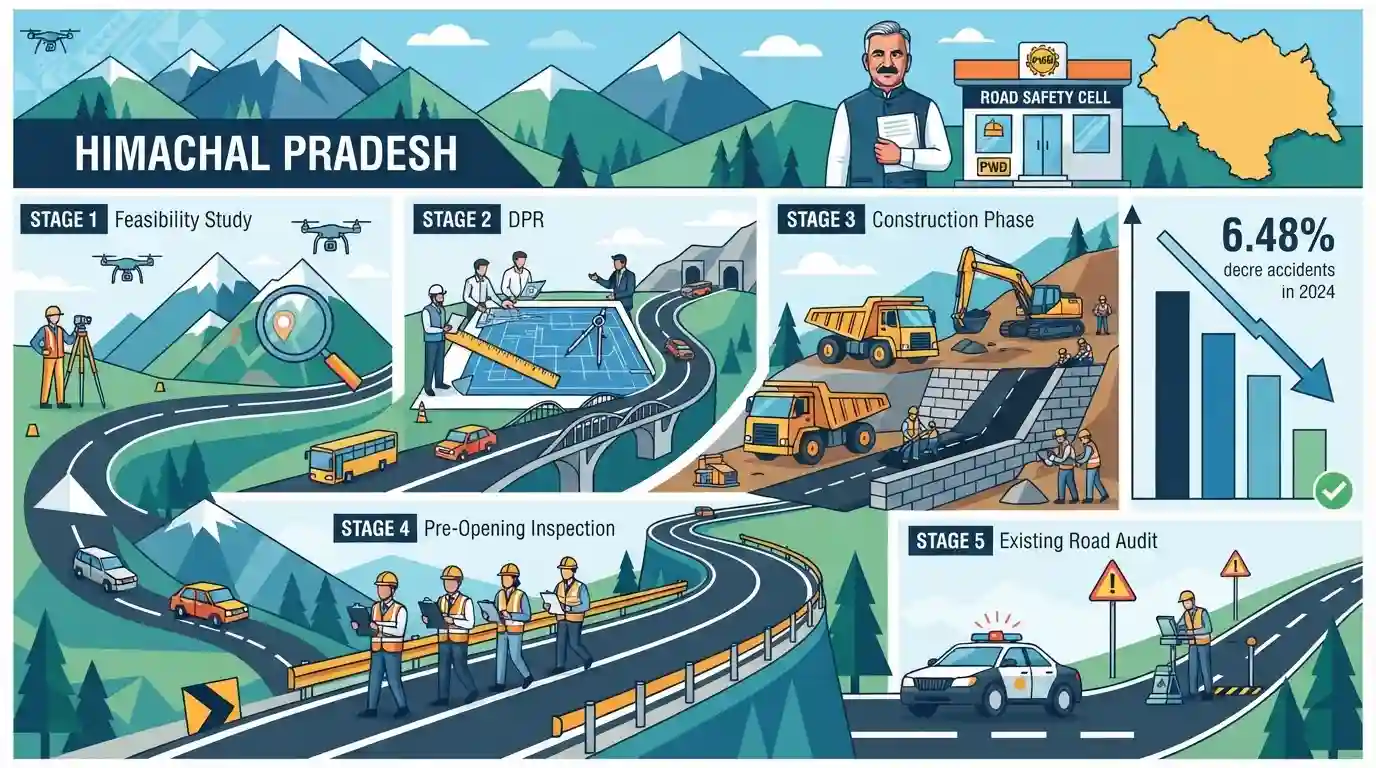
Himachal Pradesh Chief Minister Sukhvinder Singh Sukhu has announced the implementation of a comprehensive road safety audit policy to minimize accidents in the state. To be managed by the Public Works Department (PWD), the initiative involves establishing a dedicated road safety cell at the PWD headquarters. The policy mandates safety audits at five critical stages, ranging from feasibility studies and DPRs to existing road checks. This move addresses the elevated road hazards inherent to the state's hilly topography and seeks to build upon recent positive trends, as road accidents in Himachal Pradesh declined by 6.48% in 2024.
Key Points
- The Himachal Pradesh government will implement a comprehensive road safety audit policy covering all roads managed by the Public Works Department (PWD).
- A dedicated road safety cell is being established at the state PWD headquarters to ensure road safety measures are integrated from the planning stage to maintenance.
- The safety audits will be executed across five stages: feasibility/preliminary design, detailed project report (DPR), construction, pre-opening, and auditing of existing roads.
- Road safety is particularly crucial in Himachal Pradesh due to its hilly terrain, sharp curves, blind spots, and adverse weather conditions that elevate accident risks.
- Data shows a 6.48% decrease in road accidents in Himachal Pradesh during 2024 (2,107 accidents, 806 deaths) compared to 2023 (2,253 accidents, 892 deaths).
Important Terms
Road safety audit policy

A systematic framework in Himachal Pradesh mandating independent safety audits at five critical stages of road development, from feasibility to existing road checks, to minimize accidents.
UPSC context
Vital for GS-3 (Infrastructure & Disaster Management), showcasing proactive, scientific policy models for road accident prevention in challenging terrains.
Public Works Department (PWD)
A state government agency responsible for planning, constructing, and maintaining public infrastructure like roads. It will establish a dedicated road safety cell to oversee the new audit framework.
UPSC context
Relevant to GS-2 (Governance) and GS-3 (Infrastructure) concerning institutional mechanisms and accountability in implementing public safety standards.
Himachal Pradesh Government
The state administrative authority executing the road safety audit policy, which includes earmarking 1% of road project costs for safety audits to mitigate risks inherent in hilly areas.
UPSC context
Useful for GS-2 (State Policies) to illustrate regional governance addressing specific geographical vulnerabilities through institutionalized safety mechanisms.
Prelims Trap
"The Brasilia Declaration on Road Safety is a legally binding treaty for all signatory UN member states."
It is a non-binding political declaration. Aspirants often confuse international declarations with legally binding conventions or treaties in Prelims multi-statement questions.
Static Concepts Connected
What are the key institutional mechanisms for Road Safety in India?
- National Safety Board: Advisory body constituted under the Motor Vehicles (Amendment) Act, 2019 to frame standards for road safety and traffic management.
- SC Committee: A Supreme Court-appointed committee (K.S. Radhakrishnan) that monitors highway safety and issues binding directives to states.
- MoRTH Guidelines: Mandates a 5-stage Road Safety Audit (RSA) for all National Highways from design and construction to operation stages.
What is the Brasilia Declaration (2015)?
- Core Objective: A WHO-co-sponsored international declaration aimed at reducing road traffic deaths and improving sustainable transport.
- SDG Alignment: Directly aligns with and reaffirms commitment to Sustainable Development Goal 3.6 (halve global road traffic deaths by 2030).
- India's Status: India is a signatory and actively integrates its principles into national transport policies and the Motor Vehicles Act.
Cross-Topic Patterns
Himalayan Ecology + Infrastructure
Road construction in fragile hill states (HP, Uttarakhand) frequently links GS3 disaster management (landslides, subsidence) with infrastructure planning and environmental audits.
Cooperative Federalism in SDGs
State-level institutional mechanisms (like HP's PWD Safety Cell) are critical decentralized vehicles for achieving national commitments to global targets like SDG 3.6.

Expect GS3 mains questions linking Himalayan road infrastructure hazards with the necessity of statutory safety and ecological audits.
Linked PYQs · 2
Linked PYQs · 2
- 2024HPAS_PRELIMSGS1
For the year 2022-23, match the Industry sub-sector in Himachal Pradesh with the percentage of workers employed in them : | List I (Industry Sub-sector) | List II (Percentage of workers employed) | |---|---| | (a) Mining and Quarrying | (i) 2 | | (b) Manufacturing | (ii) 41 | | (c) Electricity and Other Utilities | (iii) 50 | | (d) Construction | (iv) 7 | Choose the correct option : Code: (a) (b) (c) (d)
- 2022HPAS_PRELIMSGS1
Select the incorrect statements from the following : (i) H.P. has been assessed second top performer in terms of Human Resource Development and Public Infrastructure among Hill States during 2020-21. (ii) Bilaspur district has been ranked at number one on the basis of District Good Governance Index (DGGI)-2020. (iii) Shimla district ranked fifth in DGGI-2020. (iv) Hamirpur has improved its position to the fourth in terms of Transparency and Accountability Index.
