Road Ministry issues safety guidelines for tunnel construction
Source:Indian Express ↗
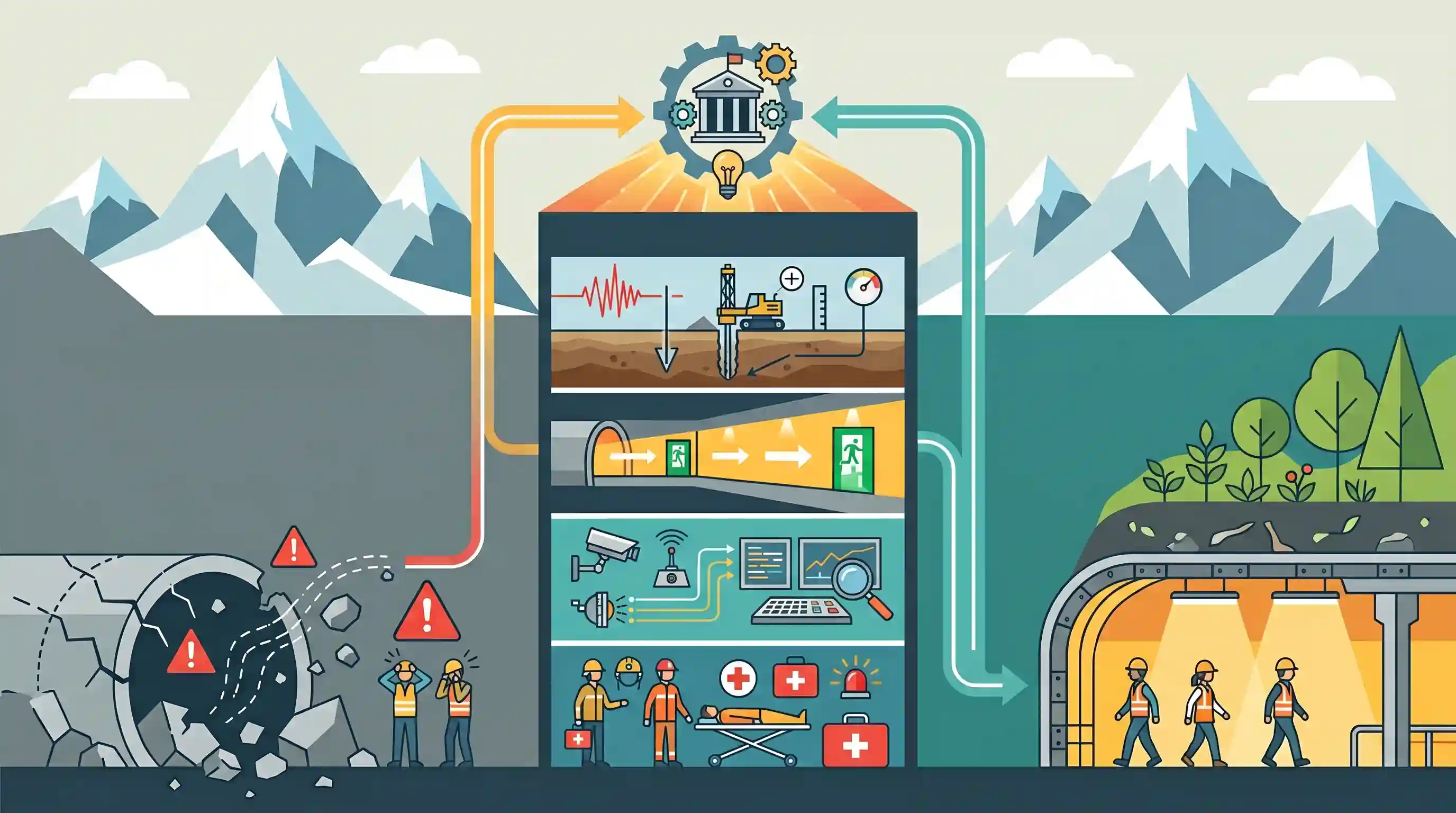
Why It Matters
The guidelines reflect institutional learning from a major infrastructural disaster. They highlight the necessity of integrating disaster mitigation, hazard zonation, and worker safety into India's developmental and strategic agenda, especially within vulnerable border and hilly terrains.
Summary
Following the Silkyara tunnel collapse in Uttarakhand, the Ministry of Road Transport and Highways has issued updated guidelines for tunnel construction. These guidelines aim to bolster safety and disaster resilience by mandating comprehensive geo-technical investigations, escape routes, continuous monitoring, and emergency response protocols, particularly for infrastructure projects in ecologically sensitive and geologically unpredictable zones like the Himalayas.
Key Points
- The Ministry of Road Transport and Highways (MoRTH) issued comprehensive guidelines for tunnel construction to prevent structural failures and occupational hazards like the Silkyara tunnel collapse.
- The SOPs emphasize thorough geo-technical hazard assessments and zonation mapping before initiating infrastructure projects in geologically fragile regions like the Himalayas.
- Mandatory safety features likely include continuous structural monitoring, dedicated escape or rescue shafts, and adequate emergency ventilation systems.
- The policy signifies a crucial transition toward proactive disaster preparedness, balancing aggressive regional infrastructure expansion with ecological sustainability and worker safety.
Important Terms
Standard Operating Procedure (SOP) for Tunnel Construction

MoRTH-mandated protocols for highway tunnels (especially >1.5 km) requiring evaluation of multiple alignments, risk registers, and mandatory escape passages to ensure safety in geologically sensitive zones.
UPSC context
GS Paper III (Disaster Management/Infrastructure). Focuses on institutional reforms and safety standards following major infrastructure failures.
Ministry of Road Transport and Highways (MoRTH)
The apex central ministry responsible for formulating and administering laws related to road transport, national highways, and developing safe, resilient tunneling infrastructure throughout India.
UPSC context
GS Paper II (Governance) and Paper III (Infrastructure). Tests knowledge of executive bodies managing critical national connectivity.
National Highways & Infrastructure Development Corporation Limited (NHIDCL)
A specialized MoRTH-owned company tasked with developing and managing national highways and strategic infrastructure in challenging terrains, including the Himalayas, North-East India, and border areas.
UPSC context
GS Paper III (Internal Security/Infrastructure). Key agency for strategic connectivity and disaster-resilient construction in fragile ecologies.
Geotechnical Investigation
The scientific study of subsurface soil and rock properties to assess geological risks, stability, and load-bearing capacity, essential for designing safe tunnel alignments in unpredictable terrains.
UPSC context
GS Paper I (Geography/Geophysical phenomena) and Paper III. Highlights technical due diligence required for large-scale engineering projects.
Geotechnical Baseline Report (GBR)
A mandatory project document establishing a contractual understanding of expected subsurface conditions and risks, ensuring accountability between owners and contractors for unforeseen geological challenges.
UPSC context
GS Paper III (Infrastructure). Important for understanding risk-sharing mechanisms and legal frameworks in public infrastructure contracts.
NP-4 Escape Pipe
A safety feature mandated by MoRTH requiring a 0.9-meter diameter steel pipe in high-risk tunnel zones to provide a dedicated emergency evacuation route for trapped workers.
UPSC context
GS Paper III (Disaster Management). Illustrates specific technological interventions for occupational safety and emergency preparedness.
Prelims Trap
"The new Standard Operating Procedures for Himalayan tunnel construction were formulated by the NDMA."
These specific proactive tunnel construction SOPs and structural guidelines were issued by the Ministry of Road Transport and Highways (MoRTH), not the NDMA.
Static Concepts Connected
Why are the Himalayas highly vulnerable to tunneling hazards?
- Tectonic Activity: They are young, seismically active fold mountains formed by the ongoing collision of the Indian and Eurasian tectonic plates.
- Fragile Lithology: The region contains highly jointed, fractured, and weak sedimentary and metamorphic rocks prone to shearing.
- Geotechnical Hazards: Tunnels face severe structural risks like squeezing ground, rock bursts, and sudden water ingress due to immense internal stress.
What is a Geotechnical Baseline Report (GBR) in infrastructure?
- Subsurface Profiling: It establishes a definitive baseline of the geological, geotechnical, and groundwater conditions expected during underground excavation.
- Risk Allocation: Acts as a critical contractual tool to transparently allocate unforeseen geological risks between the project owner and the executing contractor.
- DPR Integration: Under new MoRTH rules, a GBR is mandatory for the Detailed Project Report (DPR) to ensure robust predictive design modeling.
Cross-Topic Patterns
Himalayan Ecology vs. Strategic Infra
This highlights the tension between strategic border infrastructure (like the Char Dham project) and the ecological carrying capacity of the tectonically active Himalayan region.
Sendai Framework Integration
Mandating 0.9m escape pipes and structural risk registers maps directly to the Sendai Framework's Priority 3: Investing in disaster risk reduction for infrastructure resilience.

Expect a 2026 GS-3 question combining Himalayan geological vulnerabilities (rock bursts, squeezing ground) with MoRTH's new tunnel SOPs.
Linked PYQs · 5
Linked PYQs · 5
- 2019MainsGS3
Disaster preparedness is the first step in any disaster management process. Explain how hazard zonation mapping will help disaster mitigation in the case of landslides.
- 2021MainsGS3
Describe the various causes and the effects of landslides. Mention the important components of the National Landslide Risk Management Strategy.
- 2016MainsGS1
The Himalayas are highly prone to landslides. Discuss the causes and suggest suitable measures of mitigation.
- 2021MainsGS3
“Investment in infrastructure is essential for more rapid and inclusive economic growth.” Discuss in the light of India's experience.
- 2025MainsGS4
Keeping the national security in mind, examine the ethical dilemmas related to controversies over environmental clearance of development projects in ecologically sensitive border areas in the country.
