Security Protocol: RJD guards leaders residence after cover revision
Source:The Hindu ↗
Why It Matters
This event highlights state-level security classifications, the restructuring of Bihar's police force under the BSAP Act 2021, and the historical roles of key political executives such as the State's first female Chief Minister and the Leader of the Opposition.
Summary
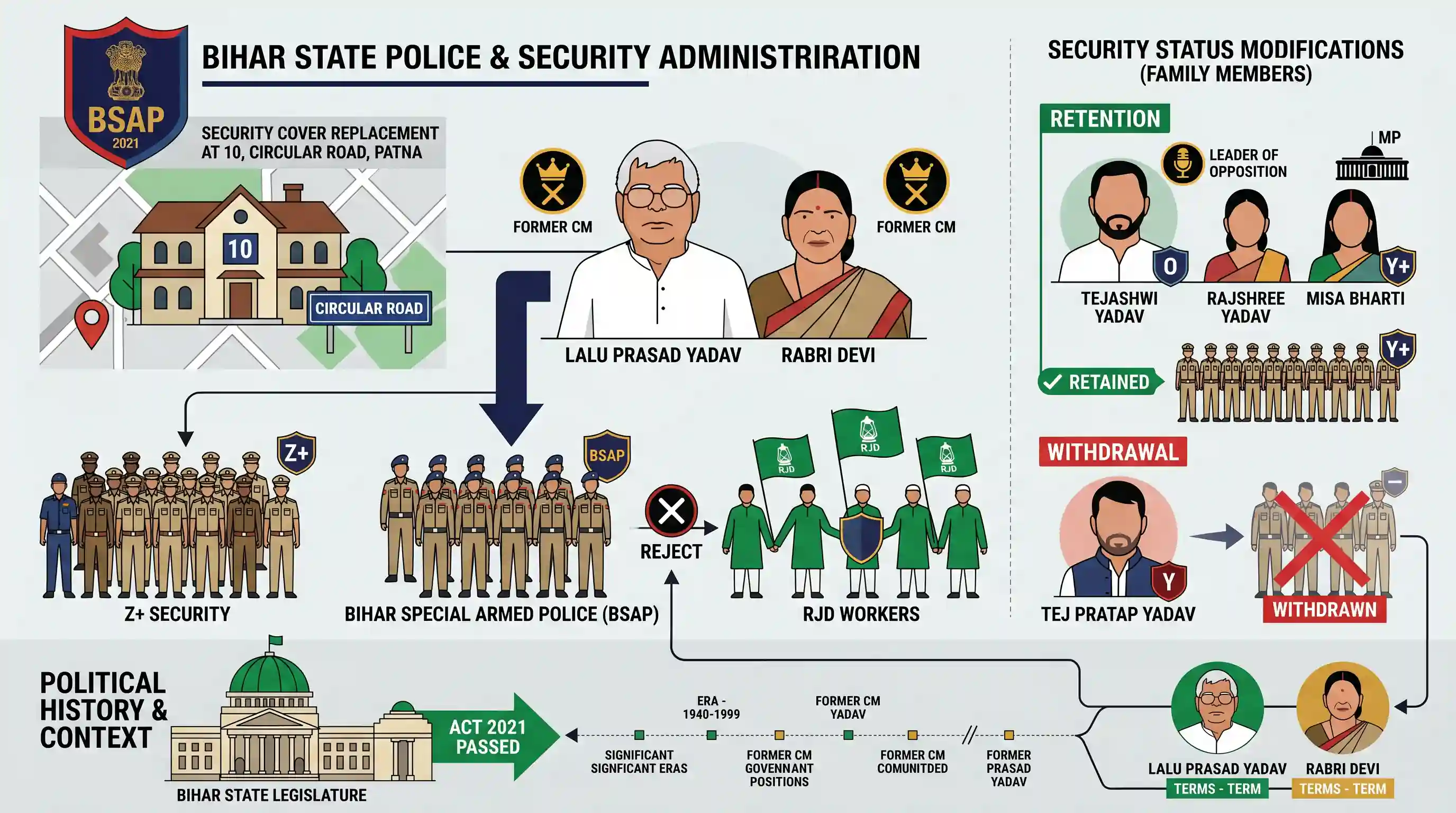
The Bihar government replaced the Z+ security cover of former Chief Ministers Lalu Prasad Yadav and Rabri Devi with Bihar Special Armed Police (BSAP) personnel, leading the RJD leadership to reject the modified cover. RJD party workers subsequently began guarding their official residence at 10, Circular Road, Patna. While the Y-category security of Tej Pratap Yadav was withdrawn, the Y+ cover for Leader of Opposition Tejashwi Yadav, Rajshree Yadav, and Patliputra MP Misa Bharti remains intact.
Key Points
- On June 4, 2026, the Bihar government withdrew the Z+ security cover of former Chief Ministers Lalu Prasad Yadav and Rabri Devi.
- The revised security protocol substituted Z+ protection with Bihar Special Armed Police (BSAP) personnel, including 2 to 8 house guards, 2 Patna District Police bodyguards, a pilot escort, and a bulletproof car.
- Deeming the change an insult, the RJD leadership rejected the newly modified security cover entirely, prompting party workers to assemble and guard their residence at 10, Circular Road, Patna with sticks.
- While the Y-category security for Tej Pratap Yadav (leader of Janshakti Janata Dal) was withdrawn, the Y+ security cover for Leader of Opposition Tejashwi Yadav, his wife Rajshree Yadav, and Patliputra MP Misa Bharti was retained.
- Rabri Devi holds historical importance as Bihar’s first female Chief Minister, serving multiple terms between 1997 and 2005.
- The BSAP, which replaced the Z+ cover, operates under the Bihar Special Armed Police Act, 2021, which renamed and restructured the erstwhile Bihar Military Police (BMP).
Important Terms
Bihar Special Armed Police (BSAP)

A specialized armed police force of Bihar, formerly known as Bihar Military Police, tasked with maintaining public order, combating extremism, and securing notified state installations.
UPSC context
GS Paper III: State armed police forces, internal security management, and police administration.
Bihar Special Armed Police Act, 2021
A state legislation that renamed the Bihar Military Police to BSAP and empowered its officers to search, seize, and make arrests without warrants inside notified establishments.
UPSC context
GS Paper II & III: Legislative executive balance, police reforms, and constitutional rights.
Rashtriya Janata Dal (RJD)
A prominent regional political party in Bihar, established in 1997, centered on a platform of social justice, secularism, and championing the rights of backward classes.
UPSC context
GS Paper II: Role of regional political parties, federalism, and political representation in India.
Janata Dal (United) (JD-U)
A major regional political party in Bihar, formed in 1999, advocating democratic socialism and regional development, frequently serving as a key player in coalition politics.
UPSC context
GS Paper II: Regional aspirations, federal structures, and coalition-era politics.
Bharatiya Janata Party (BJP)
A major national political party in India, advocating cultural nationalism, social conservatism, and market-oriented economic reforms, currently leading the central ruling coalition.
UPSC context
GS Paper II: Party systems, electoral dynamics, and the role of national parties in federalism.
Prelims Trap
The categorization and withdrawal of Z+ VIP security is exclusively administered and funded by the Union Ministry of Home Affairs.
State governments maintain independent authority to classify, downgrade, or upgrade security using state police personnel and local state intelligence inputs, distinct from the central MHA list.
Static Concepts Connected
What is the constitutional process for creating or abolishing a State Legislative Council under Article 169?
- Assembly Resolution: The State Legislative Assembly must pass a resolution supported by a special majority (majority of total membership and 2/3rd of members present and voting).
- Parliamentary Law: Parliament can then approve or reject the creation/abolition of the Council through an ordinary bill passed by a simple majority.
- No Article 368 Amendment: An Act of Parliament passed under Article 169 is not deemed to be an amendment of the Constitution under Article 368.
How are 'Police' and 'Public Order' constitutionally distributed under the Seventh Schedule?
- State List Jurisdiction: Both 'Public Order' (Entry 1) and 'Police' (Entry 2) are placed under List II (State List), giving state legislatures primary power to make laws.
- Union List Exception: The Union government retains control over Central Armed Police Forces (CAPFs) under Entry 2 of List I (Union List).
Cross-Topic Patterns
Special Police Acts vs. Civil Liberties
State legislative acts (like BSAP 2021) granting warrant-free arrest powers resemble colonial-era policing structures, raising core civil liberty and federalism issues frequently tested in GS-2.
State Bifurcation and Resource Asymmetry
The 2000 bifurcation of Bihar highlights how political separation shifts economic resource distribution, a recurring theme under GS-1 regional development and resource geography.

Article 169 legislative council dynamics and state vs. central jurisdiction over security classifications likely to feature in GS-2.
Linked PYQs · 2
Linked PYQs · 2
- 2020BPSC_PRELIMSGS1
Who was the first Chief Minister of Bihar?
- 2024-IBPSC_PRELIMSGS1
Which of the following Acts converted Unicameral Legislature of Bihar into Bicameral : Bihar Legislative Assembly and Bihar Legislative Council?
