RJD Opposes New Panchayat Tax Rules Over Burden on Rural Poor
Source:thestatesman ↗
Why It Matters
Understanding the financial empowerment of PRIs is crucial for BPSC Prelims, as it directly relates to the effective functioning of local self-government under the 73rd Constitutional Amendment and the fiscal powers delegated to them by the State Legislature.
Summary
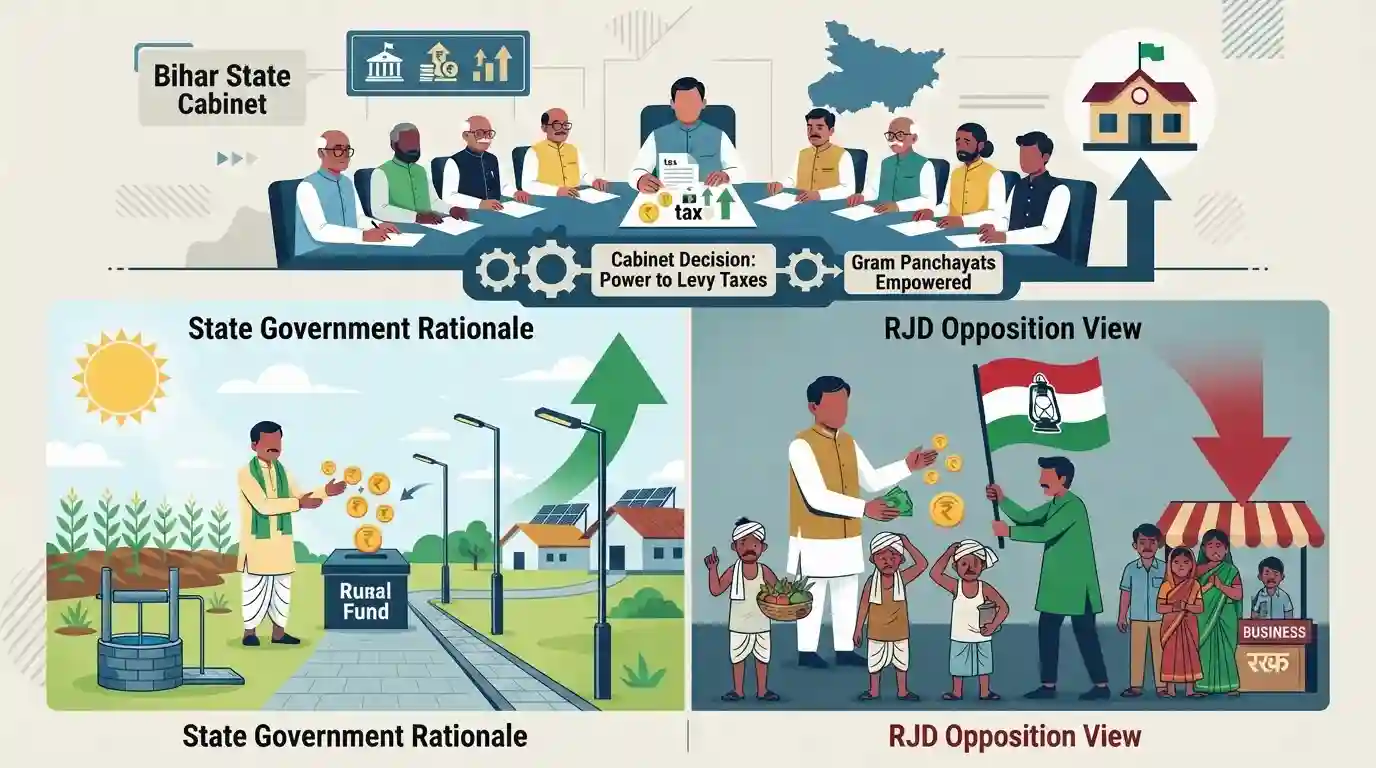
The Rashtriya Janata Dal (RJD) has strongly opposed the Bihar government's cabinet decision to empower Gram Panchayats to levy taxes and user charges. While the state government aims to strengthen the financial position of local bodies to fund rural development, the opposition argues the move will unfairly burden the rural poor and small business owners in a state lagging in economic indicators.
Key Points
- The Bihar Cabinet approved amendments enabling Gram Panchayats to levy taxes on rural houses, commercial setups, and collect user charges for civic services like water and sanitation.
- Additional Chief Secretary Arvind Choudhary noted that while Panchayats had the underlying legal authority, the new amendments clear the path for actual implementation of tax collection.
- RJD leader Sudhakar Singh criticized the decision, arguing it will worsen the financial difficulties of marginalized rural populations and roadside vendors in an already economically lagging state.
- The policy underscores the ongoing debate over fiscal decentralization and the practical challenges of financial empowerment for Panchayati Raj Institutions (PRIs) in Bihar.
Important Terms
Gram Panchayats

The foundational tier of India's Panchayati Raj system, functioning as the local self-government body at the village level. It is responsible for rural development, civic service delivery, and managing local revenue resources.
UPSC context
GS-2 (Local Self-Government). Tests knowledge of the 73rd Constitutional Amendment, democratic decentralization, and fiscal autonomy of local bodies.
State Cabinet
The supreme executive body of a state government, comprising senior ministers led by the Chief Minister. It holds the constitutional mandate to finalize administrative decisions, including policy framing and legislative proposals.
UPSC context
GS-2 (State Executive). Relevant for understanding the role of the Council of Ministers in state governance and policy implementation.
Rashtriya Janata Dal (RJD)
A major state-level political party in Bihar, historically recognized for championing social justice and mobilizing backward classes. It serves as a key political force and opposition actor in the state's legislative framework.
UPSC context
GS-2 (Political Parties). Evaluates comprehension of regional parties, electoral dynamics, and their influence on state-level policy formulation.
Kisan Cell
The specialized agricultural or farmers' wing of a political party. It focuses on mobilizing agrarian vote banks, advocating for farmers' rights, and shaping party policies regarding rural economic issues and agrarian welfare.
UPSC context
GS-2 (Political Parties). Tests knowledge of intra-party organizations, agrarian mobilization, and how political outfits articulate rural development issues.
Prelims Trap
"The Constitution of India directly empowers Gram Panchayats to levy and collect taxes."
Article 243H is not self-executing. The Constitution does not directly give Panchayats the power to tax; it leaves it entirely to the discretion of the State Legislature.
Static Concepts Connected
What are the constitutional provisions for the financial empowerment of Panchayats?
- Article 243H: Authorizes the State Legislature to empower Panchayats to levy, collect, and appropriate taxes, duties, tolls, and fees.
- Article 243-I: Mandates the Governor to constitute a State Finance Commission every 5 years to review PRI finances and recommend resource allocation.
- Grants-in-aid: Empowers the State Legislature to make provisions for grants-in-aid to Panchayats from the State's Consolidated Fund.
Why is 'Own Source Revenue' (OSR) generation historically poor in Indian PRIs?
- Political reluctance: Geographical proximity to voters makes Panchayat leaders highly reluctant to levy taxes for fear of immediate electoral backlash.
- Narrow tax base: Rural areas generally lack commercial establishments, high-value real estate, or organized markets to generate substantial tax yields.
- Capacity constraints: PRIs suffer from severe shortages of dedicated administrative staff for scientific tax assessment, billing, and enforcement.
Cross-Topic Patterns
Fiscal Decentralization vs Rural Poverty
The tension between generating Own Source Revenue (OSR) for PRIs and burdening marginalized populations connects GS2 decentralization directly with GS3 inclusive growth and poverty alleviation debates.
State vs Central Finance Commissions
Local tax autonomy links with the 15th and 16th Finance Commission mandates, which increasingly condition local body grants on states empowering PRIs to collect property taxes.

PRI taxation power (Art 243H) being statutory via State Legislature, not directly Constitutional, is a high-probability 2026 Prelims trap.
Linked PYQs · 3
Linked PYQs · 3
- 2025BPSC_PRELIMSGS1
Who is empowered to review the financial position of the Panchayats?
- 2025BPSC_PRELIMSGS1
What is the main purpose of Panchayati Raj?
- 2024-EBPSC_PRELIMSGS1
Under Article “243J” which of the following can make provisions to the maintenance of accounts by Panchayats?
