RJD Dissolves Bihar Units Following Bankipur By Election Defeat
Source:social-news-xyz ↗
Why It Matters
Provides insight into shifting political dynamics in Bihar, the emergence of new regional players (Jan Suraaj), and internal party restructuring following electoral setbacks. Relevant for polity questions on state parties and election rules (e.g., forfeiting deposits).
Summary
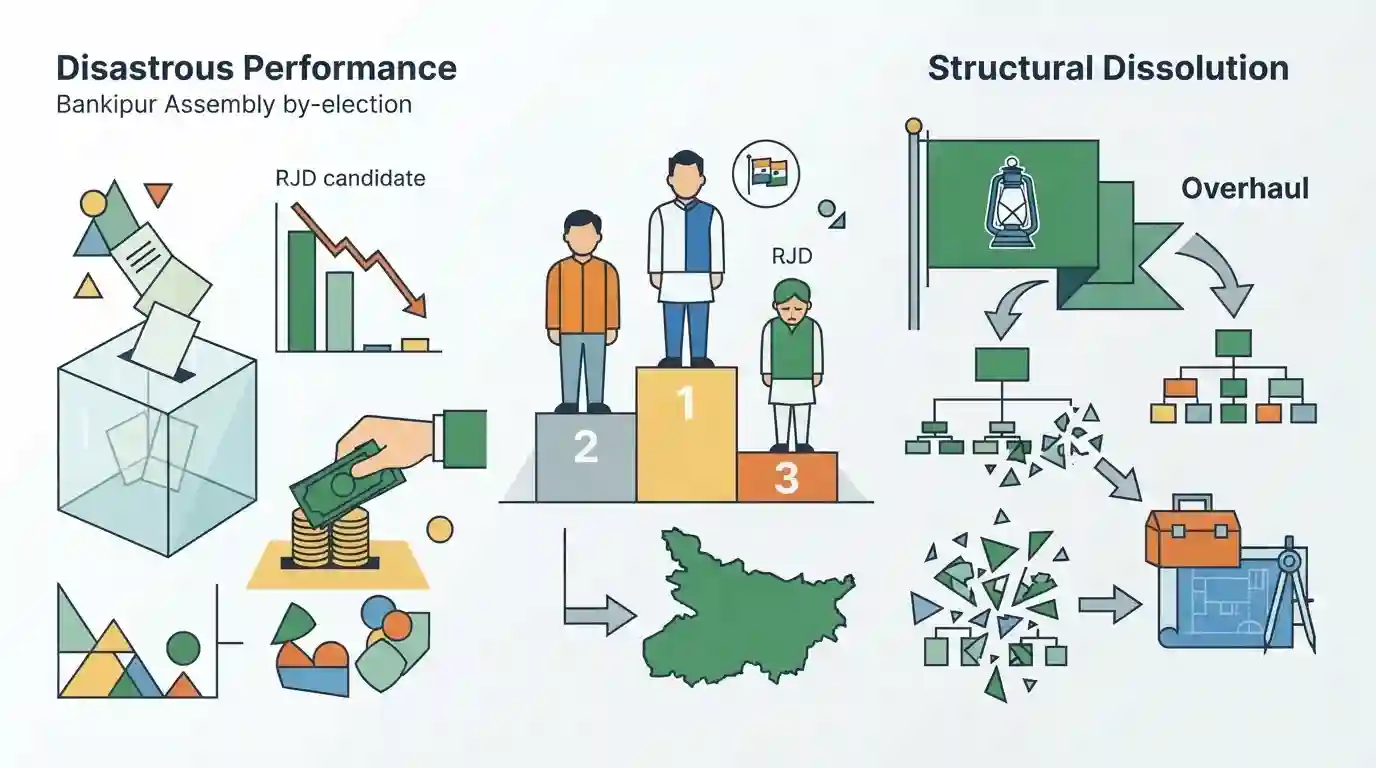
Following a disastrous performance in the Bankipur Assembly by-election where its candidate lost her security deposit, the Rashtriya Janata Dal (RJD) has dissolved all its organisational units in Bihar. The by-election was notably won by Prashant Kishor's newly launched Jan Suraaj party, which defeated the BJP. The structural dissolution signals RJD's intent to overhaul its party machinery in response to emerging regional political dynamics in the state.
Key Points
- RJD dissolved all its organisational units in Bihar following a humiliating defeat in the Bankipur Assembly by-election.
- Jan Suraaj, a new political outfit founded by Prashant Kishor, won the Bankipur seat by defeating the BJP candidate.
- The RJD candidate performed poorly, securing only the third position and forfeiting her security deposit.
- The decision to dissolve the party units aims to restructure and revitalize the RJD organisation ahead of future electoral battles in Bihar.
Important Terms
Rashtriya Janata Dal (RJD)

A state-recognized political party in Bihar, founded in 1997 by Lalu Prasad Yadav after breaking away from the Janata Dal, historically championing lower castes and minority interests.
UPSC context
GS Paper 2 (State Politics). Relevant to studying regional political parties, coalition dynamics, and caste-based political mobilization in India.
Jan Suraaj
A political party launched in October 2024 by former strategist Prashant Kishor. Rooted in a grassroots movement, it campaigns on a platform of governance, education, and development over traditional caste equations.
UPSC context
GS Paper 2 (Political Parties). Important for understanding the emergence of new regional parties, electoral strategy shifts, and youth voting behavior.
Forfeiture of Security Deposit
The confiscation of a candidate's mandatory election deposit (under the Representation of the People Act, 1951) if they fail to secure at least one-sixth of the total valid votes polled.
UPSC context
GS Paper 2 (RPA 1951). Tests knowledge of statutory mechanisms designed to deter non-serious candidates and streamline the electoral process.
Bharatiya Janata Party (BJP)
A major national political party in India, currently the dominant force in national politics. Its platform typically centers on cultural nationalism, economic development, and conservative socio-political policies.
UPSC context
GS Paper 2 (Political Parties). Central to questions about India's shift toward a dominant-party system, federal relations, and national versus regional dynamics.
Prelims Trap
A candidate forfeits their deposit if they fail to secure 1/6th of the total votes polled.
The statutory requirement under Section 158 of the RPA 1951 strictly specifies one-sixth of the total 'valid' votes polled, excluding rejected or invalid votes.
Static Concepts Connected
What are the security deposit forfeiture rules under RPA 1951?
- Assembly elections: ₹10,000 for General category and ₹5,000 for SC/ST candidates.
- Lok Sabha elections: ₹25,000 for General category and ₹12,500 for SC/ST candidates.
- Forfeiture threshold: The deposit is forfeited to the government if a candidate fails to secure more than 1/6th of the total valid votes polled.
How is an MLA disqualified on grounds other than defection?
- Governor's role: Under Article 192, questions regarding disqualification (such as holding an office of profit) are referred to the Governor.
- Binding ECI opinion: The Governor must obtain the opinion of the Election Commission of India (ECI) and is bound to act according to it.
Cross-Topic Patterns
Electoral churn & RPA 1951
High-profile security deposit forfeitures routinely prompt UPSC to test specific numeric thresholds under the Representation of the People Act, 1951, alongside ECI's powers.
Emergence of new State Parties
The registration of new political outfits connects directly to Section 29A of the RPA 1951 and the ECI's subsequent criteria for granting recognized State or National party status.

RPA 1951 numeric thresholds (deposit forfeiture at 1/6th valid votes vs assembly quorum at 1/10th) are highly probable trap statements.
Linked PYQs · 2
Linked PYQs · 2
- 2023BPSC_PRELIMSGS1
Match the following political parties listed in List-I with their years of establishment in List-II: List-I (Political Parties) List-II (Years of Establishment) a. Communist Party of India (Marxist) 1. 1964 b. Communist Party of India 2. 1998 c. Bahujan Samaj Party 3. 1925 d. All India Trinamool Congress (AITC) 4. 1984
- 2019BPSC_PRELIMSGS1
Aam Admi party is a
