Supreme Court Mandates Sand Replenishment Study for Riverbed Mining
Source:Indian Express ↗
Why It Matters
Sand mining is a recurring theme in UPSC exams due to its severe ecological consequences and the massive illegal economy surrounding it. This Supreme Court ruling is a crucial update for answers on environmental jurisprudence, groundwater conservation, and the regulation of minor minerals.
Summary
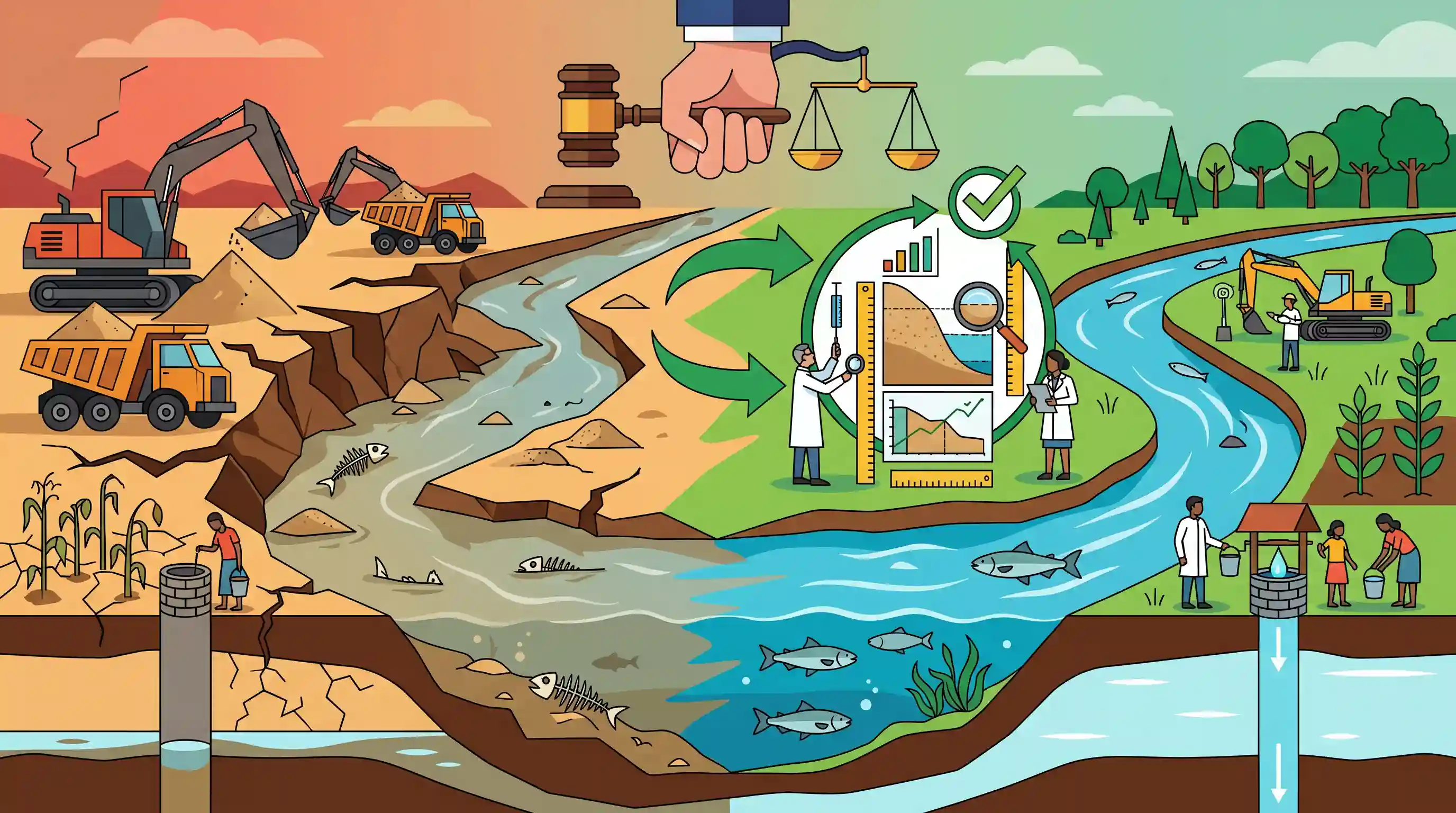
The Supreme Court of India has mandated that no riverbed mining (sand mining) operations can receive environmental clearance without a prior 'sand replenishment study'. This critical judicial intervention aims to halt the widespread ecological damage caused by unchecked sand extraction, which leads to the deepening of riverbeds, severe groundwater depletion, increased pollution risks, and habitat destruction. By strictly enforcing the Ministry of Environment, Forest and Climate Change's (MoEFCC) guidelines from 2016 and 2020, the Court has tightened the regulatory framework for minor minerals, reinforcing the principle that natural resource exploitation must be scientifically sustainable.
Key Points
- The Supreme Court ruled that no environmental clearance for riverbed mining can be granted without a comprehensive sand replenishment study.
- The directive aims to combat the ecological devastation caused by rampant sand extraction, including river channel deepening, groundwater depletion, and loss of natural water filtration.
- The ruling reinforces the mandatory nature of the MoEFCC's Sustainable Sand Mining Management Guidelines 2016 and the 2020 Enforcement & Monitoring Guidelines.
- The judgment represents a significant application of environmental jurisprudence, emphasizing that the extraction of minor minerals must be scientifically balanced with ecological sustainability.
Important Terms
Sustainable Sand Mining Management Guidelines 2016

MoEFCC guidelines promoting scientific mining via mandatory District Survey Reports (DSR) to maintain river equilibrium, protect biodiversity, and prevent groundwater depletion.
UPSC context
GS Paper 3 (Environment/Resource Management). Tests regulatory frameworks for minor minerals and sustainable extraction.
Enforcement & Monitoring Guidelines for Sand Mining 2020
Supplemental MoEFCC rules focused on curbing illegal extraction using IT-enabled surveillance (drones) and requiring replenishment studies for scientific resource management.
UPSC context
GS Paper 2 (Governance). Relevant for executive policies and technological interventions in environmental oversight.
Sand Replenishment Study
A scientific assessment measuring the natural rate at which riverbeds replace extracted sand, used to determine sustainable mining limits and extraction depths.
UPSC context
GS Paper 3 (Conservation). Central to questions on sustainable development and judicial environmental mandates.
District Survey Report (DSR)
A mandatory prerequisite for mining clearances that identifies mineral deposition areas and quantifies available resources through scientific survey and replenishment data.
UPSC context
GS Paper 3 (EIA). Key for understanding procedural compliance in the Environmental Impact Assessment process.
Environment Protection Act 1986
An "umbrella" legislation enacted after the Bhopal tragedy, empowering the Centre to coordinate environmental protection and set nationwide pollution standards.
UPSC context
GS Paper 3 (Environment). Fundamental law for environmental regulations and landmark judicial interpretations in India.
MoEFCC
India's nodal ministry for planning, promoting, and overseeing the implementation of environmental and forestry policies and climate change programs.
UPSC context
GS Paper 2 (Institutions). Tests knowledge of administrative structures governing India's ecological and conservation efforts.
Prelims Trap
"The Central Government has exclusive authority to frame rules for sand mining and grant leases."
Sand is classified as a "minor mineral" under the MMDR Act, 1957. State Governments have the exclusive power to frame rules for its extraction and leasing.
Static Concepts Connected
How is the regulation of minor minerals governed under the MMDR Act, 1957?
- State Government Control: State Governments hold the exclusive power to frame rules regarding the grant of quarry leases, mining leases, and preventing illegal mining for minor minerals.
- Central Notification: The Central Government retains the sole power to officially notify and declare specific minerals as "minor minerals" (e.g., sand, building stones, ordinary clay).
What are the critical ecological functions of riverbed sand?
- Groundwater Recharge: Sand acts as a massive natural sponge, slowing river flow and facilitating the percolation of surface water to recharge local underground aquifers.
- Natural Filtration: The sand bed naturally filters impurities, sediments, and pollutants, playing a vital role in maintaining the baseline water quality and clarity of the river.
- Biodiversity Habitat: It provides indispensable spawning grounds, nesting sites, and habitats for benthic organisms, turtles, gharials, and various freshwater fish species.
Cross-Topic Patterns
Federalism in environmental regulation
While States manage minor mineral leases, the SC enforcement of Central MoEFCC clearance guidelines demonstrates the overarching application of the Environment Protection Act over State-managed resources.
Infrastructure demand vs groundwater crisis
The explosive infrastructure demand for construction sand directly drives illegal riverbed mining, forming a critical nexus between rapid urbanization (GS1) and severe rural groundwater depletion (GS3).

Expect a 2026 Prelims question mixing MMDR Act minor mineral classifications (State power) with SC's mandate for environmental clearance.
Linked PYQs · 5
Linked PYQs · 5
- 2018PrelimsGS1
Which of the following is/are the possible consequence/s of heavy sand mining in riverbeds? 1. Decreased salinity in the river 2. Pollution of groundwater 3. Lowering of the water-table Select the correct answer using the code given below:
- 2019MainsGS3
Coastal sand mining, whether legal or illegal, poses one of the biggest threats to our environment. Analyze the impact of sand mining along the Indian coasts, citing specific examples.
- 2022MainsGS2
“The most significant achievement of modern law in India is the constitutionalization of environmental problems by the Supreme Court.” Discuss this statement with the help of relevant case laws.
- 2025MainsGS3
Examine the factors responsible for depleting groundwater in India. What are the steps taken by the government to mitigate such depletion of groundwater?
- 2025MainsGS3
Mineral resources are fundamental to the country's economy and these are exploited by mining. Why is mining considered an environmental hazard? Explain the remedial measures required to reduce the environmental hazard due to mining.
