Industrial Effluents and Sewage Severely Pollute Erode Rivers
Source:The Hindu ↗
Why It Matters
It serves as a stark case study on the intersection of industrial development, environmental degradation, and public health. This exemplifies the real-world consequences of poor solid waste management and untreated industrial effluents, themes frequently tested in GS-3 Environment and GS-2 Governance/Public Health.
Summary
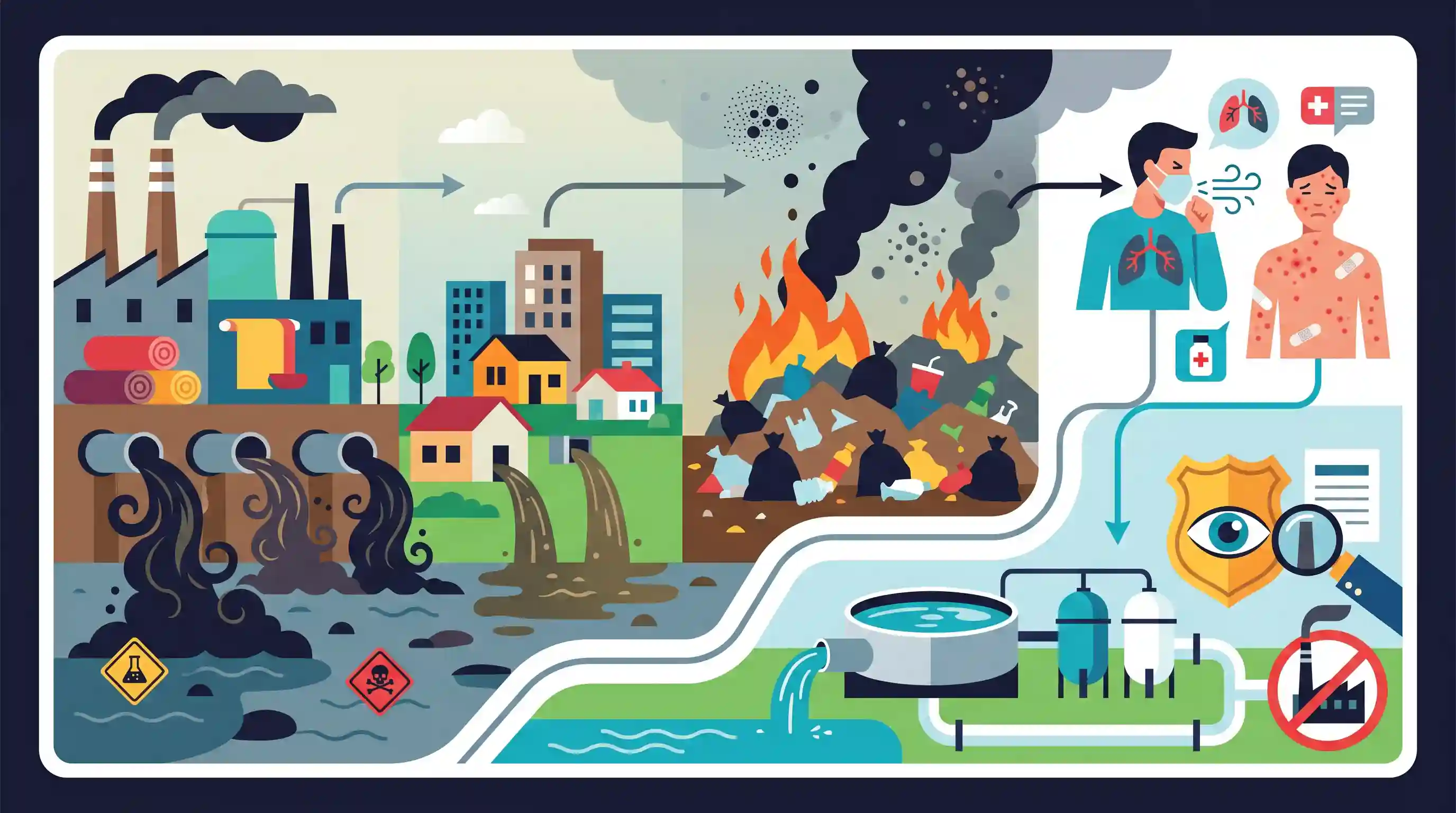
The Erode district in Tamil Nadu is grappling with severe environmental pollution as untreated industrial effluents, primarily from textile units, and domestic sewage are continually discharged into critical water bodies like the Cauvery and Bhavani rivers. Additionally, improper solid waste management has led to the open dumping and burning of garbage, worsening air quality. This toxic combination of water and air pollution has been linked to a rise in serious health issues among local residents, including a high incidence of cancer and various respiratory and skin ailments. There is a pressing need for stricter enforcement by pollution control boards and the expedited establishment of sewage treatment facilities.
Key Points
- Water bodies in Erode district, including the Cauvery and Bhavani rivers, are severely polluted by untreated effluents from textile processing units and domestic sewage.
- The dumping and burning of plastic and household waste along canals and open spaces are exacerbating air and water pollution in the region.
- There has been a notable rise in health issues among residents, including cancer, skin ailments, respiratory problems, and gastrointestinal infections, attributed to this environmental degradation.
- Despite proposals for sewage treatment plants, lack of execution and inadequate enforcement by the TNPCB and municipal authorities continue to allow illegal dumping and effluent discharge.
Important Terms
Tamil Nadu Pollution Control Board (TNPCB)

A statutory body established under the Water Act, 1974, responsible for enforcing environmental laws, monitoring pollution levels, and granting operational consents to industries in Tamil Nadu.
UPSC context
GS Paper II/III: Statutory bodies and environmental governance. Tests institutional frameworks for pollution control and enforcement.
Erode City Municipal Corporation (ECMC)
The urban local body governing Erode, responsible for civic amenities including solid waste management and domestic sewage treatment to prevent contamination of local water bodies like the Cauvery.
UPSC context
GS Paper II: Urban Local Bodies (74th Amendment). Tests municipal roles in environmental sanitation and public health.
Cauvery and Bhavani Rivers
Major perennial rivers in Tamil Nadu; the Bhavani is a significant tributary of the Cauvery, both serving as primary drinking and irrigation sources for the Erode region.
UPSC context
GS Paper I: Indian Geography. Tests knowledge of river systems, tributaries, and environmental challenges like industrial pollution.
Common Effluent Treatment Plant (CETP)
Collective treatment facilities designed for clusters of small/medium industries to treat combined wastewater before discharge, crucial for textile hubs like Erode to mitigate toxic industrial effluents.
UPSC context
GS Paper III: Environment and Infrastructure. Tests understanding of industrial pollution mitigation and sustainable MSME cluster development.
Water (Prevention and Control of Pollution) Act, 1974
India's primary legislation for preventing and controlling water pollution, establishing the Central and State Pollution Control Boards and regulating the discharge of industrial and domestic effluents.
UPSC context
GS Paper III: Environmental Legislation. Tests knowledge of the legal framework for water protection and regulatory powers.
Prelims Trap
Zero Liquid Discharge (ZLD) norms allow treated industrial effluents to be discharged into rivers if they meet CPCB standards.
ZLD mandates absolute zero discharge of liquid effluent into the environment. All wastewater must be treated, purified, and entirely reused within the facility itself.
Static Concepts Connected
What are the major tributaries and flow characteristics of the Cauvery River?
- Left Bank: Major left bank tributaries joining the Cauvery include the Harangi, Hemavati, Shimsha, and Arkavathy.
- Right Bank: Major right bank tributaries include the Lakshmantirtha, Kabini, Suvarnavathi, Bhavani, Noyyal, and Amaravati.
- Bhavani River: It is a major right bank tributary originating in the Nilgiris (Western Ghats) that flows east and confluences with the Cauvery at Kooduthurai in Erode.
How do BOD and COD differ in assessing water pollution levels?
- Biochemical Oxygen Demand: Measures the amount of dissolved oxygen consumed by aerobic microorganisms to decompose biodegradable organic matter in a water sample over a specific time.
- Chemical Oxygen Demand: Measures the total amount of oxygen required to chemically oxidize both organic and inorganic compounds in water.
- Key Difference: COD values are always higher than BOD values because COD accounts for the oxidation of all chemically reactive pollutants, not just the biologically degradable ones.
Cross-Topic Patterns
Textile Clusters & Water Stress
South India's textile hubs (Erode, Tiruppur) are concentrated in water-stressed basins. Enforcing Zero Liquid Discharge often challenges the economic viability of MSME clusters, bridging economic geography and ecology.
Open Burning & Stockholm Convention
Open burning of plastics releases unintentionally produced POPs (dioxins, furans). This links municipal solid waste mismanagement to India's commitments under the Stockholm Convention on POPs.

Expect a multi-statement question mapping Peninsular rivers (Bhavani, Noyyal) to their primary industrial pollution sources (textile dyes).
Linked PYQs · 2
Linked PYQs · 2
- 2024MainsGS3
Industrial pollution of river water is a significant environmental issue in India. Discuss the various mitigation measures to deal with this problem and also the government's initiatives in this regard.
- 2018MainsGS3
What are the impediments in disposing the huge quantities of discarded solid wastes which are continuously being generated? How do we remove safely the toxic wastes that have been accumulating in our habitable environment?
