RIVER develops Rabi Track app to boost grassroots rabies surveillance
Source:The Hindu ↗
Why It Matters
The 'Rabi-Track' app serves as an excellent case study for GS-2 (Issues relating to Health, e-Governance applications) and GS-3 (Science & Tech in daily life). It demonstrates how digital tools and the 'One Health' approach can be operationalized at the state level to tackle zoonotic diseases and achieve targets like the elimination of rabies by 2030.
Summary
The Rajiv Gandhi Institute of Veterinary Education and Research (RIVER) in Puducherry has launched a mobile application, 'Rabi-Track RIVER App', to enhance rabies surveillance and reporting. Supported by the National Rabies Control Programme and built in collaboration with local technology incubators, the app uses real-time tracking to maintain data on animal bites and suspected rabies incidents. Officials highlighted the importance of a 'One Health' approach, which integrates both animal and human health strategies, to meet the national goal of eliminating rabies by 2030. This showcases the role of localized digital health solutions in strengthening grassroots public health surveillance against zoonotic diseases.
Key Points
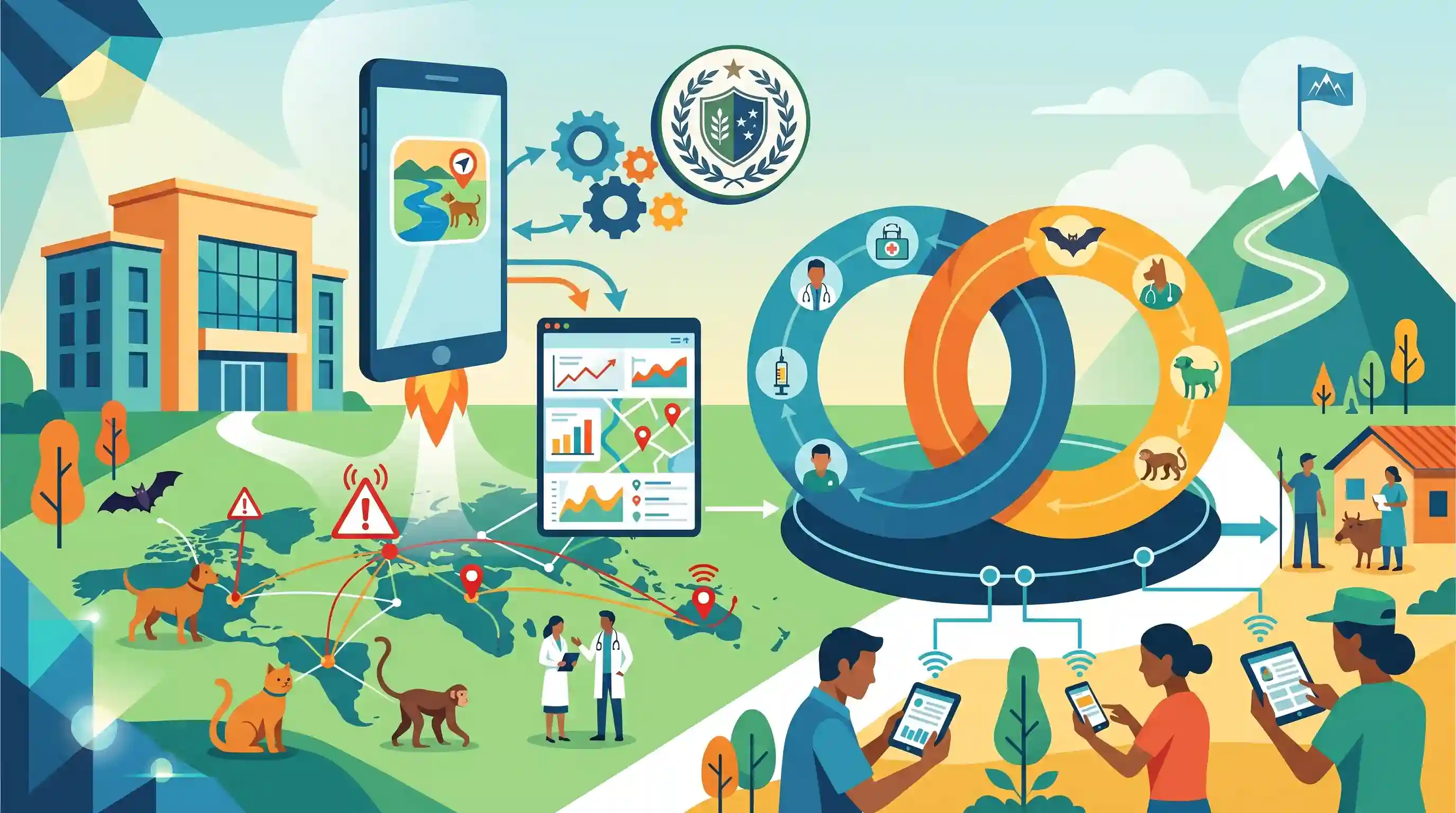
- The Rajiv Gandhi Institute of Veterinary Education and Research (RIVER) launched the 'Rabi-Track RIVER App' for real-time tracking, surveillance, and reporting of rabies cases.
- The initiative is grounded in the 'One Health' approach, seeking to integrate veterinary and human health responses to achieve the goal of eliminating rabies by 2030.
- The app was developed in collaboration with the Atal Incubation Centre at Puducherry Technological University and is supported by funding from the National Rabies Control Programme and Puducherry State Health Mission.
- This technological intervention aids in maintaining precise data on animal bites, suspected rabies cases, and post-exposure prophylaxis, strengthening the overall grassroots public health infrastructure against zoonotic diseases.
Important Terms
One Health Approach

A collaborative, multi-sectoral approach that recognizes the interconnection between human health, animal health, and their shared environment to achieve optimal health outcomes.
UPSC context
GS-II (Public Health) and GS-III (Science & Tech); essential for managing zoonotic diseases and antimicrobial resistance.
National Rabies Control Programme (NRCP)
A central government initiative launched to reduce human rabies deaths and control rabies in dogs through vaccination, surveillance, and awareness campaigns.
UPSC context
GS-II (Government Schemes/Health); relevant for national disease elimination targets like the "Zero by 30" goal.
Atal Incubation Centre (AIC)
An initiative under NITI Aayog’s Atal Innovation Mission (AIM) designed to foster innovation and entrepreneurship by providing startups with infrastructure, mentorship, and funding support.
UPSC context
GS-III (Economy/Innovation); tests knowledge of India's innovation ecosystem and NITI Aayog’s flagship missions.
Zoonotic Diseases
Diseases or infections that are naturally transmissible from vertebrate animals to humans, such as rabies, Nipah virus, and COVID-19.
UPSC context
GS-III (Science & Technology/Bio-diversity); tests understanding of epidemiological threats and their impact on public health.
Public Health Surveillance
The continuous, systematic collection and analysis of health-related data to facilitate early detection, prevention, and control of disease outbreaks at the grassroots level.
UPSC context
GS-II (Governance/Social Justice); critical for evaluating the efficiency of e-governance and digital health solutions.
Rajiv Gandhi Institute of Veterinary Education and Research (RIVER)
A Puducherry-based veterinary college that acts as a regional hub for veterinary education, research, and implementing public health initiatives like rabies tracking.
UPSC context
GS-II/GS-III; serves as a case study for localized institutional contributions to national health missions.
Prelims Trap
Rabies can be cured with vaccines and immunoglobulins even after clinical symptoms have started to appear.
Rabies is virtually 100% fatal once clinical symptoms manifest. Post-exposure prophylaxis (vaccines and immunoglobulins) is strictly preventive and must be administered before the onset of symptoms.
Static Concepts Connected
What is the 'One Health' approach in public health?
- Interconnected health: Acknowledges that human health is inextricably linked to the health of animals, plants, and our shared environmental ecosystem.
- Target areas: Crucial for combating zoonotic spillover diseases (Rabies, Nipah, COVID-19), tracking antimicrobial resistance (AMR), and ensuring environmental and food safety.
- Global champions: Globally championed by the Quadripartite: the WHO, FAO, World Organisation for Animal Health (WOAH), and the UN Environment Programme (UNEP).
Why is Rabies classified as a Neglected Tropical Disease (NTD)?
- Poverty link: It disproportionately affects marginalized, impoverished populations in tropical and subtropical regions who lack access to prompt medical care and sanitation.
- Preventable fatality: Despite being 100% vaccine-preventable, it causes massive mortality (India accounts for ~1/3 of global deaths), showing severe neglect in research and health investments.
Cross-Topic Patterns
One Health framework beyond Zoonoses
The One Health approach is not just for zoonotic viruses; it is the fundamental strategy for the National Action Plan on Antimicrobial Resistance (AMR), linking veterinary antibiotic use to human health.
Digital disease surveillance (IHIP)
Localized apps like Rabi-Track reflect the push for grassroots e-governance in health, acting as feeder data for broader architectures like the Integrated Health Information Platform (IHIP) to map outbreak hotspots.

Expect a 2026 multi-statement Prelims question linking 'One Health', Neglected Tropical Diseases (NTDs), and the 2030 elimination targets.
Linked PYQs · 2
Linked PYQs · 2
- 2024MainsGS2
In a crucial domain like the public healthcare system the Indian State should play a vital role to contain the adverse impact of marketisation of the system. Suggest some measures through which the State can enhance the reach of public healthcare at the grassroots level.
- 2023MainsGS3
Introduce the concept of Artificial Intelligence (AI). How does Al help clinical diagnosis? Do you perceive any threat to privacy of the individual in the use of Al in healthcare?
