Delhi Approves Eight Foot Over Bridges at Accident Sites
Source:Indian Express ↗
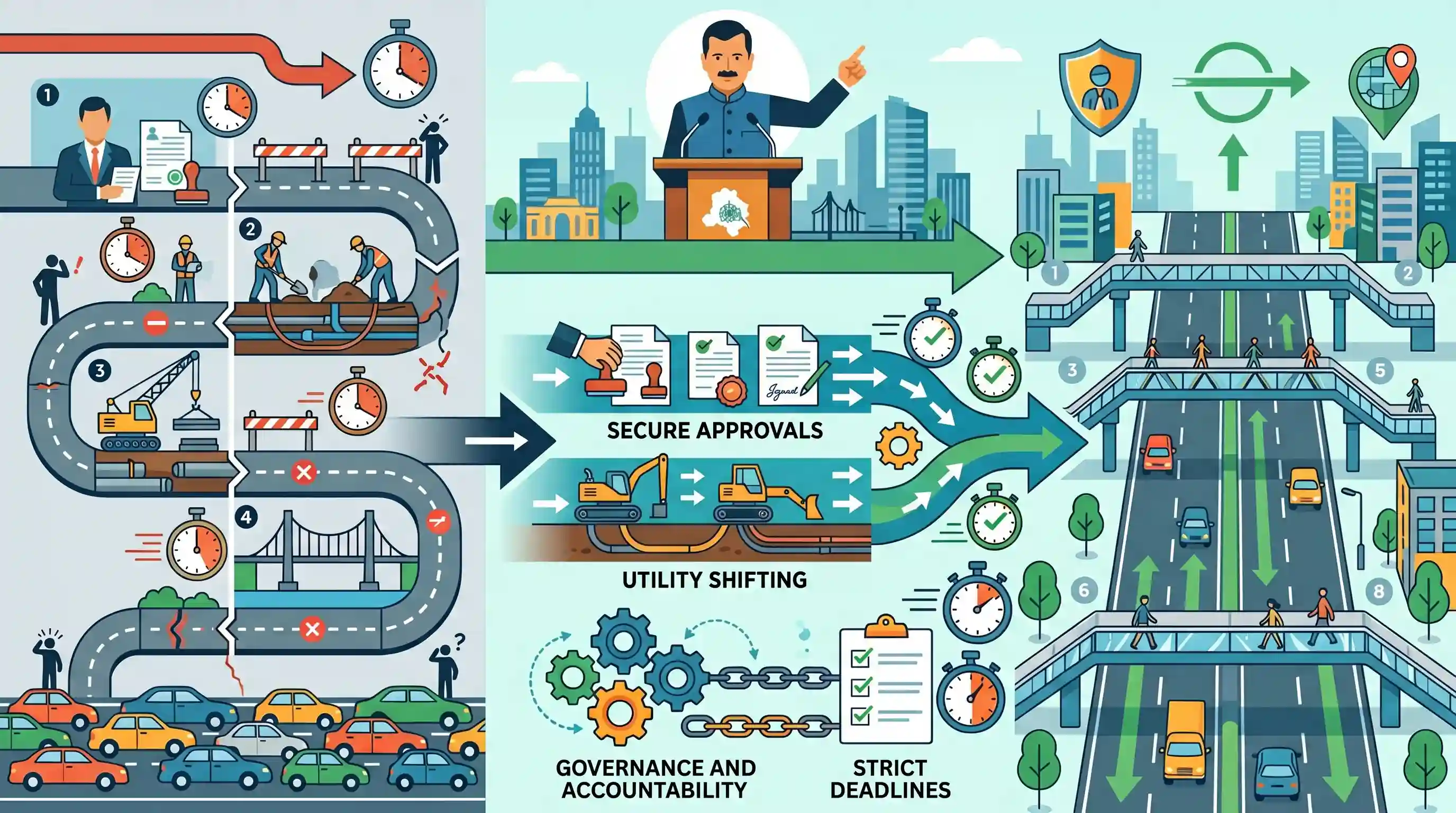
Why It Matters
This development serves as a practical example of addressing urban transportation bottlenecks and pedestrian safety. It is highly relevant for GS-3 (Infrastructure) and GS-2 (Governance), demonstrating how simultaneous processing and strict deadlines can tackle chronic delays in public infrastructure projects.
Summary
The Delhi government has sanctioned the construction of eight Foot Over Bridges (FOBs) at accident-prone locations across the city to enhance pedestrian safety and ease traffic congestion. The initiative marks a significant administrative shift as the PWD Minister emphasized ending the 'slow infrastructure' culture. By mandating parallel execution of prerequisite tasks such as utility shifting and securing approvals, the government aims to enforce strict deadlines and greater accountability in public project implementation.
Key Points
- The Delhi Public Works Department (PWD) has approved the construction of eight new Foot Over Bridges (FOBs) across critical accident-prone intersections to prioritize pedestrian safety.
- The initiative aims to facilitate smoother traffic flow on major arterial roads while providing secure crossing mechanisms for pedestrians.
- The administration is actively trying to eliminate the 'slow infrastructure' culture by setting strict, non-negotiable deadlines for project completion.
- To prevent typical public work delays, officials are instructed to work simultaneously on site readiness, utility shifting, and obtaining necessary No Objection Certificates (NOCs).
Important Terms
Public Works Department (PWD)

The premier government agency responsible for planning, designing, and maintaining public assets like roads, bridges, and buildings. It manages the "built environment" and physical infrastructure to ensure safety and accessibility.
UPSC context
GS Paper 2 (Governance) and GS 3 (Infrastructure); tests understanding of executive agencies in project implementation.
Road Safety
Measures taken to reduce traffic fatalities and injuries through engineering, enforcement, and education. It is increasingly viewed as a component of the "Right to Life" under Article 21.
UPSC context
GS Paper 3 (Infrastructure); critical for addressing India's high accident burden and socio-economic costs.
Urban Infrastructure
Physical systems—roads, transit, and utilities—essential for city functioning. In UPSC, the focus is on sustainable, people-centric planning to manage rapid urbanization and protect vulnerable users.
UPSC context
GS Paper 3 (Economic Development/Infrastructure); tests analysis of urban planning challenges and modernization strategies.
Accountability
The ethical and legal obligation of public officials to be answerable for their actions. It ensures transparency, prevents corruption, and promotes efficient resource use in public project implementation.
UPSC context
GS Paper 4 (Ethics) and GS 2 (Governance); core value for efficient service delivery and administrative reform.
Black Spots
Specific road stretches where accidents are frequently concentrated due to poor design or traffic density. Rectifying these sites is a priority for reducing India's high road fatality rates.
UPSC context
GS Paper 3 (Infrastructure); relevant for policy and engineering interventions in accident mitigation and safety audits.
Foot Over Bridge (FOB)
A dedicated pedestrian walkway built over busy thoroughfares to provide safe crossing. They are essential for segregating high-speed vehicular traffic from pedestrians, thereby reducing accidents at urban sites.
UPSC context
GS Paper 3 (Urban Planning/Infrastructure); highlights inclusive design for protecting vulnerable road users in cities.
Prelims Trap
National Urban Transport Policy prioritizes the rapid movement of vehicles to eliminate urban congestion.
NUTP's core philosophy is "moving people, not vehicles." It explicitly emphasizes pedestrian infrastructure, non-motorized transport (NMT), and public transit over merely widening roads.
Static Concepts Connected
What are the key pillars of the National Urban Transport Policy (NUTP)?
- Moving People: Shift focus from vehicle mobility to passenger mobility through equitable road space allocation.
- NMT Priority: Prioritize Non-Motorized Transport (NMT) like walking and cycling by creating dedicated, safe infrastructure like FOBs and cycle tracks.
- Integrated Transit: Encourage Transit-Oriented Development (TOD) and multi-modal integration to reduce dependence on personal motor vehicles.
Why do Indian public infrastructure projects face systemic time and cost overruns?
- Sequential Clearances: Delays in environmental, forest, and land acquisition clearances traditionally processed one after the other rather than simultaneously.
- Utility Shifting: Lack of inter-departmental coordination (water, electricity, telecom) delays the relocation of underground and overhead networks.
- Poor Project Prep: Inadequate Detailed Project Reports (DPRs) often lead to major mid-project design changes, escalating both timelines and budgets.
Cross-Topic Patterns
Road crashes and macroeconomic drain
India accounts for 11% of global road deaths. Road traffic accidents drain ~3% of India's GDP annually, explicitly linking urban infrastructure gaps to major macroeconomic losses.
PM Gati Shakti and infrastructure delays
Delhi's push for parallel utility shifting and clearance processing mirrors the PM Gati Shakti National Master Plan, which aims to break departmental silos to resolve pre-construction delays.

Expect a GS-3 Mains question linking urban transport design (pedestrian focus) to the macroeconomic burden of road traffic fatalities.
Linked PYQs · 3
Linked PYQs · 3
- 2019MainsGS1
How is efficient and affordable urban mass transport key to the rapid economic development of India?
- 2021MainsGS3
“Investment in infrastructure is essential for more rapid and inclusive economic growth.” Discuss in the light of India's experience.
- 2025MainsGS2
"In contemporary development models, decision-making and problem-solving responsibilities are not located close to the source of information and execution defeating the objectives of development." Critically evaluate.
