Water Stress and Inter State River Disputes in India
Source:Indian Express ↗
Why It Matters
Inter-state river water disputes are a recurring theme in UPSC Mains GS2 (Federalism) and GS1 (Water Resources). Understanding the linkage between ecological water stress and political conflict is critical for analyzing the limitations of India's constitutional dispute resolution mechanisms.
Summary
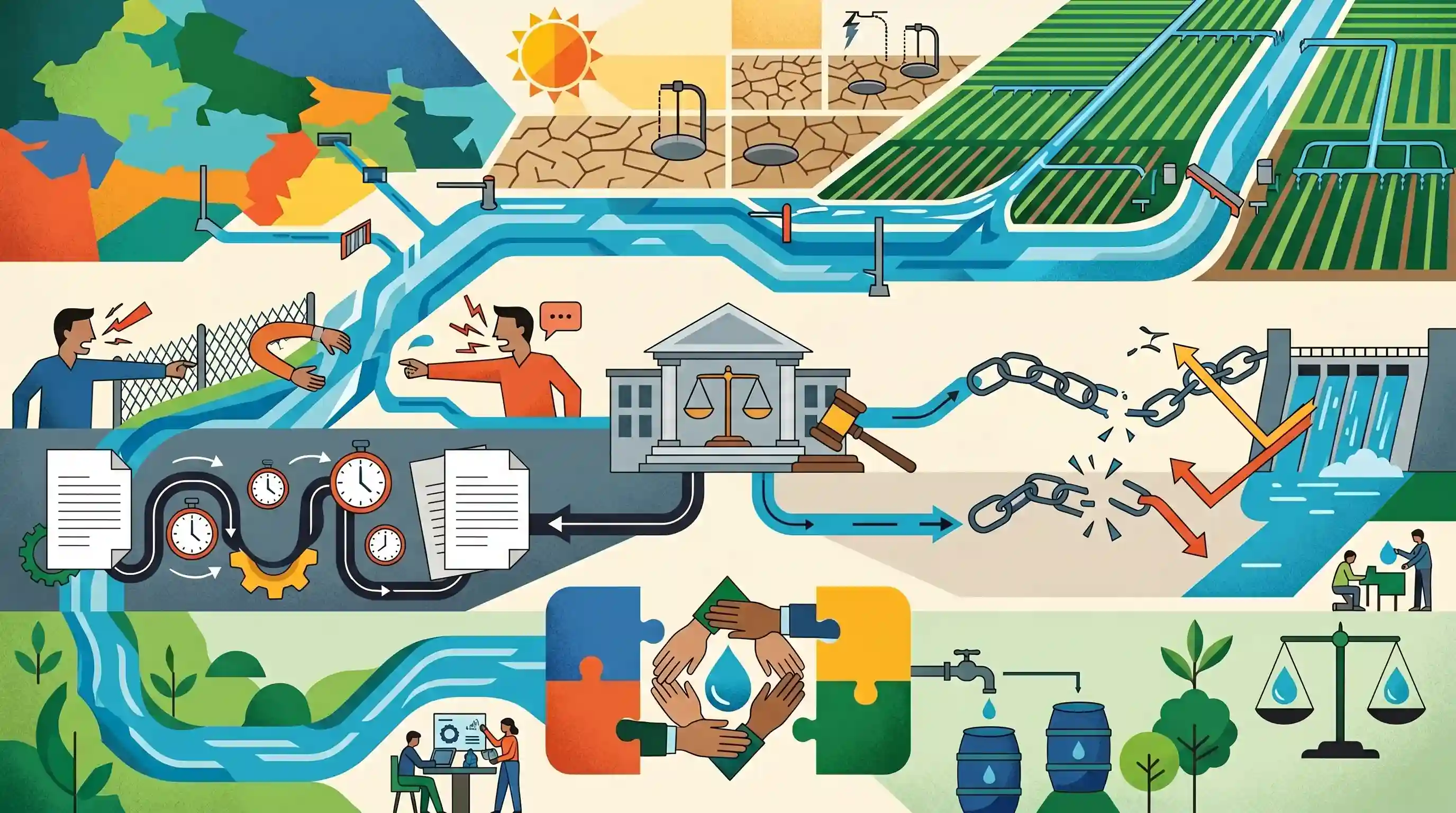
The article examines the escalating water stress in India and its direct correlation with the intensification of inter-state river water disputes. Driven by groundwater depletion, changing climate patterns, and high agricultural water demand, states are increasingly protective of their river water shares, exacerbating regional conflicts. Despite constitutional provisions like Article 262 and statutory mechanisms like the Inter-State River Water Disputes Act, the tribunal adjudication process has been hindered by protracted delays and compliance issues. Addressing this dual crisis requires robust water conservation strategies and a shift towards cooperative federalism in managing shared river basins.
Key Points
- India is facing severe water stress driven by groundwater depletion, inefficient agricultural water use, and erratic climate patterns.
- Rising water scarcity directly intensifies inter-state river water disputes, as states struggle to balance internal demand with shared basin agreements.
- Article 262 and the Inter-State River Water Disputes Act, 1956 provide the legal framework for resolving these conflicts through tribunals.
- The existing tribunal system is hampered by procedural delays, institutional bottlenecks, and the frequent politicization of water sharing.
- Resolving these disputes requires a shift from adversarial litigation to cooperative federalism, alongside sustainable water conservation practices.
Important Terms
Article 262 of the Constitution

A constitutional provision empowering Parliament to provide for the adjudication of disputes regarding the use, distribution, or control of inter-state river waters while barring the jurisdiction of the Supreme Court.
UPSC context
GS Paper II (Polity); critical for understanding the constitutional framework and judicial exclusion in federal water disputes.
Inter-State River Water Disputes Act, 1956
Legislation enacted under Article 262 that allows the Union government to establish ad hoc tribunals for resolving inter-state river disputes when negotiations fail.
UPSC context
GS Paper II & III; tests knowledge of statutory mechanisms for dispute resolution and recent amendments for time-bound adjudication.
Inter-State Water Disputes Tribunals
Quasi-judicial bodies appointed by the Center to adjudicate river water sharing; their awards have the force of a Supreme Court decree but often face significant procedural delays.
UPSC context
GS Paper II; focuses on the challenges of administrative adjudication and the impact on inter-state relations.
Central Ground Water Authority (CGWA)
A regulatory body constituted under the Environment (Protection) Act, 1986, mandated to manage and regulate groundwater development and issue extraction guidelines to prevent overexploitation.
UPSC context
GS Paper III (Environment); relates to sustainable resource management and the legal aspects of groundwater governance.
Entry 56 of the Union List
A constitutional provision granting Parliament the power to regulate and develop inter-state rivers and river valleys to the extent declared by law to be in the public interest.
UPSC context
GS Paper II (Federalism); tests the division of power between the Center and States regarding shared water resources.
Cooperative Federalism
A federalism model where the Center and States work together to solve common problems; in water disputes, it emphasizes basin-wide management over parochial state interests.
UPSC context
GS Paper II (Governance); a core theme for suggesting solutions to persistent federal conflicts in Mains answers.
Prelims Trap
The Supreme Court has original jurisdiction under Article 131 to adjudicate all inter-state river water disputes.
False. Article 262 allows Parliament to bar SC's original jurisdiction, enacted via the 1956 Act. However, the SC can still intervene via Special Leave Petitions (Article 136).
Static Concepts Connected
How is 'Water' distributed between the Union and States in the 7th Schedule?
- State List (Entry 17): Water supply, irrigation, and canals are placed under the jurisdiction of states.
- Union List (Entry 56): Grants the Union power to regulate and develop inter-state rivers/valleys if Parliament declares it expedient in the public interest.
- Article 262: Empowers Parliament to enact laws for adjudicating inter-state river disputes and to bar judicial review by courts.
What are the recognized thresholds for defining water stress?
- Falkenmark Indicator: A standard index measuring annual renewable freshwater availability per capita to determine water scarcity levels.
- Water Stress: Occurs when annual water availability drops below 1,700 cubic meters per person.
- Water Scarcity: Triggered when annual water availability drops below 1,000 cubic meters per person, indicating severe constraint.
Cross-Topic Patterns
Climate Change as a Federalism Stressor
Erratic monsoons and El Niño-driven droughts directly strain cooperative federalism, transforming ecological phenomena into constitutional deadlocks over resource sharing.
MSP, cropping patterns, and water conflicts
State procurement policies (MSP) favoring water-intensive crops like paddy and sugarcane drive groundwater depletion, inadvertently forcing states to over-claim shared river resources to sustain local agriculture.

Expect a mixed-statement Prelims question combining Article 262, the Falkenmark index, and 7th Schedule entries on water in 2026.
Linked PYQs · 5
Linked PYQs · 5
- 2019MainsGS1
What is water stress? How and why does it differ regionally in India?
- 2015MainsGS1
India is well endowed with fresh water resources. Critically examine why it still suffers from water scarcity.
- 2023MainsGS1
Why is the world today confronted with a crisis of availability of and access to freshwater resources?
- 2023PrelimsGS1
Consider the following statements: Statement-I: According to the United Nations' 'World Water Development Report, 2022', India extracts more than a quarter of the world's groundwater withdrawal each year. Statement-II: India needs to extract more than a quarter of the world's groundwater each year to satisfy the drinking water and sanitation needs of almost 18% of world's population living in its territory. Which one of the following is correct in respect of the above statements?
- 2022PrelimsGS1
Which one of the following has been constituted under the Environment (Protection) Act, 1986?
