Rising Evaporative Demand Exposes India Climate Data Deficits
Source:The Hindu ↗
Why It Matters
Evaporative demand and evapotranspiration are critical components of the hydrological cycle affecting crop survival and groundwater recharge. Recognizing the data deficits in measuring these metrics is crucial for aspirants understanding the technical and policy hurdles in India's climate resilience and agricultural planning.
Summary
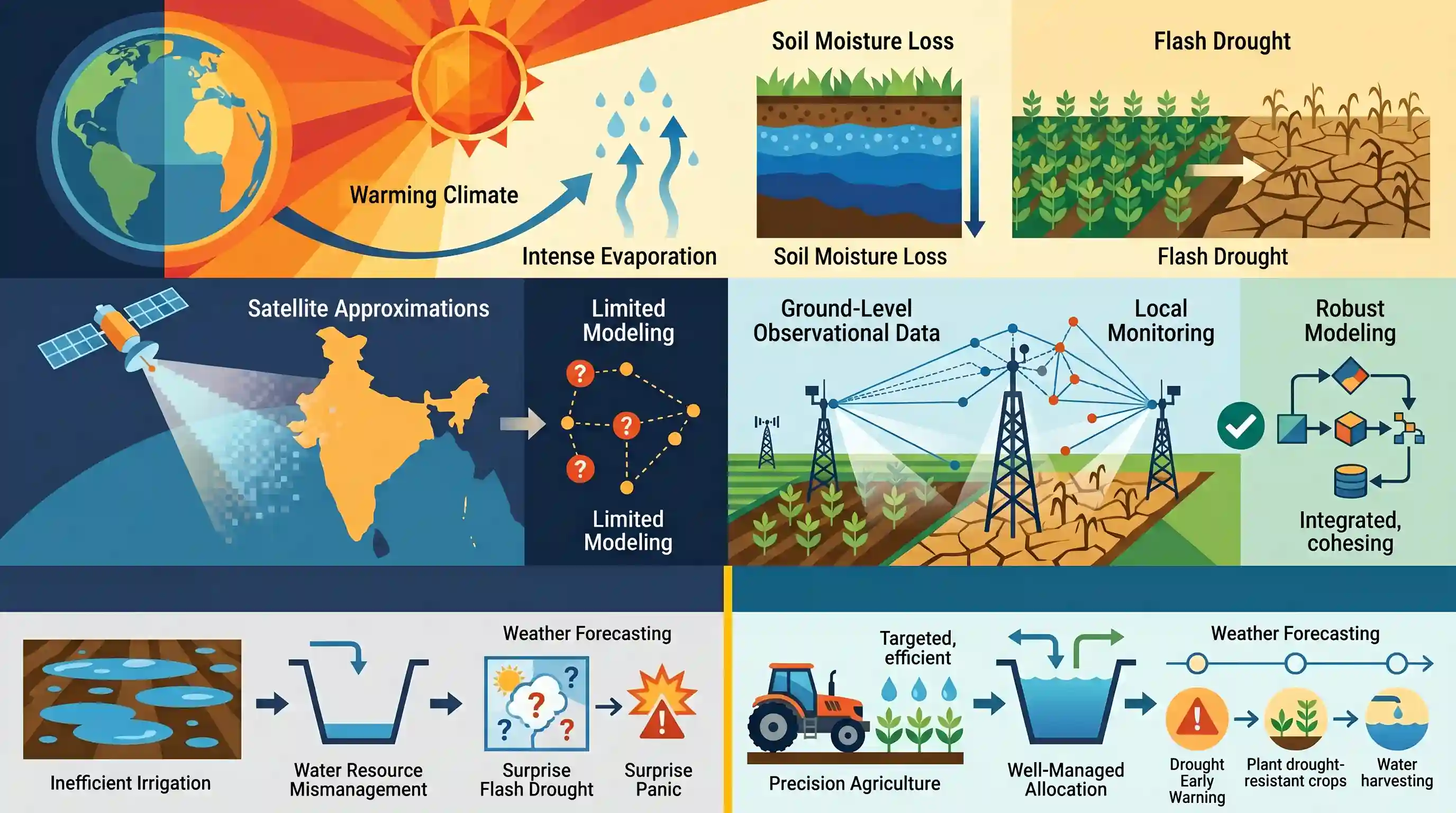
The article emphasizes how rising global temperatures are amplifying atmospheric evaporative demand, accelerating soil moisture loss, and increasing the vulnerability to flash droughts. However, India's capacity to track and model these changes is severely constrained by a lack of ground-level observational data. By relying largely on satellite approximations rather than dense networks of flux towers or local monitoring stations, India faces challenges in precision agriculture, water resource management, and climate forecasting. Addressing this critical data and research gap is necessary to build robust early warning systems and formulate localized, effective climate adaptation strategies.
Key Points
- Rising global temperatures increase evaporative demand (the atmosphere's 'thirst'), leading to rapid soil moisture depletion and the onset of flash droughts.
- India suffers from a significant data gap in monitoring evapotranspiration, primarily due to an inadequate network of ground-based observational tools like flux towers.
- Over-reliance on coarse satellite data and empirical models limits the accuracy of localized hydrological assessments and agricultural planning.
- Bridging this research gap is vital for improving irrigation efficiency, ensuring food security, and developing precise early warning systems for climate-induced water stress.
Important Terms
Atmospheric Evaporative Demand (AED)

The atmosphere's potential to remove water from surfaces via evaporation and transpiration, assuming unlimited water supply. It represents 'atmospheric thirst' driven by temperature, humidity, wind, and radiation.
UPSC context
GS Paper 1 (Geography); tests knowledge of hydrological cycle changes and factors driving water scarcity under global warming.
Flash Drought
A rapid-onset drought developing within weeks due to extreme heat and high evaporative demand. It causes swift soil moisture depletion, severely impacting rain-fed agriculture.
UPSC context
GS Paper 3 (Disaster Management); essential for understanding non-traditional disasters and the need for localized early warning systems.
Flux Towers (Eddy Covariance Towers)
Ground-based stations that measure the high-frequency exchange of water vapor, carbon dioxide, and energy between the land and atmosphere. They provide essential data for validating satellite-based climate models.
UPSC context
GS Paper 3 (S&T); highlights India's data gap in climate research and the importance of ground-truthing satellite observations.
Vapor Pressure Deficit (VPD)
The difference between the amount of moisture in the air and its saturation capacity. High VPD increases plant water loss and can trigger crop stress by closing leaf stomata.
UPSC context
GS Paper 3 (Agriculture); important for understanding plant physiology, irrigation needs, and climate impacts on food security.
India Meteorological Department (IMD)
Established in 1875, India's principal agency for meteorological observations and weather forecasting. It provides life-saving warnings for cyclones, heatwaves, and monsoons under the Ministry of Earth Sciences.
UPSC context
GS Paper 3 (Disaster Management); fundamental institutional agency for questions on monsoon prediction and disaster tracking.
Ministry of Earth Sciences (MoES)
The nodal ministry overseeing India's policies on meteorology, oceanography, and seismology. It coordinates scientific research across agencies like the IMD and Indian Institute of Tropical Meteorology.
UPSC context
GS Paper 2 (Governance); relevant for understanding the administrative structure of scientific research and climate adaptation initiatives.
Prelims Trap
"Evaporative demand refers to the actual amount of water lost from soil and plants."
This conflates Actual Evapotranspiration (AET) with Potential Evapotranspiration (PET). Evaporative demand is PET—the atmosphere's capacity or "thirst" for moisture, which often exceeds actual available water.
Static Concepts Connected
What is the difference between AET and PET in climatology?
- PET (Potential): The maximum moisture the atmosphere can extract if the water supply is unlimited; driven by temperature, radiation, and wind.
- AET (Actual): The real amount of moisture evaporated and transpired, strictly constrained by the actual soil moisture available in the environment.
- Aridity Index: Calculated as the ratio of precipitation to PET; higher PET relative to precipitation indicates increasing aridity and drought vulnerability.
How do 'flash droughts' differ from conventional droughts?
- Onset Speed: They develop rapidly over just a few weeks, compared to conventional droughts which accumulate over seasons or years.
- Primary Driver: Driven primarily by anomalously high evaporative demand (heatwaves, high winds, low humidity) rather than just isolated rainfall deficits.
- Agricultural Impact: Causes rapid, severe depletion of root-zone soil moisture, often devastating standing crops before conventional drought warning thresholds are triggered.
Cross-Topic Patterns
Flash Droughts & Groundwater Depletion
Climate-induced "thirstwaves" force farmers to increase irrigation frequency to combat rapid soil moisture loss, directly accelerating India's critical groundwater depletion cycle and threatening food security.
Space Technology vs. Ground Truthing
India's over-reliance on coarse satellite models for hydrology highlights a critical need for ground-based sensor networks (like flux towers) to calibrate future ISRO earth observation missions like NISAR and TRISHNA.

Expect a multi-statement prelims question in 2026 contrasting flash droughts with conventional droughts, emphasizing PET and soil moisture.
Linked PYQs · 4
Linked PYQs · 4
- 2011MainsGS1
Discuss the impact of climate change on water resources in India.
- 2023MainsGS1
Discuss the consequences of climate change on the food security in tropical countries.
- 2020MainsGS3
Suggest measures to improve water storage and irrigation system to make its judicious use under depleting scenario.
- 2024MainsGS3
What are the major challenges faced by Indian irrigation system in recent times? State the measures taken by the government for efficient irrigation management.
