Uttarakhand halts tree felling for Rishikesh highway after protests
Source:indiatoday ↗
Why It Matters
The article is a classic case study of the conflict between infrastructure development (highway widening) and environmental conservation (deforestation and wildlife protection) in ecologically fragile regions like Uttarakhand. It is highly relevant for GS3 questions related to environmental impact assessments, sustainable development, and conservation movements.
Summary
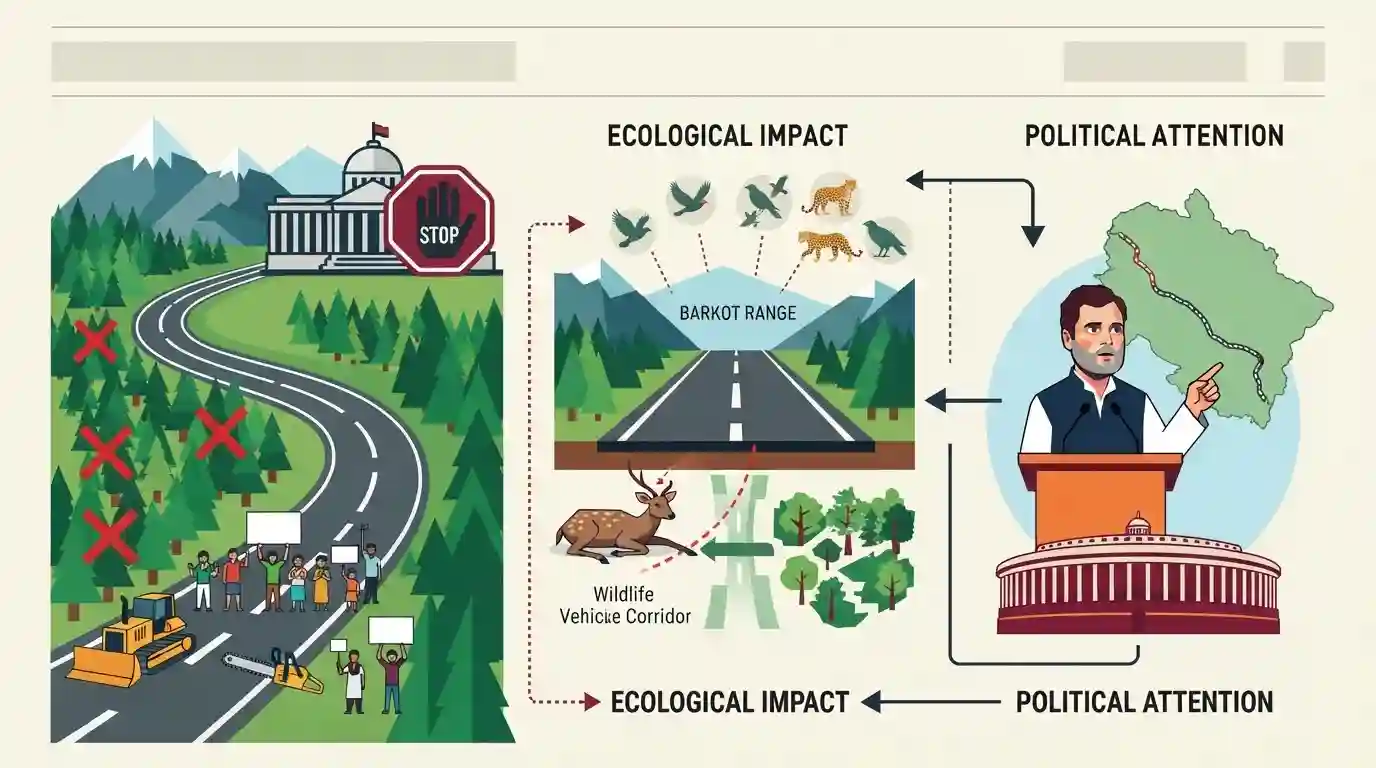
Following intense protests by environmentalists and local residents, the Uttarakhand government has halted the felling of over 4,300 trees slated for the Bhaniyawala–Rishikesh highway widening project. The protests underscore growing concerns regarding the ecological impact of large-scale infrastructure projects in sensitive Himalayan and forest regions. The death of a sambar deer on the highway in the Barkot Range further highlighted the risks such expansions pose to wildlife corridors. Political attention has also been drawn to the issue, with Leader of the Opposition Rahul Gandhi promising to address it in Parliament.
Key Points
- The Uttarakhand government has temporarily paused the felling of 4,369 trees for the Bhaniyawala–Rishikesh four-lane highway project following widespread local protests.
- The affected area falls within the ecologically sensitive Ranipokhari-Rishikesh forest division.
- Environmentalists and citizens are demanding an alternative road alignment to minimize deforestation and protect the region's biodiversity.
- Leader of the Opposition Rahul Gandhi expressed solidarity with the protesters and assured he would raise the issue in Parliament.
- Concerns over the highway's impact on local fauna were heightened after a female sambar deer was killed in a collision on the Rishikesh highway in the Barkot Range.
Important Terms
Sambar Deer

A large deer native to the Indian subcontinent (IUCN status: Vulnerable). It is highly susceptible to habitat fragmentation and vehicular collisions, making it a key indicator of linear infrastructure impacts on wildlife.
UPSC context
GS3 Environment. Tests species conservation status (IUCN) and impacts of linear infrastructure on wildlife corridors.
Barkot Range
A biodiverse forest range in Uttarakhand’s Dehradun Forest Division. It serves as a vital ecological link and wildlife movement corridor, particularly for elephants and leopards, connecting adjacent forest patches in the Shivalik landscape.
UPSC context
GS3 Environment. Relevant for protected areas mapping and understanding habitat connectivity in the Shivalik landscape.
Shivalik Elephant Reserve
Notified in 2002, this vast reserve spans multiple forest divisions in Uttarakhand. It is a critical habitat for Asian elephants, increasingly threatened by linear infrastructure projects like the Bhaniyawala-Rishikesh highway.
UPSC context
GS3 Environment. Important for mapping elephant reserves and understanding conservation challenges in the Himalayan foothills.
Wildlife Corridor
A continuous patch of native vegetation connecting isolated habitats. It allows animals to migrate, forage, and interbreed safely across landscapes disrupted by human activities like highway construction.
UPSC context
GS3 Conservation. Crucial for discussing solutions to habitat fragmentation and human-wildlife conflict mitigation.
Environmental Impact Assessment (EIA)
A mandatory regulatory process used to evaluate the potential ecological and socioeconomic consequences of proposed infrastructure projects before statutory clearance is granted.
UPSC context
GS3 Environment. Tests knowledge of statutory clearances, the Environment (Protection) Act, and sustainable development frameworks.
Compensatory Afforestation
The statutory requirement to plant trees on alternative land to offset the ecological loss when forest land is diverted for non-forest development projects like highway widening.
UPSC context
GS3 Environment. Relevant to evaluating mitigation measures, CAMPA funds, and forest conservation laws.
Lok Sabha
The directly elected lower house of India's bicameral Parliament. It serves as a primary forum for the Opposition to hold the government accountable and raise urgent public interest issues like deforestation.
UPSC context
GS2 Polity. Tests understanding of parliamentary oversight mechanisms and the role of the Opposition.
Prelims Trap
All highway expansions passing through forested regions require mandatory Environmental Clearance under EIA 2006.
Under EIA 2006, National Highway expansions generally require clearance only if they exceed 100 km, a frequent loophole used to bypass federal scrutiny.
Static Concepts Connected
How does EIA Notification 2006 regulate highway expansion projects?
- Distance Threshold: Expansions of National Highways generally mandate prior Environmental Clearance only if the project length is greater than 100 km.
- Right of Way: Clearance is also triggered if the additional Right of Way (RoW) exceeds 40 meters, or 60 meters on specific alignments.
- Piecemeal Exemptions: Exemptions often allow smaller state projects to bypass federal EIA, leading to controversies over piecemeal clearances in sensitive terrains.
What compensatory mechanisms are required under the Forest (Conservation) Act?
- Equivalent Land: Agencies executing projects must provide equivalent non-forest land to offset the ecological area lost due to forest diversion.
- Net Present Value: Agencies must deposit the quantified ecological cost of the diverted forest into CAMPA funds.
- Judicial Backing: The Supreme Court institutionalized the collection of NPV to offset the loss of ecosystem services following the T.N. Godavarman case.
Cross-Topic Patterns
Linear intrusions in wildlife corridors
Himalayan highway expansions connect to wildlife fragmentation (like the sambar deer death), linking to UPSC's recurring focus on eco-bridges, animal passages, and the Shivalik Elephant Reserve.
Himalayan carrying capacity debates
This mirrors the Char Dham project debate, where unchecked infrastructure expansion directly clashes with recent Supreme Court directives to assess the carrying capacity of Himalayan states.

EIA 2006 highway exemptions combined with IUCN status of affected fauna (like Sambar) will likely form a multi-statement 2026 question.
Linked PYQs · 2
Linked PYQs · 2
- 2024UKPSC_PRELIMSGS1
Which Constitutional Amendment Act relates to the protection and improvement of environment and safeguarding of forests and wildlife ?
- 2025UKPSC_PRELIMSGS1
Consider the following statements and select the correct answer from the options given below : Statement 1 : Uttarakhand is highly vulnerable to climate change. Statement 2 : Climate change is causing water stress and depleting biodiversity in Uttarakhand.
