Digital Hawala Rise Money Laundering and Terror Financing Risks
Source:The Hindu ↗
কেন এটি গুরুত্বপূর্ণ
The intersection of fintech, crypto-assets, and traditional underground networks like hawala represents a critical modern threat to internal security and global economic stability, directly aligning with UPSC GS3 syllabus requirements on money laundering and organized crime.
সারসংক্ষেপ
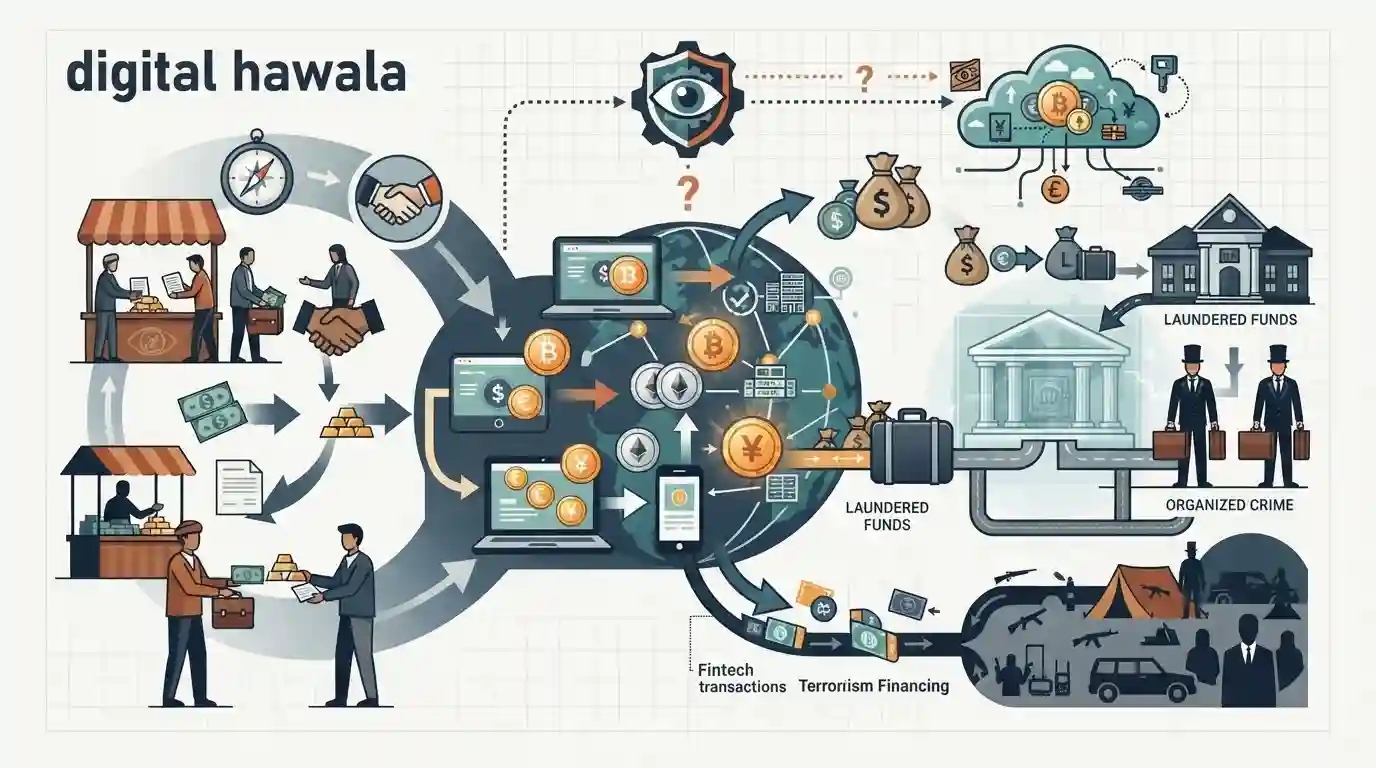
A global financial watchdog report highlights how 'digital hawala'—leveraging crypto assets and fintech innovations alongside traditional informal value transfer networks—is increasingly utilized for money laundering and terror financing, circumventing traditional law enforcement and compliance tools.
মূল বিষয়
- Global financial watchdogs have warned about the rapid rise of 'digital hawala', combining traditional informal value transfer systems with modern financial technology and cryptocurrencies.
- This evolution facilitates sophisticated money laundering and cross-border terror financing, evading formal banking regulatory oversight and Know Your Customer (KYC) frameworks.
- The phenomenon poses significant challenges to national security, international financial integrity, and regulatory bodies worldwide.
গুরুত্বপূর্ণ শব্দ
FATF

An intergovernmental policy-making body that sets global standards to combat money laundering, terrorist financing, and proliferation financing through peer reviews and recommendations.
UPSC context
UPSC Prelims/Mains (GS Paper II/III) - International organizations, global governance standards, and mechanisms to counter money laundering and terror financing.
digital hawala
An informal, trust-based value transfer system operating outside traditional banking channels, historically reliant on cash and human brokers but increasingly digitised via fintech and crypto.
UPSC context
UPSC Mains (GS Paper III) - Internal security, organized crime-terror nexus, and emerging technological challenges to financial intelligence systems.
প্রিলিমস ফাঁদ
Digital hawala completely replaces traditional informal value transfer systems (IVTS) with blockchain ledgers.
Aspirants often assume traditional Hawala is purely paperless or strictly manual; 'digital hawala' specifically integrates crypto assets, P2P fintech rails, and stablecoins into informal value transfer systems.
সংযুক্ত স্থির ধারণা
What are the primary institutional pillars and evaluation tools of the Financial Action Task Force (FATF)?
- Origins & Mandate: Established in 1989 by the G7 summit in Paris to combat money laundering and later expanded to terror financing.
- Grey & Black Lists: Countries facing strategic deficiencies are placed under increased monitoring (Grey List) or high-risk call for action (Black List).
- Mutual Evaluations: Mutual evaluations assess member countries' implementation of the 40 FATF Recommendations through peer reviews.
আন্তঃবিষয় প্যাটার্ন
Crypto Regulation meets FATF Standards
The convergence of traditional informal value transfer networks with crypto assets creates regulatory blind spots that test both FATF compliance frameworks and RBI's domestic monetary sovereignty.
Fintech Terror Financing & Internal Security
Digital hawala ecosystems operate across porous borders, directly funding proxy groups and undermining counter-terrorism intelligence and internal security operations.

FATF mutual evaluations + crypto asset tracing (Chainalysis/VASP) likely to be tested via a multi-statement prelims question.
সংযুক্ত PYQ · 3
সংযুক্ত PYQ · 3
- 2021MainsGS3
Discuss how emerging technologies and globalisation contribute to money laundering. Elaborate measures to tackle the problem of money laundering both at national and international levels.
- 2021MainsGS3
Analyse the complexity and intensity of terrorism, its causes, linkages and obnoxious nexus. Also suggest measures required to be taken to eradicate the menace of terrorism.
- 2022MainsGS3
Discuss the types of organised crimes. Describe the linkages between terrorists and organised crime that exist at the national and transnational levels.
