Economic Growth and Rising Vulnerability of Middle Class
Source:The Hindu ↗
Why It Matters
The article provides a critical analysis of India's economic structure, directly addressing core GS3 syllabus themes like jobless growth, inclusive growth, and the informal economy. It challenges simplistic narratives of poverty reduction, offering valuable data (e-Shram statistics, inequality figures, structural shifts to agriculture) and conceptual frameworks (the 'vulnerable middle') crucial for writing nuanced Mains answers on poverty, employment, and economic development.
Summary
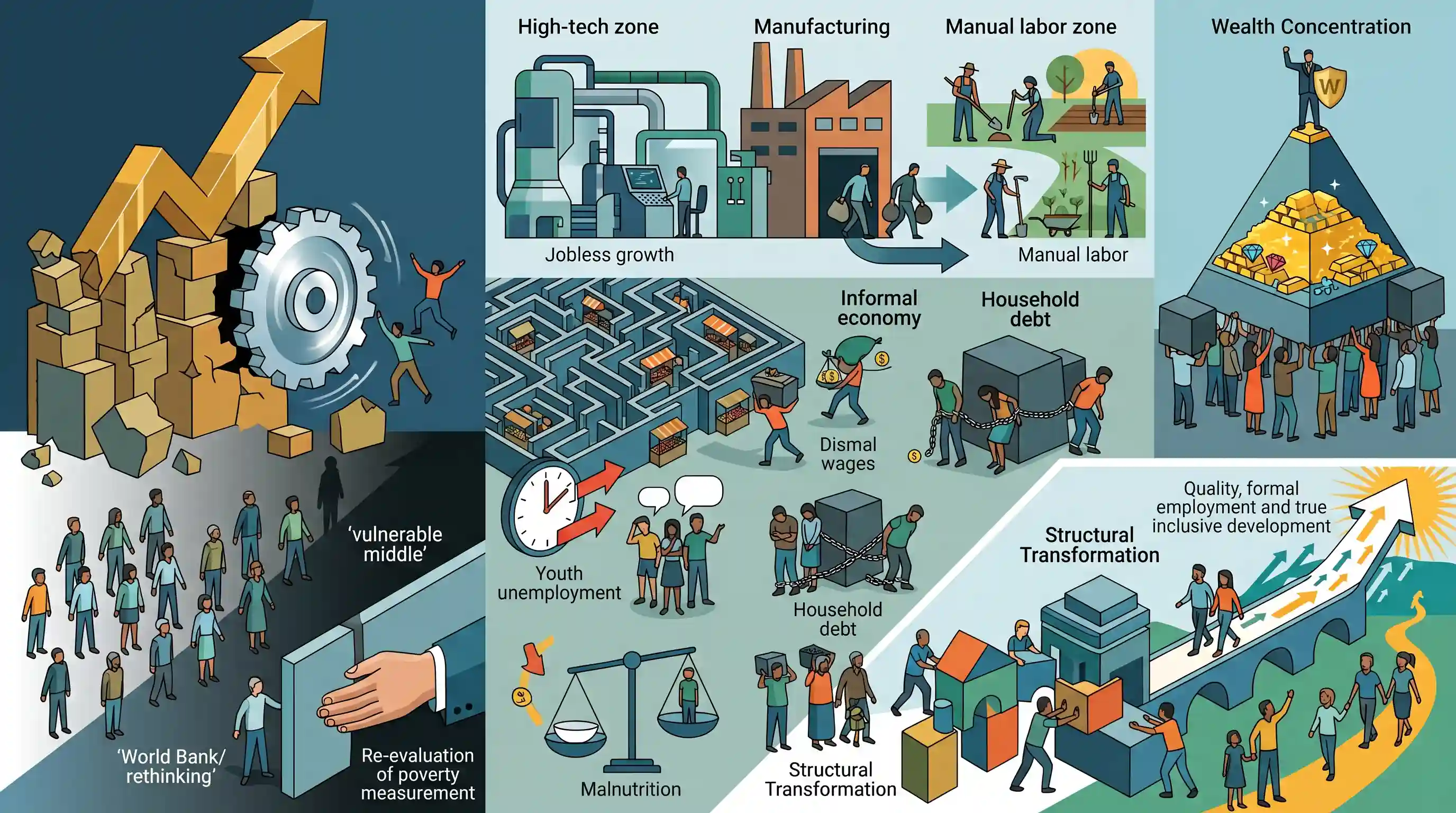
The article analyzes the structural flaws in India's current economic growth model through the lens of a recent World Bank paper on rethinking poverty measurement. It argues that relying on traditional binary poverty lines masks the reality of a massive 'vulnerable middle' class. Despite high GDP growth, the economy suffers from jobless growth, with capital-intensive sectors expanding while manufacturing sheds jobs, forcing labor back into agriculture. Furthermore, the dominance of the informal sector—where a vast majority earn dismal wages—coupled with soaring youth unemployment, rising household debt, extreme wealth concentration, and enduring malnutrition, prevents true inclusive development. A structural transformation generating quality, formal employment is essential to secure sustainable upward mobility for this vulnerable population.
Key Points
- A recent World Bank policy paper advocates moving away from binary poverty lines towards measuring the distance from a decent standard of living, highlighting a spectrum of vulnerability.
- While India's economic growth has lifted many out of extreme poverty, it has generated a large 'vulnerable middle' class that struggles with sustained upward mobility.
- India is experiencing jobless growth characterized by capital-intensive expansion, resulting in fewer formal jobs and forcing millions back into low-productivity agriculture.
- The workforce is overwhelmingly informal; data from the e-Shram portal shows that 94.11% of registered unorganized workers earn less than ₹10,000 per month, compounded by stagnant real wages.
- High wealth inequality, rising unsecured household debt, massive youth unemployment (45%), and persistent malnutrition (high rates of child wasting and stunting) threaten human capital development.
Important Terms
Periodic Labour Force Survey (PLFS)

A survey launched in 2017 by the National Statistical Office (NSO) to provide frequent, timely data on employment, unemployment, and labor force participation rates across India.
UPSC context
GS-III (Economy); essential for tracking jobless growth and the quality of employment in India.
e-Shram Portal
A centralized national database launched in 2021 by the Ministry of Labour and Employment to register unorganized workers, enabling access to social security and portable welfare benefits.
UPSC context
GS-II (Social Justice) and GS-III (Labor); tests knowledge of formalizing the informal sector.
Structural Transformation
The economic process where labor and resources shift from low-productivity primary sectors (agriculture) to high-productivity sectors (manufacturing and services), accompanying modern growth.
UPSC context
GS-III (Inclusive Growth); core concept for analyzing India's transition from agriculture-led to services-led growth.
World Bank Poverty Lines
Global benchmarks (e.g., $2.15/day for extreme poverty) used by the World Bank to track and compare poverty levels across countries using Purchasing Power Parity (PPP).
UPSC context
GS-III (Poverty); critical for comparing national vs. global poverty estimation methodologies.
National Sample Survey Office (NSSO)
A premier statistical wing of the Ministry of Statistics and Programme Implementation (MoSPI) historically responsible for conducting large-scale socio-economic surveys, now merged into the National Statistical Office (NSO).
UPSC context
GS-III (Economy); key institution for data-driven policymaking and official statistical records.
Oxfam India
An international NGO whose periodic "Inequality" reports are frequently cited to highlight extreme wealth concentration and the widening rich-poor divide in India.
UPSC context
GS-III (Inclusive Growth); provides critical data for debating wealth concentration and the K-shaped recovery.
Prelims Trap
"India's recent high GDP growth marks a positive structural transformation with labor shifting from agriculture to manufacturing."
Aspirants confuse high GDP growth with positive employment shifts. Actually, India is experiencing "structural retrogression"—manufacturing is shedding jobs, forcing labor back into low-productivity agriculture.
Static Concepts Connected
What are the key committees for poverty estimation in India?
- Tendulkar Committee: Shifted away from purely calorie-based estimation to a broader consumption basket that included health and education expenditure.
- Rangarajan Committee: Reverted to separate rural and urban consumption baskets, incorporating specific nutritional requirements alongside non-food expenses.
How do specific types of unemployment manifest in the Indian economy?
- Disguised Unemployment: Occurs when more people are employed than necessary, meaning marginal productivity is zero. Rampant in Indian agriculture.
- Structural Unemployment: Caused by a mismatch between worker skills and available jobs, often exacerbated by capital-intensive technological growth.
- Jobless Growth: A macroeconomic phenomenon where an economy experiences significant GDP expansion without a proportionate increase in new employment opportunities.
Cross-Topic Patterns
Malnutrition blocks demographic dividend
Persistent child stunting and wasting (GS2 Health) erode cognitive development, ensuring the vulnerable middle lacks the human capital to escape informal, low-wage labor (GS3 Economy).
E-Shram and the new Labour Codes
The stark wage distress revealed by the e-Shram portal underscores the urgency of operationalizing the pending Labour Codes to provide a statutory social security net for the unorganized sector.

Expect a multi-statement Prelims question testing the difference between classical 'structural transformation' and India's 'structural retrogression'.
Linked PYQs · 5
Linked PYQs · 5
- 2022MainsGS3
Economic growth in the recent past has been led by increase in labour productivity." Explain this statement. Suggest the growth pattern that will lead to creation of more jobs without compromising labour productivity.
- 2023MainsGS3
Faster economic growth requires increased share of the manufacturing sector in GDP, particularly of MSMEs. Comment on the present policies of the Government in this regard.
- 2023MainsGS3
Most of the unemployment in India is structural in nature. Examine the methodology adopted to compute unemployment in the country and suggest improvements.
- 2025MainsGS3
Distinguish between the Human Development Index (HDI) and the Inequality-adjusted Human Development Index (IHDI) with special reference to India. Why is the IHDI considered a better indicator of inclusive growth?
- 2022MainsGS3
Is inclusive growth possible under market economy ? State the significance of financial inclusion in achieving economic growth in India.
