World Bank Report Highlights Growing Middle Class Vulnerability
Source:The Hindu ↗
Why It Matters
Provides crucial arguments and data for GS3 mains answers on jobless growth, informalization, and inclusive growth. It critiques the conventional binary approach to poverty, offering a nuanced perspective on the 'vulnerable middle' class.
Summary
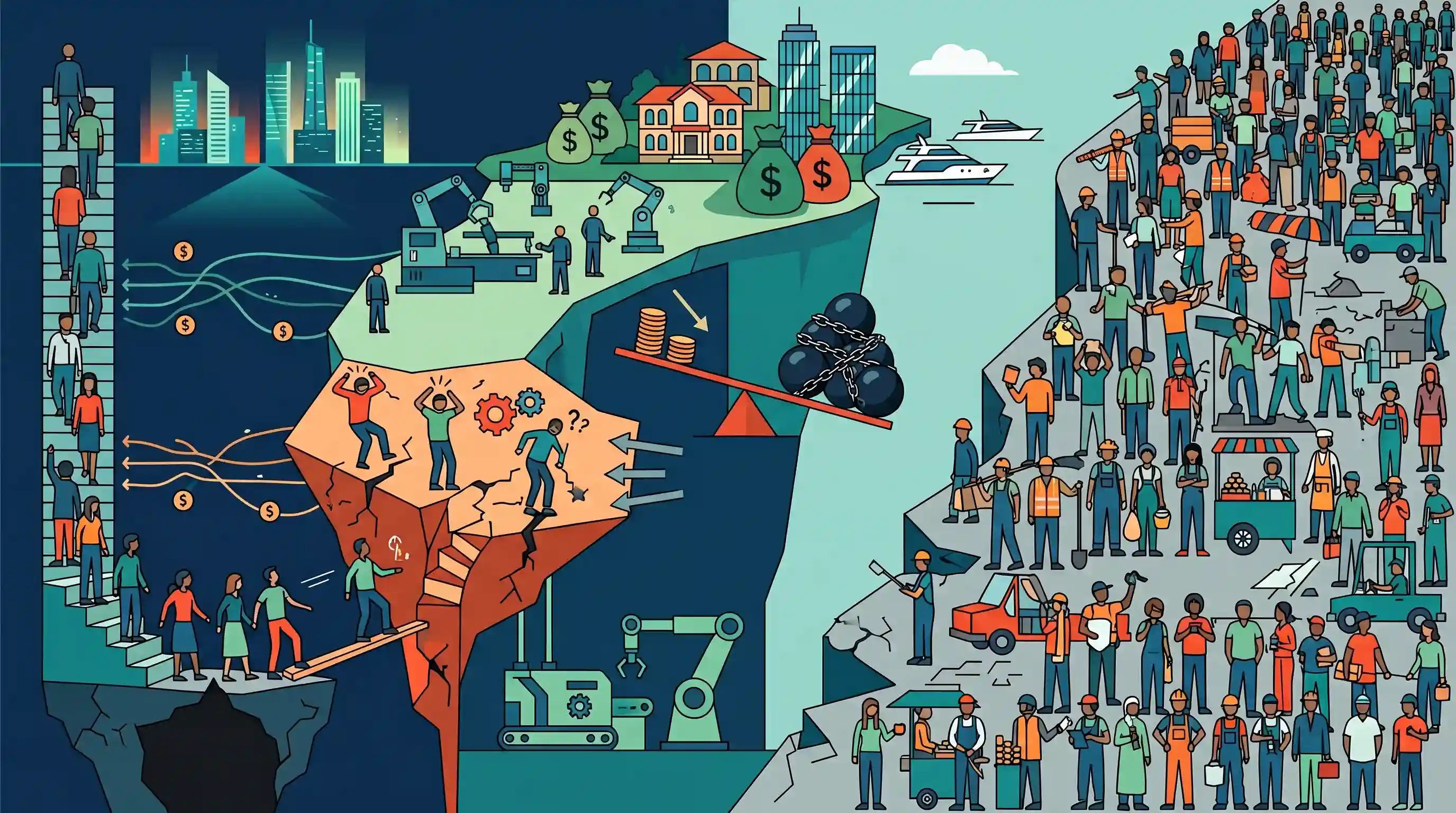
The article highlights the growing vulnerability of India's middle class, driven by a structural crisis in the country's economic growth model. A World Bank paper suggests that while absolute poverty has declined, upward mobility has stalled, expanding a 'vulnerable middle' rather than a secure middle class. Capital-intensive growth has failed to generate sufficient formal jobs, leaving over 90% of the workforce in the informal sector with stagnant wages. This jobless growth has exacerbated inequality, plummeting household savings, and rising unsecured debt, demonstrating that mere income-based poverty reduction does not translate into sustained economic security or improved living standards.
Key Points
- A recent World Bank policy paper advocates measuring economic well-being on a spectrum rather than using a binary poverty line, highlighting a large and expanding 'vulnerable middle' class in India.
- India's economic growth has been predominantly capital-intensive, resulting in poor employment generation ('jobless growth') and failure to absorb the growing labor force into the formal sector.
- Over 90% of employment is informal, with 94% of e-Shram registrants earning less than ₹10,000 per month, reflecting stagnant real wages despite labor productivity gains.
- Economic inequality is stark, with the top 1% capturing 22% of national income, while household savings have dropped to a historic low of 5% of GDP amid rising unsecured debt.
- The manufacturing sector has been shedding jobs, leaving agriculture to disproportionately absorb the workforce (46% of workers generating only 18% of output).
Important Terms
Jobless Growth

A condition where the economy expands in terms of GDP without a corresponding proportional increase in employment opportunities, often due to capital-intensive production or automation.
UPSC context
Crucial for GS Paper III (Economy). Tests understanding of the 'missing middle' in Indian manufacturing and challenges to the demographic dividend.
Informal Sector
Economic activities operating outside formal regulatory frameworks, lacking legal protections, written contracts, and social security. It employs over 90% of India's workforce.
UPSC context
Critical for GS Paper III topics like 'Employment' and 'Inclusive Growth'. Tests awareness of structural bottlenecks in labor market formalization.
Inclusive Growth
Economic growth that is broad-based across sectors and creates equitable opportunities for all sections of society, specifically targeting the marginalized and poor.
UPSC context
A core syllabus topic in GS Paper III. Focuses on the trade-off between rapid growth and social equity.
Vulnerable Middle Class
A demographic segment that has exited absolute poverty but remains financially precarious, lacking sufficient savings or social safety nets to withstand economic shocks.
UPSC context
Relevant for GS Paper II (Social Justice) and Paper III (Economy). Highlights limitations of income-based poverty lines in measuring welfare.
Net Financial Savings
The difference between a household's total financial assets (bank deposits, currency) and its liabilities (loans). India's rate recently hit a four-decade low of approximately 5% of GDP.
UPSC context
Vital for GS Paper III (Resource Mobilization). Tests knowledge of macroeconomic stability and domestic capital availability for investment.
Unsecured Debt
Loans provided without collateral, such as credit card debt or personal loans. A rise in this sector indicates borrowing for consumption rather than asset creation.
UPSC context
Significant for GS Paper III (Banking). Relates to risks of financial fragility and the sustainability of consumption-led growth models.
e-Shram Portal
A national database launched by the Ministry of Labour and Employment to register unorganized workers, providing them with a Universal Account Number (UAN) and social security access.
UPSC context
Important for GS Paper II (Welfare Schemes). Tests knowledge of government interventions for the protection of the informal workforce.
Prelims Trap
Absolute poverty has increased in India, creating a large vulnerable middle class.
Absolute poverty has actually declined. The trap is assuming a larger 'vulnerable' class means extreme poverty rose. They escaped poverty but lack security.
Static Concepts Connected
What defines the structural transformation of an economy?
- Labor shift: Movement of surplus workforce from low-productivity agriculture to higher-productivity manufacturing and services.
- India's anomaly: India bypassed robust labor-intensive manufacturing, resulting in 'jobless growth' where agriculture still traps 46% of the workforce.
How does vulnerability differ from binary poverty measurement?
- Binary approach: Traditional poverty lines (like Tendulkar committee) use fixed consumption baskets, creating a rigid poor/non-poor categorization.
- Vulnerability spectrum: Assesses the economic risk of marginally non-poor households falling back into poverty due to unexpected shocks.
Cross-Topic Patterns
E-Shram & Social Security Codes
e-Shram data showing 94% earning under ₹10,000 highlights the urgent need to operationalize the Social Security Code for unorganized and gig workers.
K-shaped Growth & Financial Stability
Plunging household savings (5% of GDP) and rising unsecured debt reflect K-shaped inequality. This threatens domestic capital formation and future banking sector stability.

Expect a Mains GS3 question linking e-Shram data to 'jobless growth' and the failure of manufacturing to absorb agricultural surplus labor.
Linked PYQs · 5
Linked PYQs · 5
- 2015MainsGS3
The nature of economic growth in India in recent times is often described as jobless growth. Do you agree with this view ? Give arguments in favour of your answer.
- 2022MainsGS3
Economic growth in the recent past has been led by increase in labour productivity." Explain this statement. Suggest the growth pattern that will lead to creation of more jobs without compromising labour productivity.
- 2016MainsGS3
How globalization has led to the reduction of employment in the formal sector of the Indian economy? Is increased informalization detrimental to the development of the country?
- 2020MainsGS2
The incedence and intensity of poverty are more important in determining poverty based on income alone". In this context analyse the latest United Nations Multidimensional Poverty Index Report.
- 2015MainsGS2
Though there have been several different estimates of poverty in India, all indicate reduction in poverty levels over time. Do you agree? Critically examine with reference to urban and rural poverty indicators.
