Oil to Chemicals Transition and Green Job Creation Strategy
Source:The Hindu ↗
Why It Matters
Demonstrates a major private-sector initiative aligning with India's national climate goals, energy security imperatives, and transition to a green economy, offering practical examples for answers on industrial transition and renewable energy.
Summary
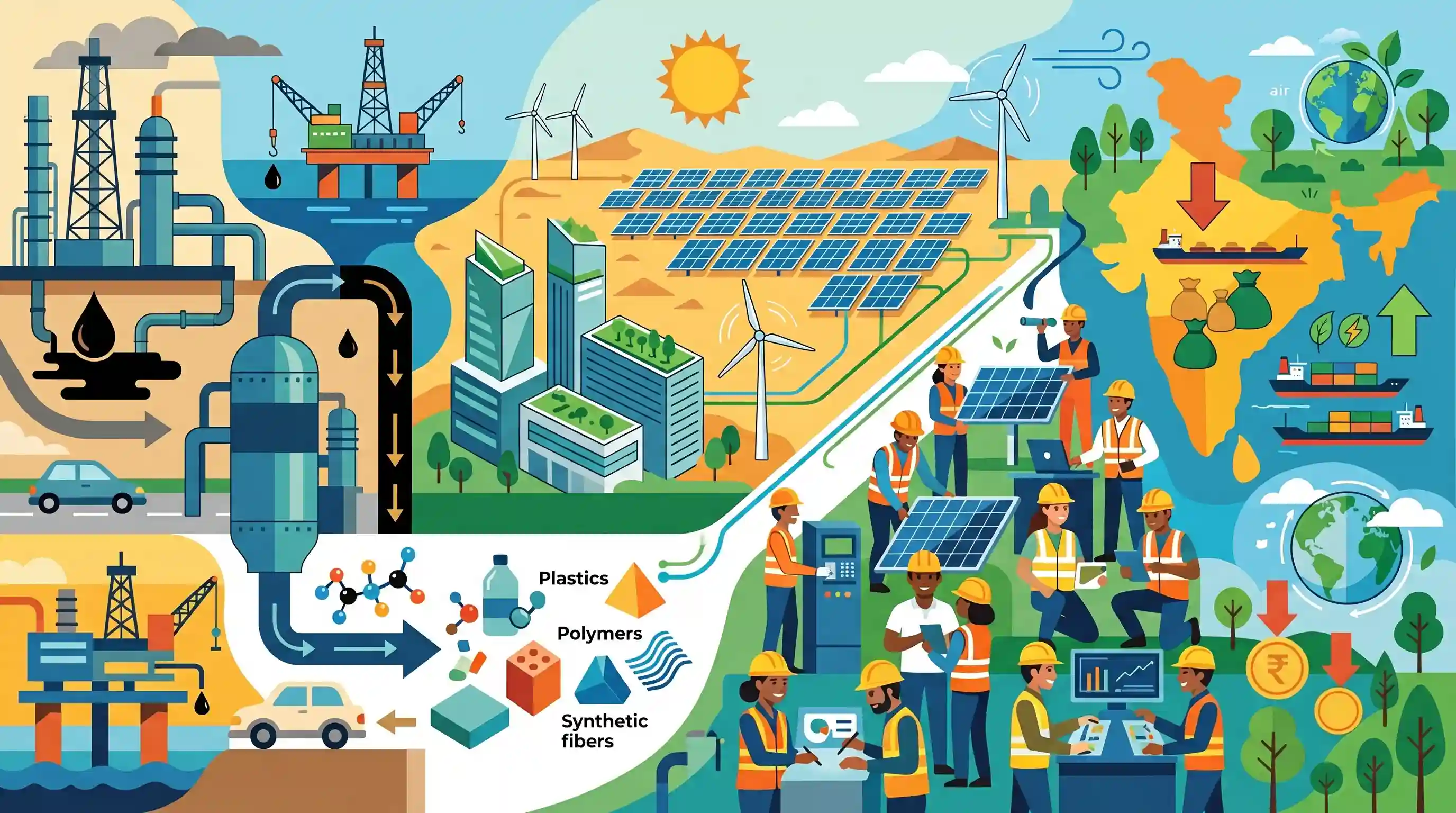
Reliance Industries Limited (RIL) is accelerating its pivot towards a sustainable energy model by planning to convert its entire oil refining output into chemicals and new materials. By phasing out traditional transport fuels in favor of an Oil-to-Chemicals (O2C) approach, RIL aims to build a fully integrated green ecosystem. The establishment of new manufacturing Giga complexes and the massive Kutch Solar Farm is expected to generate 2,00,000 green jobs. This corporate transition reflects broader national objectives to reduce dependency on imported oil, boost clean energy exports, lower domestic energy costs, and fulfill climate commitments by harnessing India's abundant solar resources.
Key Points
- RIL plans to convert all the crude oil it refines into chemicals and new materials (O2C), moving away from traditional transport fuels.
- The development of the Giga Complex and the Kutch Solar Farm is projected to create 2,00,000 green jobs.
- The strategic transition aims to build a fully integrated green ecosystem encompassing bioenergy, solar, and new materials.
- This clean energy shift is intended to lower energy costs, reduce import dependence on Middle Eastern oil, and support India's climate obligations by capitalizing on solar energy ('Indian sunshine').
Important Terms
Oil-to-Chemicals (O2C)

Industrial strategy of processing crude oil directly into high-value petrochemicals and polymers rather than traditional transportation fuels like petrol or diesel.
UPSC context
GS-III: Industrial Growth & Infrastructure; relevant for manufacturing sector shifts and value-addition in the petroleum industry.
Green Jobs
Decent employment in sectors that contribute to preserving or restoring the environment, such as renewable energy, resource efficiency, and low-carbon manufacturing.
UPSC context
GS-III: Employment & Environment; crucial for discussing sustainable development goals and the 'Just Transition' in labor markets.
Energy Transition
The global structural shift from fossil-based energy systems (coal, oil, gas) to renewable and zero-carbon energy sources like solar, wind, and green hydrogen.
UPSC context
GS-III: Infrastructure: Energy; tests knowledge of India's Panchamrit targets and climate change mitigation strategies.
Giga Complexes
Massive, integrated manufacturing hubs designed for the large-scale production of clean energy technologies, including solar panels, battery storage, and electrolyzers.
UPSC context
GS-III: Industrial Policy & Technology; reflects India's ambition to become a global hub for green manufacturing.
Net Zero Emissions
A state in which the greenhouse gases going into the atmosphere are balanced by removal from the atmosphere. India aims for this by 2070.
UPSC context
GS-III: Conservation & Environmental Pollution; core concept for Paris Agreement compliance and national climate policy.
Prelims Trap
"The Oil-to-Chemicals (O2C) transition means a refinery completely stops importing and using crude oil."
O2C still relies on crude oil as a feedstock. It merely re-routes refined crude from transport fuels (petrol/diesel) into higher-value petrochemicals, polymers, and materials.
Static Concepts Connected
How does Oil-to-Chemicals (O2C) differ from traditional petroleum refining?
- Traditional Refining: Converts crude oil primarily into transportation and heating fuels like petrol, diesel, and aviation turbine fuel.
- O2C Technology: Maximizes direct conversion of crude oil into petrochemicals, bypassing traditional fuel production to create plastics and polymers.
- Strategic Need: Acts as an industry hedge against 'peak fuel demand' driven by the global transition to electric vehicles and biofuels.
What qualifies as a "Green Job" under the ILO framework?
- Core Definition: Decent work that contributes to preserving or restoring the environment, either in traditional sectors like construction or new green sectors like renewables.
- Key Objectives: Focuses on improving energy and raw materials efficiency, limiting greenhouse gas emissions, minimizing waste, and protecting ecosystems.
- India's Push: The Skill Council for Green Jobs (SCGJ) was launched by the Ministry of Skill Development to standardise these roles in India.
Cross-Topic Patterns
PLI Schemes + Corporate Giga Factories
Private sector Giga complexes for solar and advanced battery storage directly dovetail with India's PLI schemes for High Efficiency Solar PV Modules and ACC Battery Storage.
Kutch's geographical advantage for renewables
Kutch is emerging as India's mega renewable hub due to vast tracts of contiguous wasteland, high solar insolation, and strong coastal wind patterns ideal for hybrid parks.

Expect a 2026 Prelims multi-statement question on O2C technology, testing its distinction from traditional refining and peak fuel demand.
Linked PYQs · 4
Linked PYQs · 4
- 2022MainsGS3
Do you think India will meet 50 percent of its energy needs from renewable energy by 2030 ? Justify your answer. How will the shift of subsidies from fossil fuels to renewables help achieve the above objective ? Explain.
- 2025PrelimsGS1
Consider the following statements about 'PM Surya Ghar Muft Bijli Yojana': I. It targets installation of one crore solar rooftop panels in the residential sector. II. The Ministry of New and Renewable Energy aims to impart training on installation, operation, maintenance and repairs of solar rooftop systems at grassroot levels. III. It aims to create more than three lakhs skilled manpower through fresh skilling, and up-skilling, under scheme component of capacity building. Which of the statements given above are correct?
- 2024PrelimsGS1
Consider the following: 1. Battery storage 2. Biomass generators 3. Fuel cells 4. Rooftop solar photovoltaic units How many of the above are considered "Distributed Energy Resources"?
- 2022PrelimsGS1
Consider the following statements: 1. Gujarat has the largest solar park in India. 2. Kerala has a fully solar powered International Airport. 3. Goa has the largest floating solar photovoltaic project in India. Which of the statements given above is/are correct?
