Drivers of Sustained Double-Digit Economic Growth in India
Source:Indian Express ↗
Why It Matters
Economic growth projections and the factors driving them (technology, demographic dividend, clean energy) are foundational for UPSC GS3. Aspirants must be able to link corporate leadership perspectives with macroeconomic concepts like potential growth, labor productivity, and digitalization.
Summary
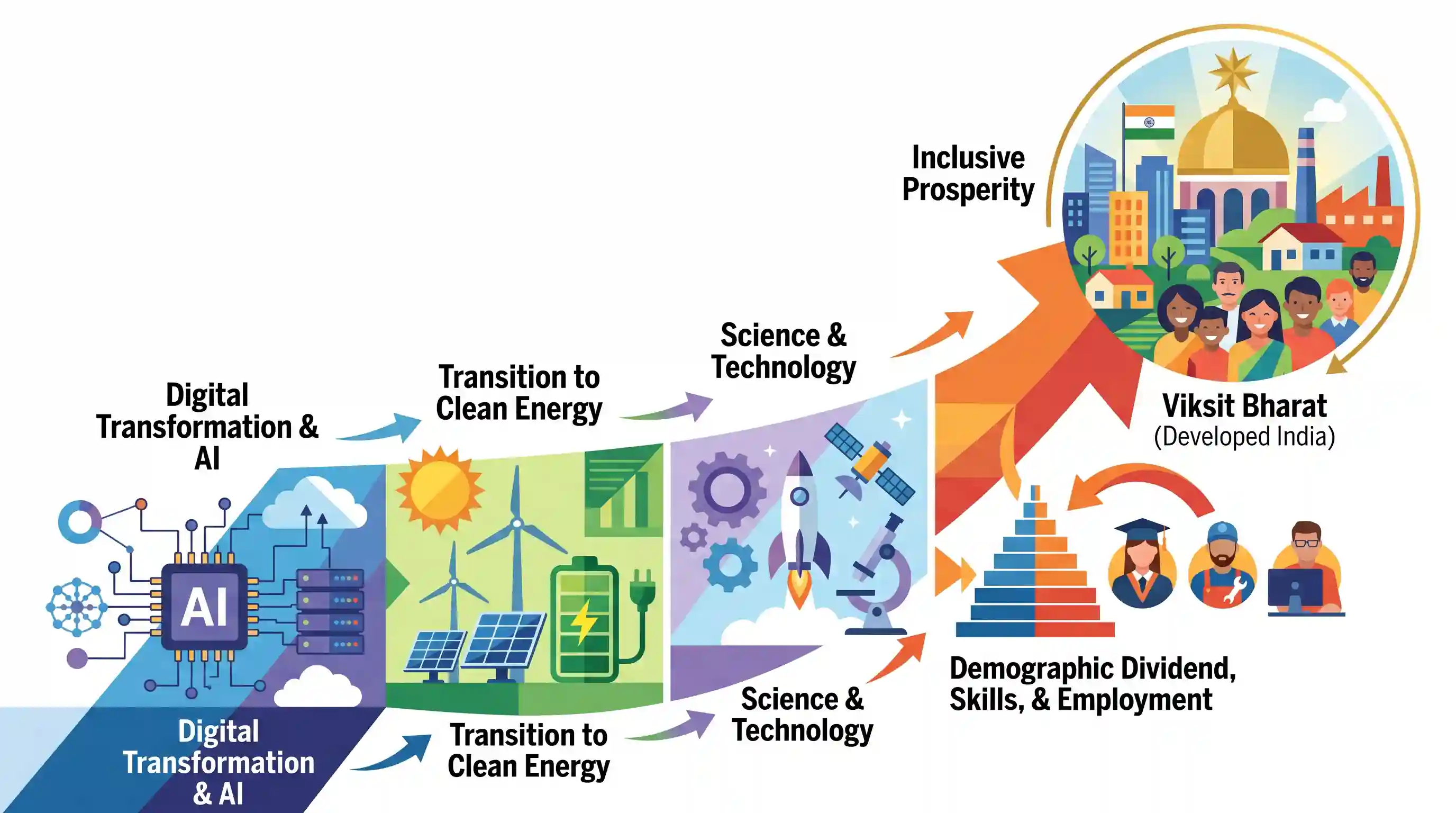
Reliance Industries Limited (RIL) Chairman Mukesh Ambani expressed optimism regarding India's macroeconomic prospects, stating that sustained double-digit economic growth is highly achievable. He identified key drivers such as digital transformation, Artificial Intelligence, and the transition to clean energy as essential to propelling the economy forward. The address underscored the necessity of harnessing India's demographic dividend through skill development and employment generation to ensure that high GDP growth translates into inclusive prosperity and the broader vision of a developed India (Viksit Bharat).
Key Points
- Mukesh Ambani projected that India has the capacity to achieve and sustain double-digit economic growth in the coming years.
- Highlighted the role of emerging technologies, such as Artificial Intelligence and robust digital infrastructure, as primary catalysts for accelerating GDP expansion.
- Emphasized that transitioning to clean energy and fostering green investments will provide a secondary engine for long-term economic resilience.
- Stressed the importance of leveraging India's demographic dividend by skilling the youth to meet the demands of a high-growth, modern economy.
Important Terms
Viksit Bharat

Government vision to transform India into a developed nation by 2047, focusing on economic prosperity, social advancement, and modern governance through pillars like youth and women.
UPSC context
GS Papers 2 & 3: Central theme for long-term national development, governance targets, and economic transformation towards 2047.
Demographic Dividend
The economic growth potential arising from a larger working-age population (15-64) compared to the dependent population, which India expects to leverage until 2055-56.
UPSC context
GS Papers 1 & 3: Crucial for topics on human resources, employment, and the socio-economic challenges of a young workforce.
Clean Energy Transition
The systemic shift of the energy sector from fossil-fuel dominance to renewable sources, targeting 500 GW capacity by 2030 and net-zero emissions by 2070.
UPSC context
GS Paper 3: Essential for environment, climate change, and India's international commitments under the Paris Agreement.
Inclusive Growth
Economic growth that is distributed fairly across society and creates opportunities for all sections, particularly the marginalized, ensuring broad-based prosperity.
UPSC context
GS Paper 3: A core syllabus topic regarding poverty alleviation, equity, and "Sabka Saath, Sabka Vikas."
Digital Economy
An economic system powered by digital technologies, high-speed connectivity (like 5G), and AI, aiming to bridge the rural-urban divide and boost productivity.
UPSC context
GS Paper 3: Relevant for digital infrastructure, e-governance, and the role of technology in economic development.
Prelims Trap
India's growing working-age population will automatically guarantee sustained double-digit economic growth.
A demographic dividend offers potential, not a guarantee. Without active state investments in health, skill development, and formal job creation, it can easily turn into a demographic disaster.
Static Concepts Connected
What are the pre-requisites for harvesting India's Demographic Dividend?
- Definition: The economic growth potential resulting from shifts in a population's age structure, where the working-age population outnumbers dependents.
- Timeframe: India's dividend window began around 2005-06 and is expected to last until roughly 2055-56, peaking near 2041.
- Policy Pre-requisites: Requires simultaneous interventions in health, quality education, skill development, and macroeconomic policies that generate formal employment.
How do modern catalysts fit into traditional economic growth models?
- Capital Accumulation: Green transition projects and infrastructure push act as major drivers of gross fixed capital formation.
- Labour force: Bridging the severe deficit in youth employability transforms raw demographic numbers into productive human capital.
- Total Factor Productivity: Digital Public Infrastructure (DPI) and AI act as technological multipliers, boosting overall output without proportional resource hikes.
Cross-Topic Patterns
AI productivity vs Demographic Dividend
AI adoption boosts GDP but threatens entry-level service jobs. India must pivot skilling frameworks toward AI-augmented tasks to prevent jobless growth while pursuing its 'Viksit Bharat' goals.
Green Transition and Labor Market Disruption
Shifting from fossil fuels creates regional job disruptions. The 3.5 million projected green jobs require a formal 'Just Transition' policy to reskill workers from legacy coal economies.

Expect a GS3 Mains question evaluating whether AI adoption and the green transition can absorb India's demographic dividend before it peaks.
Linked PYQs · 5
Linked PYQs · 5
- 2019MainsGS3
Do you agree with the view that steady GDP growth and low inflation have left the Indian economy in good shape? Give reasons in support of your arguments.
- 2017MainsGS3
Among several factors for India's potential growth, savings rate is the most effective one. Do you agree? What are the other factors available for growth potential?
- 2023MainsGS3
What is the status of digitalization in the Indian economy? Examine the problems faced in this regard and suggest improvements.
- 2014MainsGS3
While we flaunt India's demographic dividend, we ignore the dropping rates of employability. What are we missing while doing so? Where will the jobs that India desperately needs come from? Explain.
- 2022MainsGS3
Economic growth in the recent past has been led by increase in labour productivity." Explain this statement. Suggest the growth pattern that will lead to creation of more jobs without compromising labour productivity.
