Aravalli Panel Hearings and Demands for Environmental Overhaul
Source:The Hindu ↗
हे का महत्त्वाचे आहे
This issue highlights the friction between environmental conservation, extractive industries, and local livelihood rights. It emphasizes the critical need for democratic decentralization and active public participation in environmental decision-making, particularly in ecologically vulnerable regions like the Aravallis.
सारांश
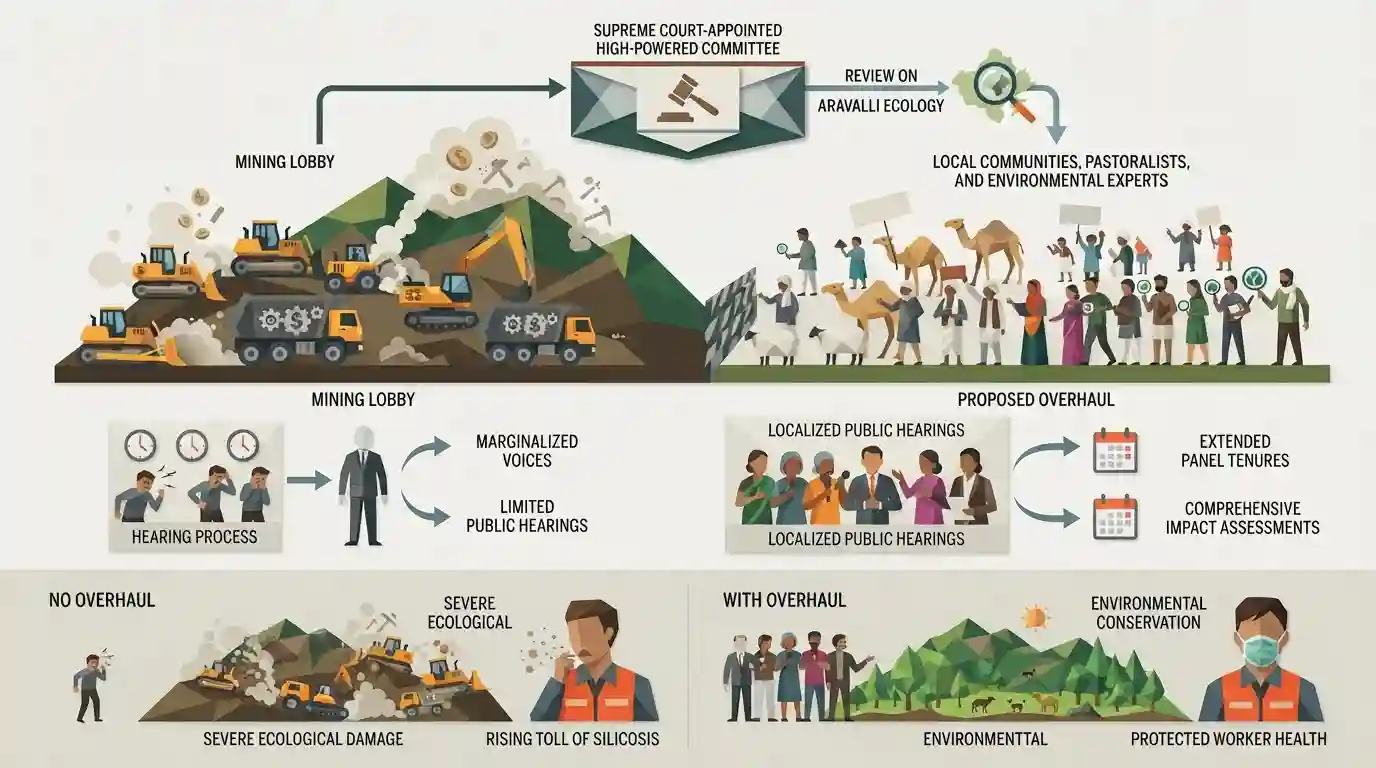
Civil rights organizations in Rajasthan have called for an immediate overhaul of the hearings conducted by a Supreme Court-appointed High-Powered Committee on the Aravalli hills. They contend that the panel's review on the delineation and ecology of the Aravallis has been co-opted by the mining lobby, marginalizing the voices of affected local communities, pastoralists, and environmental experts. The groups are pushing for extended panel tenures, localized public hearings, and comprehensive environmental and public health impact assessments to address the severe ecological damage and the rising toll of silicosis among mining workers.
मुख्य मुद्दे
- Civil rights and environmental groups in Rajasthan are demanding a major overhaul in the functioning of the Supreme Court-appointed High-Powered Committee (HPC) on the Aravalli hill range.
- Activists argue that the public hearings conducted by the panel are dominated by the mining lobby and real estate developers, leaving out crucial stakeholders like rural communities, farmers, pastoralists, and ecological/water experts.
- The Aravallis face severe environmental degradation due to illegal and aggressive mining, leading to critical groundwater depletion, loss of biodiversity, and the rise of occupational health crises like silicosis among mine workers.
- The groups have demanded an extension of the committee's tenure, transparent public notices, regional-level hearings, and a comprehensive, interdisciplinary assessment (ecological, hydrological, and social) before finalizing the definition and delineation of the Aravalli range.
महत्त्वाच्या संज्ञा
Supreme Court of India

The apex judicial body in India, established under Part V, Chapter IV of the Constitution, serving as the ultimate court of appeal and guardian of the Constitution.
UPSC context
GS Paper II: Polity & Governance. Tests understanding of judicial activism, landmark judgments, and separation of powers.
Mazdoor Kisan Shakti Sangathan
A grassroots civil society organization founded in Rajasthan in 1990, pioneering the struggle for transparency, minimum wages, and the landmark Right to Information Act.
UPSC context
GS Paper II: Governance & Civil Society. Tests understanding of pressure groups, social accountability, and rights-based legislations.
People’s Union for Civil Liberties
A premier national human rights organization formed in 1976 by Jayaprakash Narayan, dedicated to defending civil liberties and human rights through advocacy and public interest litigation.
UPSC context
GS Paper II: Civil Society & Fundamental Rights. Tests the role of NGOs and landmark judicial pronouncements.
Aravalli Hills Range
One of the world’s oldest fold mountain systems, stretching through Gujarat, Rajasthan, Haryana, and Delhi, providing vital ecological barriers, water recharge, and biodiversity.
UPSC context
GS Paper I: Geography & GS Paper III: Environment. Tests geological systems and ecological conservation challenges.
Silicosis
An incurable, preventable occupational lung disease caused by inhaling crystalline silica dust, prevalent among workers in mining, quarrying, construction, and stone-cutting industries.
UPSC context
GS Paper III: Environment & GS Paper II: Social Justice. Tests occupational hazards, public health policies, and labor welfare.
पूर्वपरीक्षा सापळा
Silicosis is a notified disease compensable exclusively under state-level schemes, lacking central statutory backing.
It is federally notified under the Mines Act 1952 and Factories Act 1948, with compensation mandated by the central Employees' Compensation Act 1923.
संबंधित स्थिर संकल्पना
What is the District Mineral Foundation (DMF) and its funding mandate?
- Origin & Mandate: Established as a non-profit trust in mining-affected districts under the MMDR Amendment Act, 2015.
- Funding Source: Miners pay a defined percentage (10% to 30%) of their royalty into the trust.
- Usage Priority: Governed by PMKKKY guidelines, prioritizing healthcare, clean water, and rehabilitation in affected areas.
What are the primary ecological roles of the Aravalli Range?
- Geological Status: One of the world's oldest fold mountain ranges, now deeply relict and dissected.
- Desertification Shield: Acts as a critical green barrier preventing the eastward expansion of the Thar Desert.
- Hydrological Function: Serves as a vital groundwater recharge zone and water divide for Northwest India.
आंतर-विषय नमुने
Judicial committees vs Executive clearances
SC-appointed committees highlight the judiciary's interventionist role when statutory environmental clearances fail to prevent severe mining-induced ecological degradation.
Occupational health as environmental justice
Uniting silicosis mitigation with eco-restoration demonstrates how labor rights under mining laws intersect with constitutional mandates for a clean environment.

Aravalli biogeography, SC-appointed committees, and DMF health-funding rules are prime for a multi-statement GS-3 question in 2026.
संबंधित PYQ · 3
संबंधित PYQ · 3
- 2025MainsGS3
Mineral resources are fundamental to the country's economy and these are exploited by mining. Why is mining considered an environmental hazard? Explain the remedial measures required to reduce the environmental hazard due to mining.
- 2024MainsGS3
What role do environmental NGOs and activists play in influencing Environmental Impact Assessment (EIA) outcomes for major projects in India? Cite four examples with all important details.
- 2025MainsGS2
What are environmental pressure groups? Discuss their role in raising awareness, influencing policies and advocating for environmental protection in India.
