Maharashtra Tribal Hostel Administration and Civil Society Protest
Source:theprint ↗
Why It Matters
The issue involves state policy regarding tribal welfare infrastructure, administration of educational facilities for marginalized sections, and civil society activism in Maharashtra, making it relevant for governance and social justice components of the syllabus.
Summary
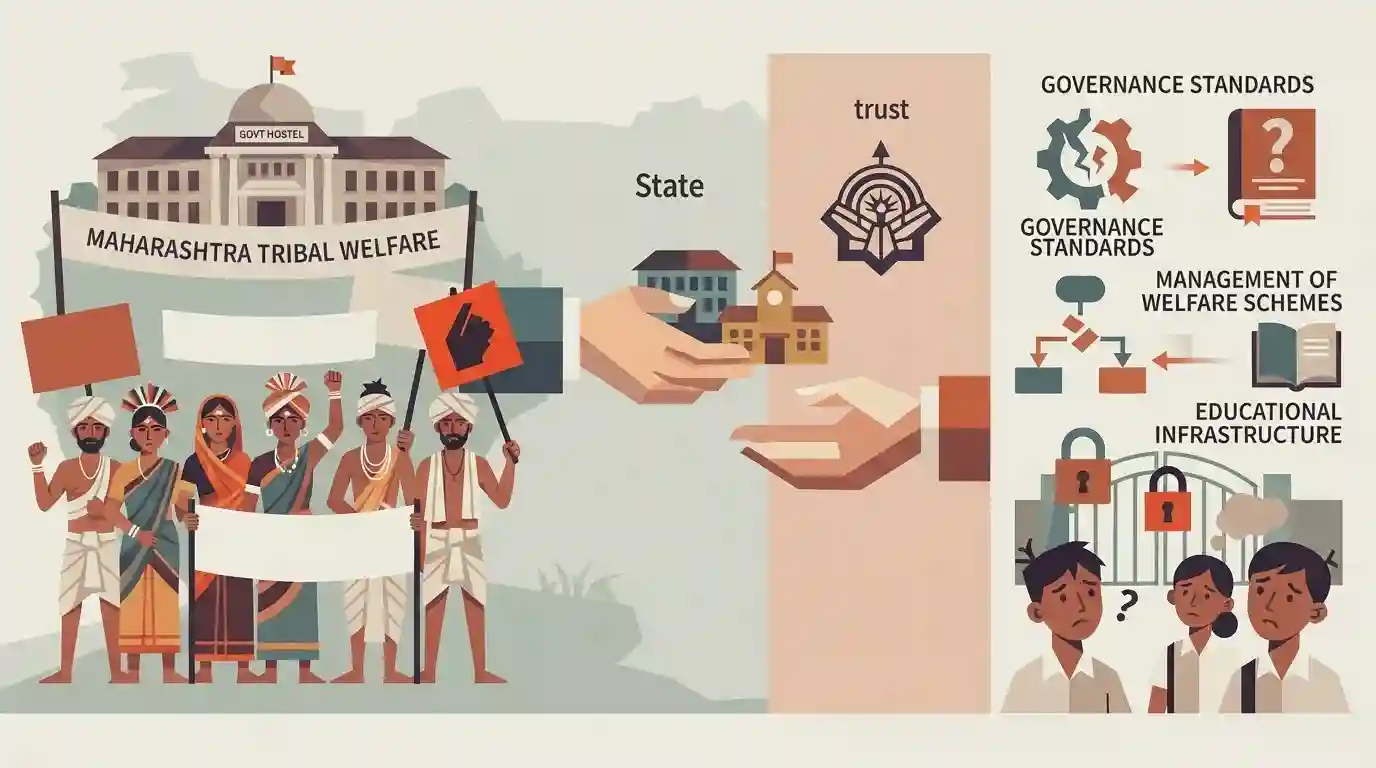
A rights group in Maharashtra has protested against the alleged handing over of state-run tribal hostels to an RSS-linked trust, bringing public attention to governance standards, management of tribal welfare schemes, and educational infrastructure for marginalized communities in the state.
Key Points
- A rights group in Maharashtra has raised concerns and sparked protests over the alleged handover of tribal student hostels to an RSS-linked trust.
- The controversy highlights governance, transparency, and public resource management issues concerning educational infrastructure for marginalized and scheduled tribe (ST) communities in Maharashtra.
- Protesters argue that state-backed welfare facilities meant for tribal students should remain under public administration to ensure equitable access and accountability.
Important Terms
Rashtriya Swayamsevak Sangh (RSS)

A volunteer organisation founded in 1925, espousing Hindu nationalist ideology, with extensive network of affiliate bodies active across social, educational, and political fields in India.
UPSC context
Relevant for MPSC (Polity/Social Issues); tests understanding of socio-political organizations, civil society groups, and ideological influences on public policy.
Maharashtra Government
The administrative and legislative apparatus governing Maharashtra, responsible for formulating and implementing welfare policies for marginalized groups including Scheduled Tribes.
UPSC context
Core to MPSC Governance and Administration topics; tests state-level institutional frameworks, tribal welfare schemes, and policy controversies.
Prelims Trap
handing over of state-run tribal hostels to a private trust
Aspirants might assume the MoU transferred total ownership of the hostels, whereas the government clarified it was restricted to educational and career guidance programs while administrative control remained with the state.
Static Concepts Connected
What are the constitutional safeguards and administrative provisions for Scheduled Tribes in Maharashtra?
- Fifth Schedule: Constitutional basis includes Article 244 and the Fifth Schedule governing scheduled areas, empowering the Governor to modify laws.
- Grants-in-Aid: Article 275(1) provides grants-in-aid from the Consolidated Fund of India for promoting the welfare of STs and upgrading administration.
- State Machinery: The Tribal Development Department of Maharashtra executes various educational, residential, and economic empowerment schemes for ST students.
Cross-Topic Patterns
Tribal Welfare Infrastructure & Fifth Schedule Governance
Tribal hostel management policies intersect with the constitutional mandate of the Fifth Schedule and Article 275(1) grants for Scheduled Tribes welfare in Maharashtra.
NGO/Trust Partnerships vs State Welfare Accountability
The public-private partnership or outsourcing model in social sector schemes mirrors debates on civil society participation versus state accountability in education.

MPSC may combine Maharashtra Tribal Development Dept schemes, hostel capacity, and fifth schedule provisions in a statement-based question.
Linked PYQs · 2
Linked PYQs · 2
- 2025MPSC_PRELIMSGS1
Identify the correct statements regarding Bhagwan Birsa Munda Road Linking Scheme. A. This scheme was started by Maharashtra Government. B. This scheme was only launched to connect the tribal villages. C. This scheme was made to connect tribal areas with primary health centres and Ashram schools through main roads. D. This scheme was discontinued by Govt. of Maharashtra in January 2025.
- 2018MPSC_PRELIMSGS1
In Maharashtra, Dr. Abdul Kalam Amrut Ahar Yojana is related with
