Right to vote versus freedom of voting in Supreme Court
Source:The Hindu ↗
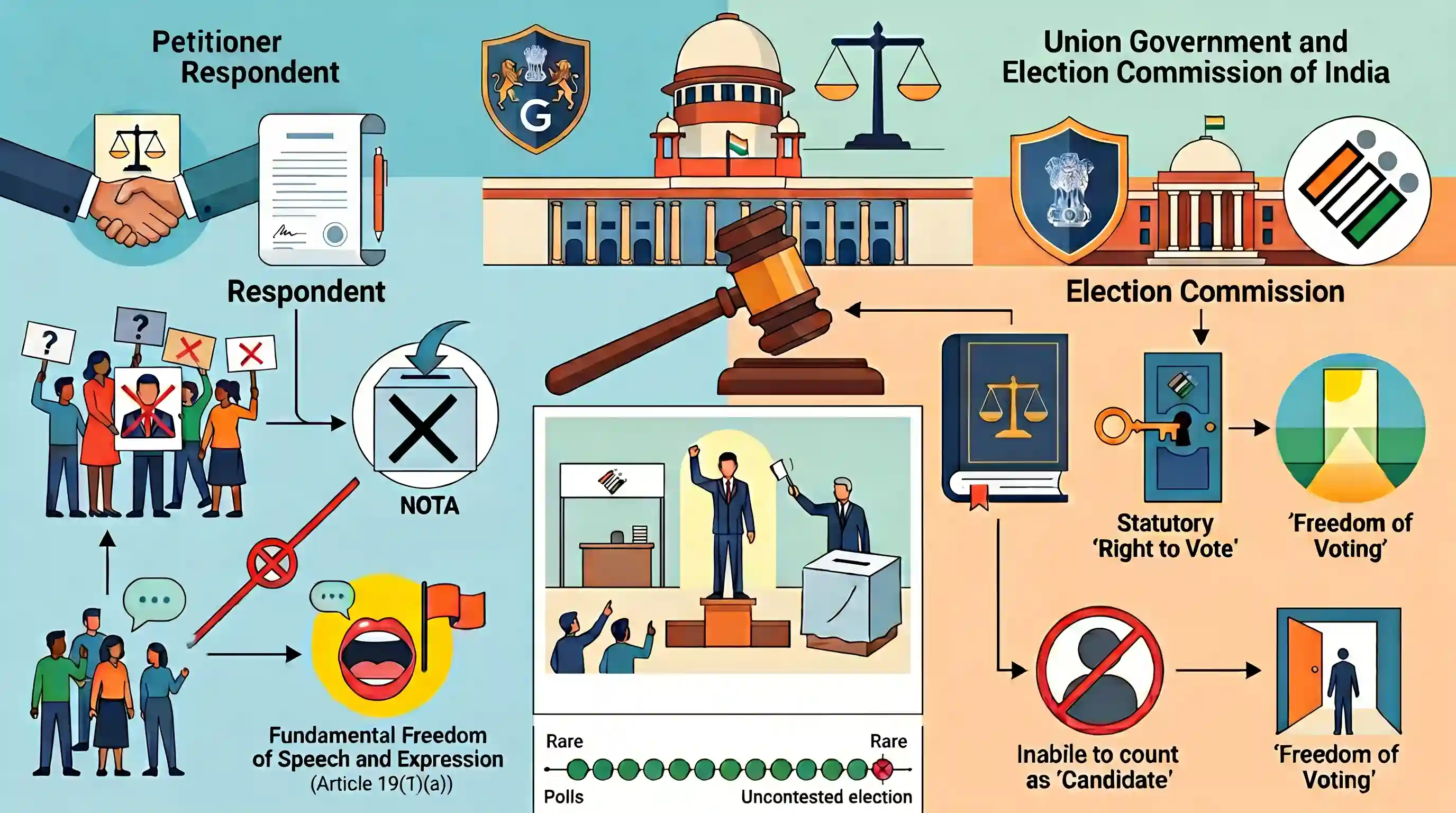
Why It Matters
The article highlights an ongoing legal and constitutional debate concerning the exact nature of the voting right in India. While the Centre argues it is purely statutory, it distinguishes it from the fundamental 'freedom of expression' exercised during voting. This touches upon core UPSC Polity topics including the nuances of the Representation of the People Act, electoral reforms like NOTA, and the interpretation of Fundamental Rights under Article 19(1)(a). A 2017 UPSC Prelims question explicitly asked if the right to vote is a Constitutional Right, making this evolving jurisprudence highly relevant.
Summary
The Union Government and the Election Commission of India have defended Section 53(2) of the Representation of the People Act (RPA), 1951, which governs uncontested elections, against a Supreme Court petition filed by the Vidhi Centre for Legal Policy and the Association for Democratic Reforms (ADR). The petitioners argue that declaring a sole candidate the winner without holding a poll denies voters the opportunity to exercise the NOTA (None of the Above) option, thereby violating their fundamental right to freedom of speech and expression under Article 19(1)(a) of the Constitution. The Centre countered by distinguishing between the statutory 'right to vote' (under Section 62 of RPA) and the fundamental 'freedom of voting', arguing that the latter is contingent upon a poll actually taking place. The Centre additionally clarified that NOTA cannot be legally construed as a "candidate" under Section 79(b) of the RPA to force a poll. The Election Commission supported this stance, noting that uncontested elections are exceedingly rare in India's democratic history.
Key Points
- The Centre informed the Supreme Court that the "right to vote" is a statutory right under Section 62 of the RPA, 1951, while "freedom of voting" is a fundamental right to expression under Article 19(1)(a) contingent on a poll taking place.
- A petition challenges Section 53(2) of the RPA and Rule 11 of the Conduct of Elections Rules, 1961, which mandate the declaration of a winner without a poll in uncontested elections.
- Petitioners (including ADR and Vidhi Centre) argue that uncontested elections deprive voters of their right to exercise the NOTA (None of the Above) option to express dissatisfaction with candidates.
- The Centre and Election Commission countered that NOTA is merely an expression and not a 'candidate' under Section 79(b) of the RPA, hence it cannot legally force a poll in uncontested scenarios.
- The Election Commission stated that uncontested elections are extremely rare, citing only 9 such instances out of 20 General Elections from 1951 to 2024.
Important Terms
Representation of the People Act, 1951

A parliamentary act regulating the actual conduct of elections, membership qualifications, and the resolution of electoral disputes like corrupt practices.
UPSC context
GS-2: Representation of People’s Act and Electoral Reforms; tests understanding of the legal framework governing Indian democracy.
Article 19(1)(a) of the Constitution
A Fundamental Right guaranteeing freedom of speech and expression, which the judiciary interprets as including a voter's right to express preference during polling.
UPSC context
GS-2: Fundamental Rights; tests the ability to link civil liberties with democratic participation and judicial interpretations.
Election Commission of India (ECI)
An autonomous constitutional body established under Article 324 to oversee free and fair elections for Parliament, State Legislatures, and the President/Vice-President.
UPSC context
GS-2: Constitutional Bodies; tests knowledge of the executive’s role in managing the electoral process and ensuring fairness.
Association for Democratic Reforms (ADR)
A prominent non-partisan NGO that advocates for electoral transparency and political accountability through strategic litigation and voter awareness campaigns.
UPSC context
GS-2: Governance and NGOs; tests the impact of civil society on policy changes and institutional transparency.
Conduct of Elections Rules, 1961
A set of statutory rules providing the procedural framework for conducting polls, counting votes, and candidate nominations under the Representation of the People Act.
UPSC context
GS-2: Electoral Reforms; tests precision regarding the administrative procedures and secondary legislation that enable democratic exercises.
Supreme Court of India
The highest judicial authority and final interpreter of the Constitution, responsible for adjudicating the constitutional validity of laws and protecting fundamental rights.
UPSC context
GS-2: Judiciary; tests understanding of judicial review and the court's role as the arbiter of constitutional disputes.
Prelims Trap
"The Right to Vote in India is a Fundamental Right guaranteed under Article 19(1)(a) of the Constitution."
The Right to Vote is a Constitutional/Statutory Right (Art 326/RPA). Only the freedom of expression while voting (like choosing NOTA) is a Fundamental Right under Art 19(1)(a).
Static Concepts Connected
What is the legal status of the Right to Vote and NOTA in India?
- Right to Vote: It is a Constitutional Right (Article 326) made operational as a Statutory Right under Section 62 of the Representation of the People Act, 1951.
- NOTA's status: The Supreme Court (PUCL case, 2013) ruled that expressing a negative choice (NOTA) is a Fundamental Right under Article 19(1)(a) (Freedom of Speech and Expression).
- No legal teeth: NOTA is strictly an expression of dissent, not a statutory 'candidate'. It cannot legally invalidate an election even if it secures maximum votes.
How are uncontested elections legally handled under the RPA, 1951?
- Section 53(2) mandate: If the number of contesting candidates exactly equals the number of seats, the Returning Officer must automatically declare them elected without a poll.
- Rule 11 impact: Under the Conduct of Elections Rules 1961, an uncontested election prevents an actual ballot from taking place, structurally disabling the exercise of NOTA.
Cross-Topic Patterns
NOTA vs. Right to Reject
While NOTA allows voter dissent, India lacks a statutory 'Right to Reject' that would mandate fresh elections if NOTA wins. The Law Commission and ECI have debated this transition frequently.
Art 326 vs Art 19(1)(a) Interplay
UPSC loves testing overlapping rights. Similar to how the Right to Property (Art 300A) interacts with Art 21, the Constitutional Right to Vote (Art 326) intersects with Freedom of Expression (Art 19).

Expect a 2026 Prelims statement distinguishing the statutory 'Right to Vote' (RPA) from the fundamental 'Freedom of Voting' (Art 19).
Linked PYQs · 3
Linked PYQs · 3
- 2017PrelimsGS1
Right to vote and to be elected in India is a
- 2022MainsGS2
Discuss the procedures to decide the disputes arising out of the election of a Member of the Parliament or State Legislature under The Representation of the People Act, 1951. What are the grounds on which the election of any returned candidate may be declared void ? What remedy is available to the aggrieved party against the decision ? Refer to the case laws.
- 2024MainsGS2
Examine the need for electoral reforms as suggested by various committees with particular reference to "one nation one election" principle.
