Constitutional Separation of Electoral Franchise and Delimitation
Source:Indian Express ↗
Why It Matters
This judicial stance clarifies that electoral representation rules are matters of federal policy rather than individual voting rights violations. It is highly relevant as India approaches the expiration of the seat-allocation freeze in 2026, which will force a delicate balance between democratic representation and federal equity.
Summary
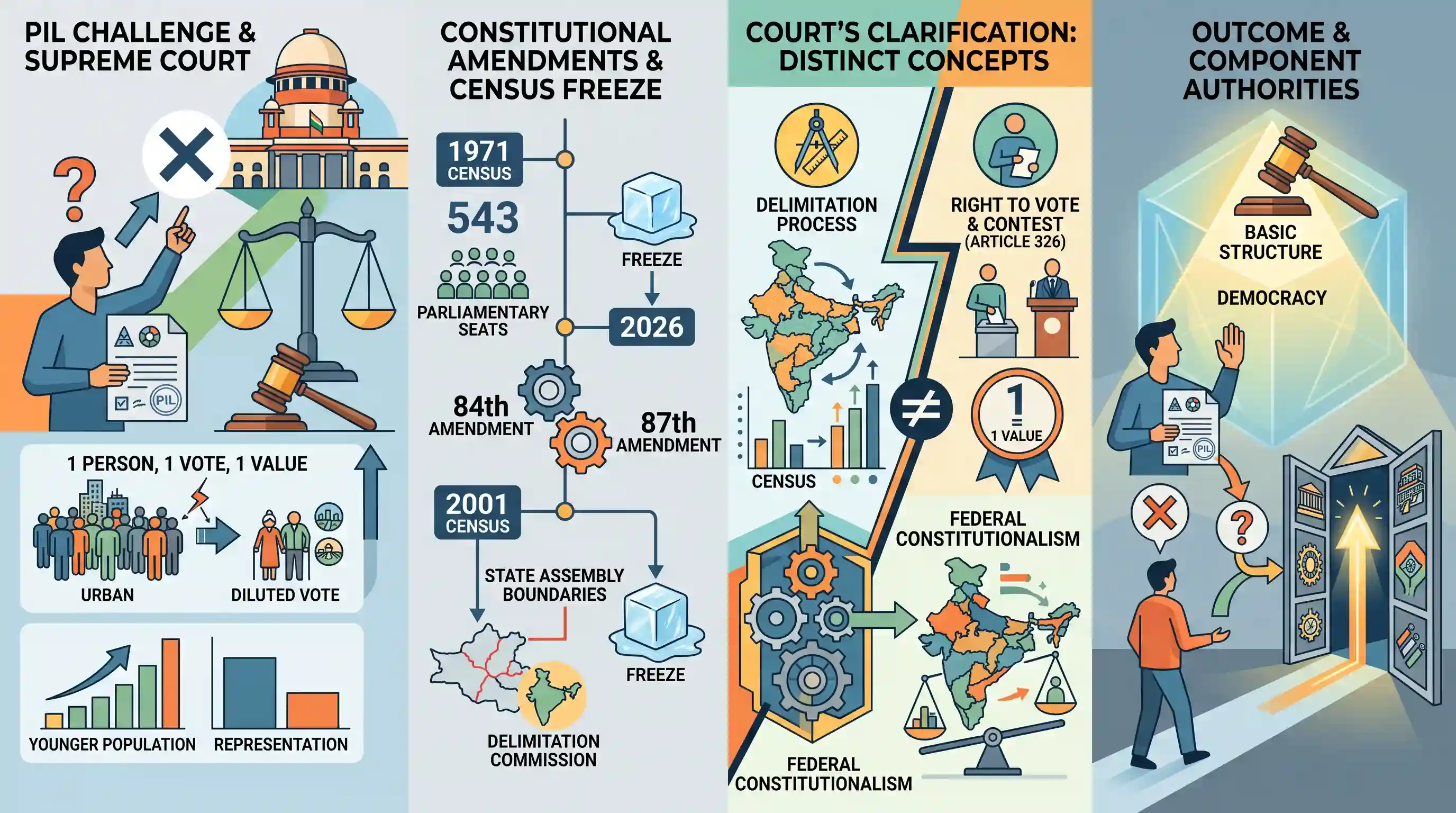
The Supreme Court of India declined to hear a Public Interest Litigation (PIL) challenging the 84th and 87th Constitutional Amendment Acts, which freeze parliamentary seat allocations based on the 1971 census and state assembly boundaries based on the 2001 census. Dismissing the argument that the seat freeze dilutes the value of individual votes and under-represents younger populations and expanding urban centers, the Court clarified that the right to vote and contest elections is structurally distinct from the process of delimitation. It emphasized that federal constitutionalism preserves the balance of vote values between states, allowing the petitioner to withdraw the plea to approach competent authorities.
Key Points
- The Supreme Court refused to entertain a PIL challenging the 84th and 87th Constitutional Amendment Acts, which freeze Lok Sabha seat allocation based on the 1971 Census and state assembly boundaries based on the 2001 Census.
- The petitioner argued that the prolonged freeze (extended to 2026) violates the principle of 'one person, one vote, one value,' dilutes political justice, and leaves nearly 70% of the population born after 1971 under-represented, especially in rapidly growing urban areas like Gurugram, Noida, and Mohali.
- The SC Bench (CJI Surya Kant, Justice Joymalya Bagchi, and Justice V Mohana) observed that the 'right to vote has nothing to do with delimitation.' Delimitation and census data do not deprive citizens of their constitutional right to vote or contest elections.
- The Court clarified that under India's framework of 'federal constitutionalism,' vote value is balanced across states to preserve federal equilibrium, even if the mathematical value of an individual vote changes relative to overall population growth.
- The case highlights the escalating constitutional debate surrounding the post-2026 delimitation exercise, where India must balance proportional democratic representation against protecting the political representation of states that successfully achieved population control.
Important Terms
84th Constitutional Amendment Act, 2001

An amendment that extended the freeze on Lok Sabha and State Assembly seat allocations based on the 1971 census until the first census post-2026, to encourage population stabilization.
UPSC context
GS Paper II (Polity & Constitution); tests knowledge of federal representation, demographic transition, and parliamentary seat allocation rules.
87th Constitutional Amendment Act, 2003
An amendment that allowed the internal readjustment and rationalisation of electoral constituency boundaries within Indian states using population data from the 2001 census instead of the 1991 census.
UPSC context
GS Paper II (Polity & Governance); covers the evolution of constituency boundaries, electoral reforms, and census-based updates of representation.
Delimitation Commission
An independent, high-powered statutory body appointed by the President of India to redraw the boundaries of parliamentary and assembly constituencies based on demographic shifts following a census.
UPSC context
GS Paper II (Elections & Constitutional Bodies); tests understanding of institutional mechanisms behind constituency mapping and equal voter representation.
Representation of the People Act
Core parliamentary acts regulating seat allocation, constituency delimitation, voter registration, conduct of elections, and the qualifications, disqualifications, and corrupt practices of political candidates.
UPSC context
GS Paper II (Salient features of RPA); a vital syllabus topic testing the statutory framework of India's electoral and democratic process.
Prelims Trap
The Lok Sabha or State Assemblies can modify or veto the final orders of the Delimitation Commission before implementation.
Under the Delimitation Act, when the Commission's orders are laid before the Lok Sabha or State Assemblies, they have the force of law and cannot be modified, amended, or rejected by any legislature.
Static Concepts Connected
What is the constitutional status and power of the Delimitation Commission?
- Constitutional Basis: Articles 82 (for Parliament) and 170 (for State Assemblies) mandate the readjustment of seats after each decennial census.
- Appointment: The President of India appoints the Commission, which functions in close collaboration with the Election Commission of India.
- Judicial Immunity: Its orders carry the force of law and cannot be called into question before any court of law once published.
- Legislative Finality: When orders are laid before the Lok Sabha or State Assemblies, no modifications are permitted.
How do the 84th and 87th Constitutional Amendment Acts differ?
- 84th Amendment (2001): Froze the total number of seats allocated to each State in the Lok Sabha based on the 1971 Census until after 2026.
- 87th Amendment (2003): Allowed internal boundary readjustments of constituencies within states using the 2001 Census, without changing the state's total seats.
Cross-Topic Patterns
Demographic Divergence & Fiscal Federalism
The use of 2011 population data by the 15th Finance Commission mirrors the delimitation challenge, potentially penalizing southern states for successful population control.
Women's Reservation & Delimitation
The 128th Constitutional Amendment Act (Nari Shakti Vandan Adhiniyam) ties the implementation of the 33% women's reservation directly to the next delimitation exercise.

Post-2026 delimitation friction between 'one vote, one value' and demographic federal balance is a high-yield GS-II UPSC Mains theme.
Linked PYQs · 2
Linked PYQs · 2
- 2017PrelimsGS1
Right to vote and to be elected in India is a
- 2012PrelimsGS1
With reference to the Delimitation Commission, consider the following statements: 1. The orders of the Delimitation Commission cannot be challenged in a Court of Law. 2. When the orders of the Delimitation Commission are laid before the Lok Sabha or State Legislative Assembly, they cannot effect any modifications in the orders. Which of the statements given above is/are correct?
