Safe Travel on National Highways and Expansion of Right to Life
Source:The Hindu ↗
Why It Matters
The Supreme Court continuously expands the ambit of Article 21 (Right to Life) to address contemporary governance challenges. This ruling is directly relevant to GS Paper 2 (Constitution and Governance) and highlights road safety as a crucial public administration issue.
Summary
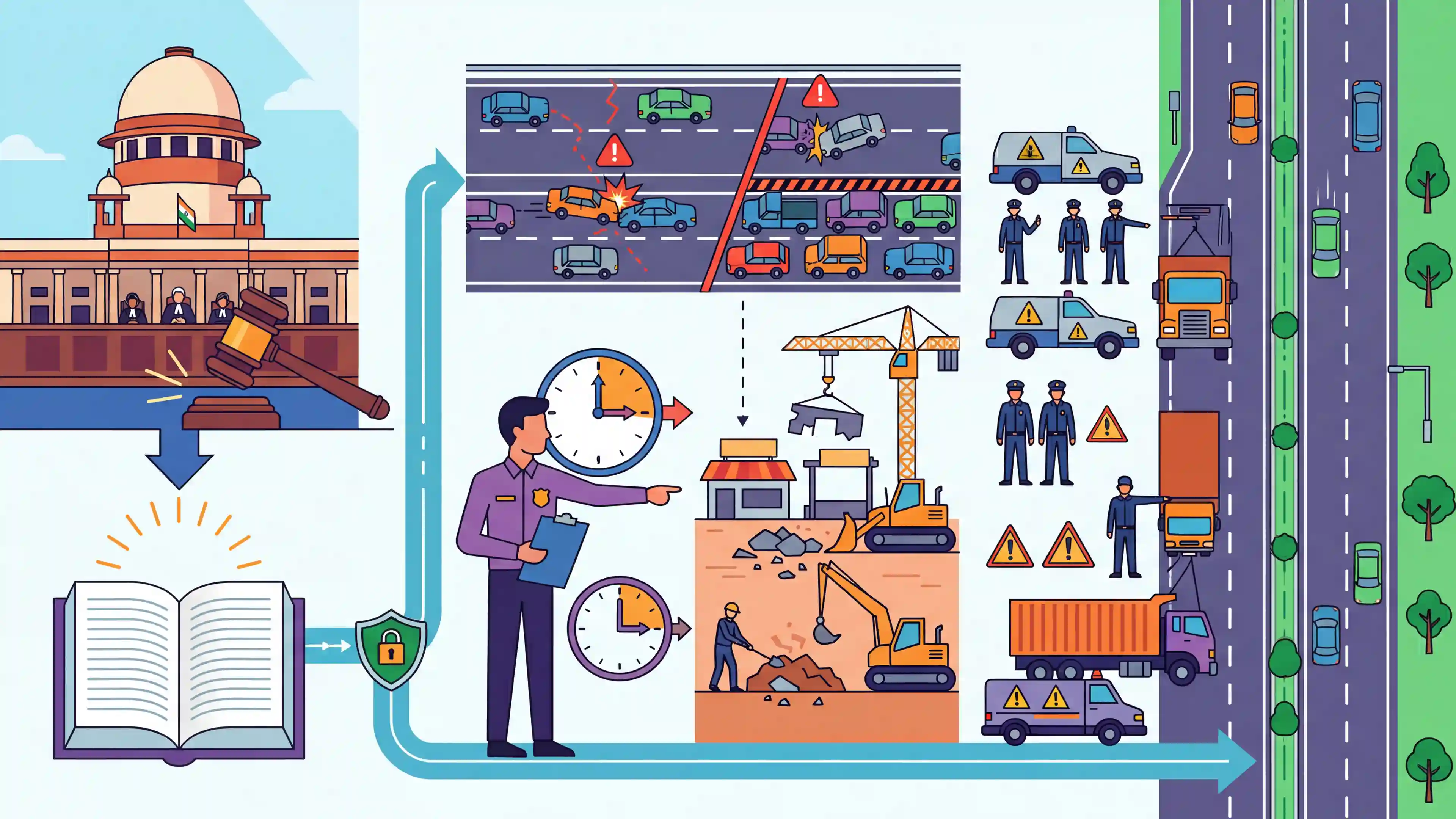
The Supreme Court of India has significantly expanded the scope of Article 21 (Right to Life) by declaring the right to safe travel on National Highways a fundamental right. Alarmed by the high fatality rates—where NHs account for nearly 30% of road deaths despite making up just 2% of the road network—the Court issued stringent directives to clear encroachments. District Magistrates have been ordered to demolish unauthorized structures like dhabas and eateries within the highway right-of-way within 60 days. Furthermore, the Court mandated the creation of a 'District Highway Safety Task Force' in every district to enforce these rules and prevent illegal parking by heavy vehicles on highways.
Key Points
- The Supreme Court ruled that the right to safe travel on National Highways (NHs) is an integral part of the fundamental right to life under Article 21.
- Despite comprising only ~2% of India's road network, National Highways account for nearly 30% of road accident fatalities.
- The Court prohibited the construction and operation of unauthorized commercial structures, including dhabas and eateries, within the right-of-way of NHs.
- Heavy and commercial vehicles are banned from parking or stopping on NHs except in designated parking bays.
- District Magistrates are ordered to demolish illegal structures within 60 days, and a 'District Highway Safety Task Force' is to be constituted in every district.
Important Terms
Article 21 of the Constitution

A fundamental right guaranteeing that no person shall be deprived of life or personal liberty except according to procedure established by law. The Supreme Court has expanded this to include safe travel.
UPSC context
GS Paper II: Fundamental Rights. Tests knowledge of judicial expansion of rights and the concept of 'Right to Life' including safety.
National Highways Authority of India (NHAI)
A statutory body under the Ministry of Road Transport and Highways responsible for the development, maintenance, and management of the National Highways network in India.
UPSC context
GS Paper III: Infrastructure. Tests understanding of statutory bodies and their role in national connectivity and safety.
District Highway Safety Task Force
A district-level multi-departmental body mandated by the Supreme Court to monitor highway safety, comprising officials from the district administration, police, NHAI, PWD, and local bodies.
UPSC context
GS Paper II: Governance. Tests knowledge of new institutional mechanisms for law enforcement and administrative accountability.
Right of Way (ROW)
The legal land area reserved for a highway, including the road surface, shoulders, and median. The Supreme Court ordered all encroachments within this zone to be cleared.
UPSC context
GS Paper III: Infrastructure/Environment. Relevant for technical terms in land management and public safety regulations.
Control of National Highways (Land and Traffic) Act, 2002
The 2002 legislation that empowers the Highway Administration to prevent and remove unauthorized occupation of highway land and regulate traffic to ensure public safety.
UPSC context
GS Paper II: Governance/Legislation. Tests knowledge of specific laws governing national infrastructure and executive powers.
Prelims Trap
"The Constitution explicitly guarantees the right to safe travel on National Highways under Article 21."
Article 21 only explicitly mentions 'life and personal liberty'. The right to safe travel is a judicially deduced right, not a textually explicit constitutional provision.
Static Concepts Connected
How has the Supreme Court expanded Article 21 (Right to Life) over time?
- Right to Privacy: Recognized in the landmark K.S. Puttaswamy case (2017) as an intrinsic part of life and personal liberty.
- Right to Environment: Established in cases like M.C. Mehta, encompassing the right to clean air, water, and a pollution-free environment.
- Right to Livelihood: Recognized in the Olga Tellis v. Bombay Municipal Corporation (1985) judgment, linking survival to livelihood.
Who regulates and manages National Highways in India?
- Union Subject: Highways declared by Parliament as National Highways fall exclusively under the Union List (Schedule VII).
- NHAI's Mandate: A statutory body created under the NHAI Act, 1988, responsible for the development, maintenance, and management of NHs.
- State Coordination: While the Centre builds NHs, local law and order (like clearing encroachments) requires District Magistrates and State Police, often causing jurisdictional friction.
Cross-Topic Patterns
Judicial intervention in executive domains
Mandating district-level task forces and ordering 60-day demolition drives borders on executive functioning, highlighting the ongoing GS2 debate over judicial activism versus executive overreach.
NH expansion vs Fatality rates
The glaring statistic—NHs hold 2% road share but 30% of deaths—links GS3 infrastructure growth directly to GS2 governance failures in enforcing the Motor Vehicles (Amendment) Act.

Expect a Prelims Q asking which implied rights fall under Article 21, or a GS2 Mains Q on judicial intervention in road safety governance.
Linked PYQs · 1
Linked PYQs · 1
- 2023MainsGS2
“The Constitution of India is a living instrument with capabilities of enormous dynamism. It is a constitution made for a progressive society.” Illustrate with special reference to the expanding horizons of the right to life and personal liberty.
