Right to Protest in India and Legal Remedies for Denied Permissions
Source:Indian Express ↗
ఇది ఎందుకు ముఖ్యం
Crucial for understanding the delicate balance between civil liberties, fundamental rights (freedom of speech and assembly), and state imperatives of public order and national security.
సారాంశం
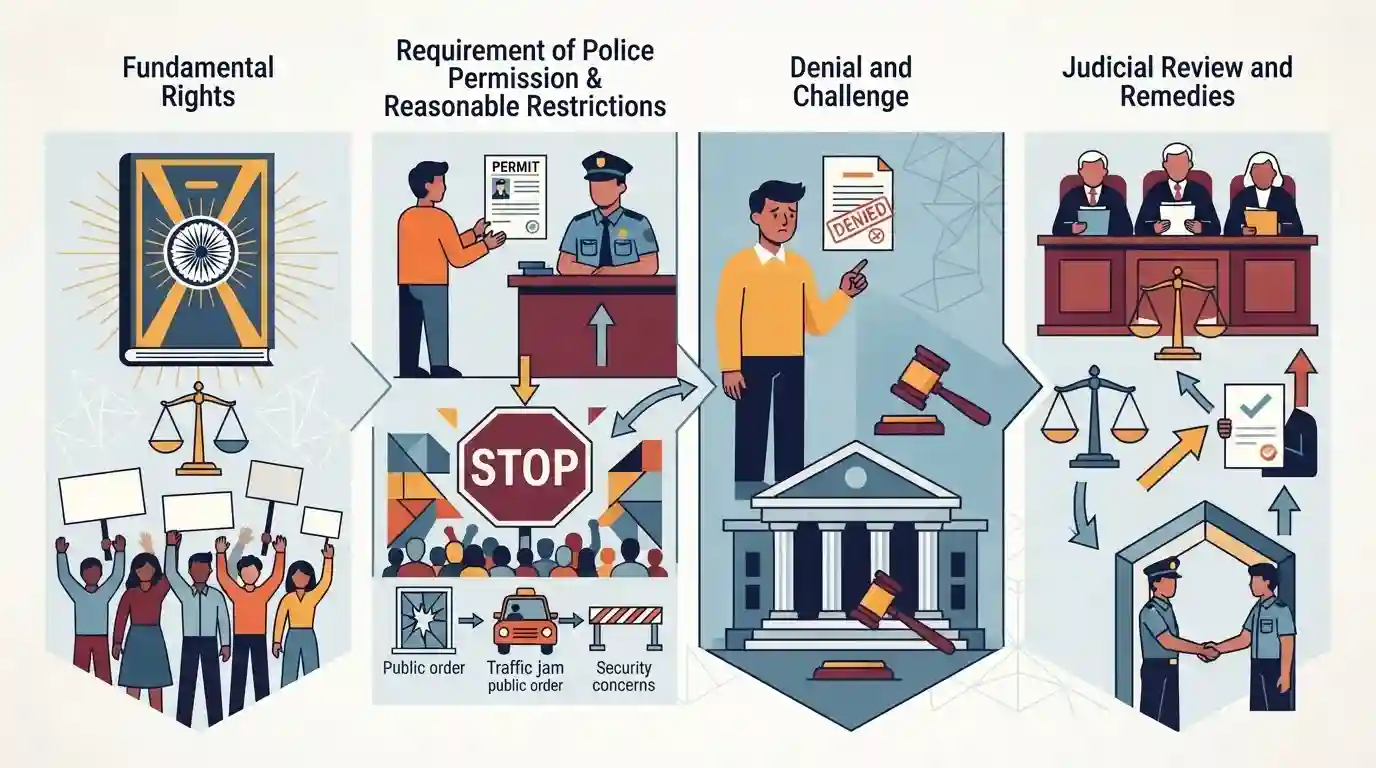
The article explains the legal framework governing the right to protest in India, the requirement of police permission, the grounds for denial under reasonable restrictions, and the constitutional and judicial remedies available when police permission is denied.
ముఖ్య అంశాలు
- The right to protest is a fundamental right guaranteed under Article 19(1)(a) (freedom of speech and expression) and Article 19(1)(b) (freedom to assemble peaceably and without arms) of the Indian Constitution.
- However, these rights are not absolute and are subject to reasonable restrictions under Articles 19(2) and 19(3) in the interests of sovereignty, integrity, public order, and morality.
- Authorities can deny permission for protests based on law and order concerns, traffic disruptions, or public safety, but such denials must be reasoned and not arbitrary or absolute censorship.
- Legal remedies against denial of police permission include approaching the High Court under Article 226 for a writ of mandamus to challenge arbitrary or unconstitutional orders.
ముఖ్యమైన పదాలు
Article 19(1)(a)

Guarantees all citizens the freedom of speech and expression, forming the primary constitutional basis for verbal and expressive forms of public protest in India.
UPSC context
GS Paper II (Polity and Governance - Fundamental Rights) - Evaluates the extent and scope of free expression in a democracy.
Article 19(1)(b)
Protects the right of citizens to assemble peaceably and without arms, allowing for peaceful rallies, processions, and public meetings subject to state regulation.
UPSC context
GS Paper II (Polity and Governance - Fundamental Rights) - Tests understanding of the freedom of assembly and public order balance.
Article 19(2)
Empowers the State to impose reasonable restrictions on freedom of speech and expression in the interests of the sovereignty and integrity of India, public order, and morality.
UPSC context
GS Paper II (Polity and Governance) - Crucial for examining the limits of fundamental rights and the doctrine of proportionality.
Article 19(3)
Empowers the State to place reasonable restrictions on the right to peaceful assembly in the interests of public order or the sovereignty and integrity of India.
UPSC context
GS Paper II (Polity and Governance) - Tests the regulatory powers of the state over public assemblies.
Supreme Court of India
The supreme judicial authority in India tasked with interpreting fundamental rights and reviewing executive or police actions that curtail peaceful democratic protests.
UPSC context
GS Paper II (Constitution and Judiciary) - Tests the role of the apex court in safeguarding fundamental rights through judicial review and landmark judgments.
అనుసంధానమైన స్థిర భావనలు
What are the constitutional grounds for reasonable restrictions on freedom of speech and assembly in India?
- Sovereignty & Integrity: Sovereignty and Integrity: Restrictions can be imposed to protect India's territorial integrity and national sovereignty against secessionist or subversive speech.
- Public Order threshold: Public Order: Distinct from mere law and order; involves situations affecting public tranquility, safety, and community peace on a broader scale.
- Morality standards: Morality and Decency: Empowers the state to curb obscene or grossly indecent public displays or expressions violating prevailing community standards.
అంతర-అంశ నమూనాలు
Fundamental Rights vs. Statutory Public Order Powers
Article 19 restrictions are routinely tested alongside statutory powers under the Police Act and CrPC Section 144 during public order crises.
Public Assembly vs. Urban Space Management
Protest restrictions and environmental litigation often intersect where public demonstrations clash with urban carrying capacity and green norms.

Expect a statement-based prelims question distinguishing 'public order' from 'law and order' under Article 19 reasonable restrictions.
అనుసంధాన PYQలు · 1
అనుసంధాన PYQలు · 1
- 2022MainsGS2
“Right of movement and residence throughout the territory of India are freely available to the Indian citizens, but these rights are not absolute.” Comment.
