Patna High Court Ruling on Freedom of Religion and Public Order
Source:thehindu ↗
Why It Matters
Questions regarding Fundamental Rights, reasonable restrictions, and the Essential Religious Practices test are crucial for BPSC Prelims and Mains (Polity segment). This High Court ruling serves as a vital case study on balancing religious freedoms with public order in the state of Bihar.
Summary
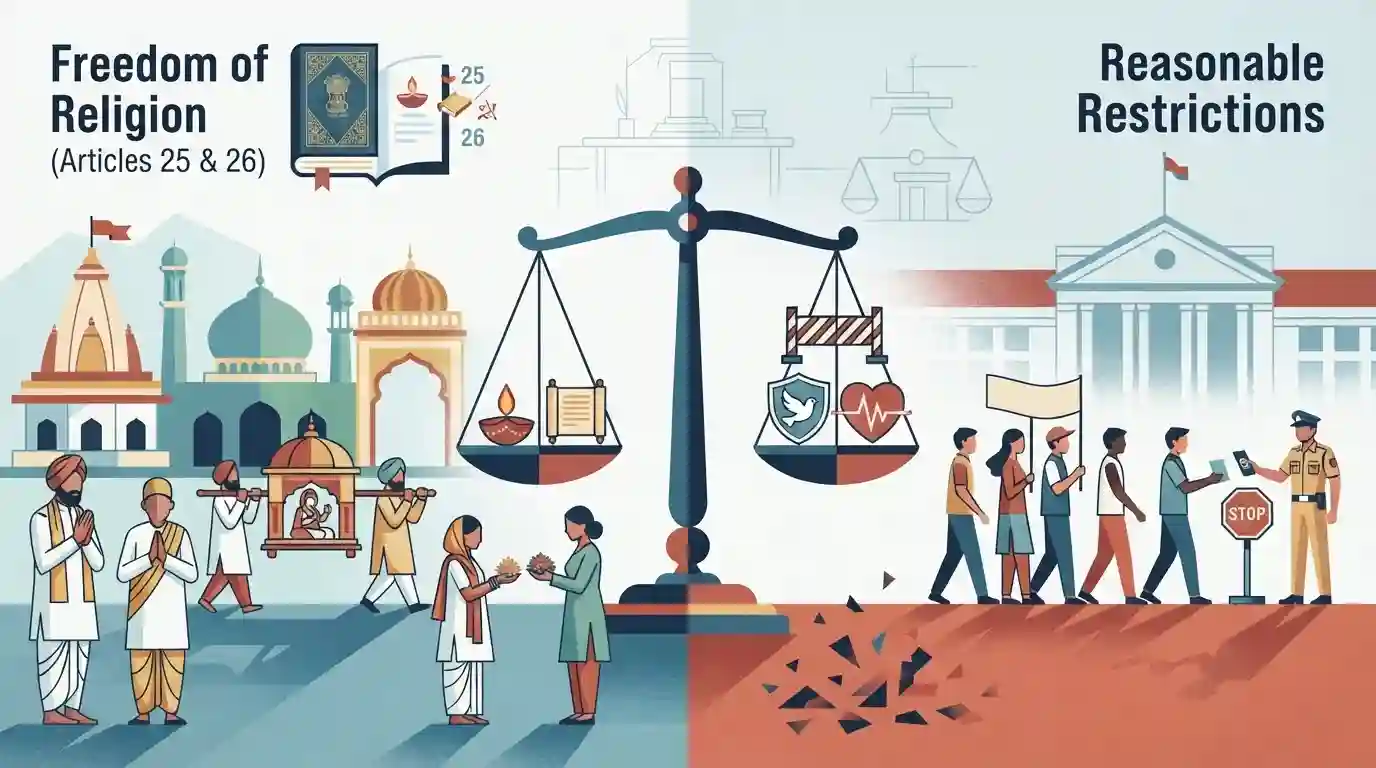
The Patna High Court has reaffirmed that the right to profess and practice religion under Articles 25 and 26 of the Indian Constitution is not absolute. The ruling came after devotees challenged a police order that limited a religious procession in Siwan, Bihar, to five participants due to violence and arson during the previous year's event. Justice Alok Kumar noted that freedom of religion is subject to reasonable restrictions—specifically public order, morality, and health—and highlighted that constitutional protections apply only to essential religious practices, which must be balanced with broader societal peace and the rights of others.
Key Points
- The Patna High Court ruled that the fundamental rights to profess and practice religion (Articles 25 and 26) are not absolute and are subject to public order, health, and morality.
- The verdict was delivered on a petition challenging police restrictions limiting a religious procession in Siwan, Bihar, to five persons following violence in the preceding year.
- The court emphasized that constitutional protection of religion extends solely to essential and integral religious practices.
- The right to freedom of religion must be harmonized with the fundamental rights of others and overarching societal norms.
Important Terms
Article 25

A fundamental right in the Indian Constitution guaranteeing freedom of conscience and the right to freely profess, practice, and propagate religion, subject to public order, morality, and health.
UPSC context
Crucial for BPSC GS Paper 2 (Polity); frequently tests the balance between individual religious freedom and reasonable restrictions by the state.
Article 26
A fundamental right granting religious denominations the freedom to manage their own religious affairs and institutions. Like Article 25, it is subject to constraints of public order, morality, and health.
UPSC context
Essential for BPSC GS Paper 2; highlights collective religious rights and the state's power to regulate them for societal peace.
Article 19(1)(b)
A constitutional provision guaranteeing Indian citizens the fundamental right to assemble peaceably and without arms, which provides the legal foundation for holding peaceful religious processions.
UPSC context
Important for BPSC GS Paper 2; tests understanding of the right to assemble and the state's power to limit processions for public tranquility.
Patna High Court
The highest judicial authority in Bihar. It has the jurisdiction to interpret the Constitution, protect fundamental rights, and adjudicate on state administrative orders within its territorial limits.
UPSC context
Highly relevant for BPSC GS Paper 2; candidates must know landmark regional judgments impacting constitutional rights and local public order.
Supreme Court of India
The apex judicial body of India, serving as the ultimate interpreter of the Constitution and setting binding precedents on the limits of fundamental rights, including religious practices.
UPSC context
Central to BPSC GS Paper 2; candidates must know how apex court precedents guide high courts in balancing rights and restrictions.
Prelims Trap
"Article 25 is subject to public order, morality, health, and the sovereignty and integrity of India."
Article 25 restrictions are strictly limited to public order, morality, health, and other provisions of Part III. "Sovereignty and integrity" restricts Article 19, not Article 25.
Static Concepts Connected
What are the constitutional grounds for restricting Article 25?
- Public Order: State can restrict practices that cause violence or disturb peace, such as regulating public religious processions.
- Morality and Health: Allows banning of practices detrimental to public safety, sanitation, or morals (e.g., banning human sacrifice).
- Part III Rights: Article 25 is uniquely subject to other Fundamental Rights, ensuring religious claims cannot bypass Article 17 (Untouchability) or Article 21.
What is the Essential Religious Practices doctrine?
- Shirur Mutt Case: The doctrine was established by the Supreme Court in the 1954 Shirur Mutt case to define the boundaries of religious protections.
- Core Tenets Only: Constitutional protection extends only to practices central and integral to a faith, not to peripheral traditions.
- State Regulation: The State retains the authority to regulate or restrict economic, financial, or political secular activities associated with religion.
Cross-Topic Patterns
Religious Freedom vs. Right to Assemble
Religious processions invoke both Article 25 and Article 19(1)(b). Both are subject to public order restrictions, typically enforced by district authorities using preventive orders like Section 163 BNSS (formerly 144 CrPC).
UCC debates and secular regulations
The Essential Religious Practices test is a core metric used by courts to separate secular personal laws from inviolable religious tenets in Uniform Civil Code (Article 44) debates.

Expect a multi-statement question mixing Article 25 restriction grounds (public order, health, morality) with Article 19 restrictions.
Linked PYQs · 3
Linked PYQs · 3
- 2025BPSC_PRELIMSGS1
The constitution of India provides for reasonable restrictions on Fundamental Rights but reasonableness must keep in mind that: 1. The restrictions must be necessary for the protection of the rights of others. 2. The restrictions must be proportionate to the end sought. 3. The restrictions must be reasonable in the light of the circumstances. 4. The restrictions must be in the public interest.
- 2025BPSC_PRELIMSGS1
Which one of the following subjects fall within the jurisdiction of both High Court and Supreme Court?
- 2024-IBPSC_PRELIMSGS1
A British Citizen staying in India can not claim right to
