Supreme Court Ruling on Digital Intermediaries and Right to Know
Source:The Hindu ↗
Why It Matters
The ruling is crucial for understanding the balance between freedom of expression/the right to know and the judiciary's powers regarding contempt of court and sub judice matters. It also highlights the evolving jurisprudence on digital intermediary liability in India.
Summary
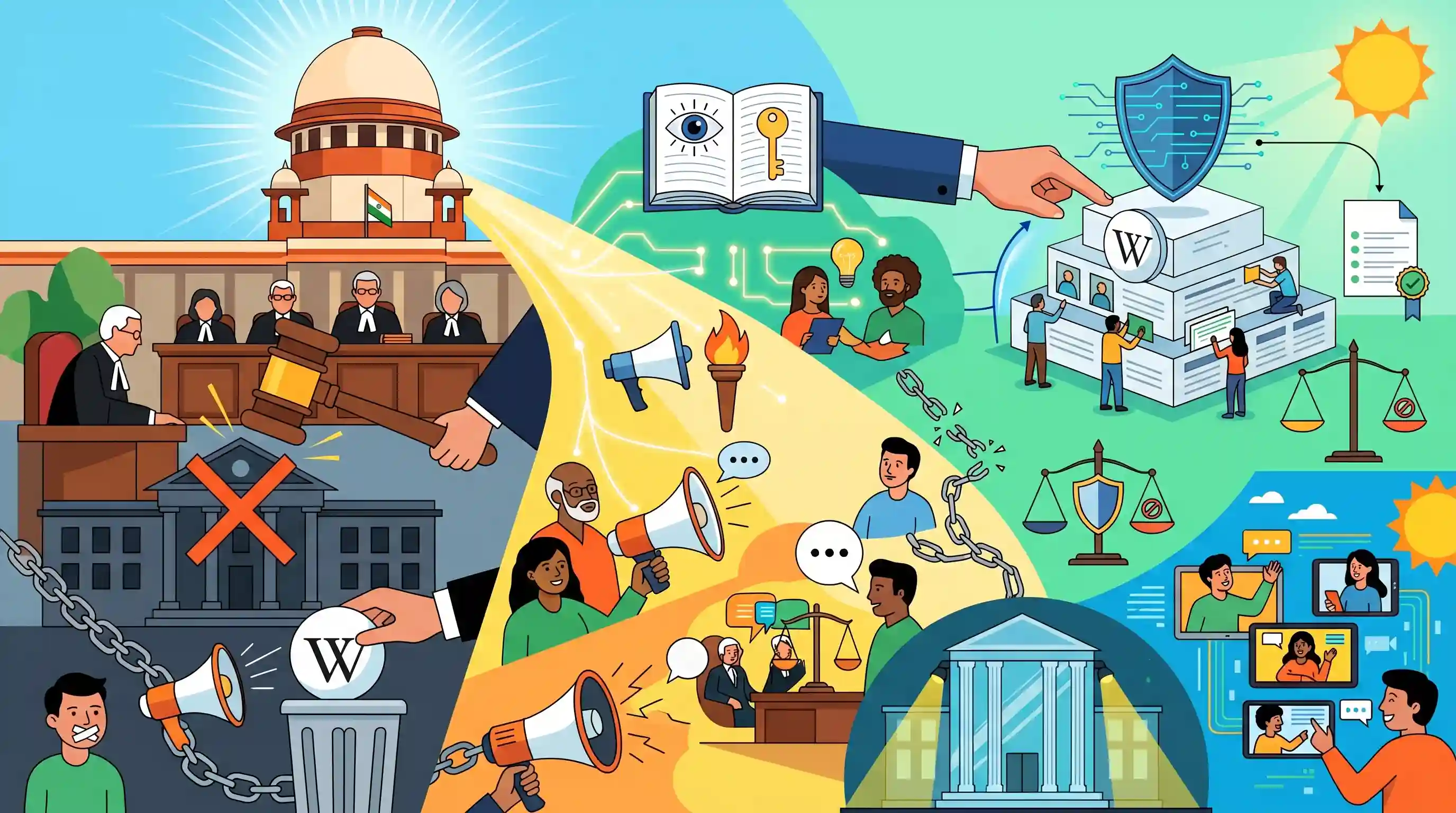
The Supreme Court of India set aside a Delhi High Court order directing the Wikimedia Foundation to remove a Wikipedia page and discussion forum related to a defamation suit filed by ANI. Justices Abhay S. Oka and Ujjal Bhuyan ruled that public debate on important issues is vital, even for sub judice matters, rejecting the notion that such discourse constitutes contempt of court. The judgment strongly reaffirmed the "right to know" as a fundamental right embedded in Articles 19(1)(a) and 21 of the Constitution. The editorial highlights the need to recognize Wikipedia's role as a digital intermediary under the Information Technology Act. By affirming that platforms facilitating independent user content should not be penalized, the ruling safeguards digital freedom of expression and promotes judicial transparency.
Key Points
- The Supreme Court set aside a Delhi High Court order that had directed Wikipedia to take down a page detailing ANI's defamation case and an associated discussion forum.
- Justices Abhay S. Oka and Ujjal Bhuyan emphasized that vigorous public debate on important issues is essential, even if a matter is sub judice, rejecting the premise that such discussions inherently amount to contempt of court.
- The Court underscored the 'right to know' as a fundamental right protected under Articles 19(1)(a) and 21 of the Constitution, emphasizing its role in public development and access to justice.
- The editorial advocates for recognizing the Wikimedia Foundation's intermediary status under the Information Technology Act, as it merely provides technical infrastructure for independent users, thereby protecting digital freedom of expression.
Important Terms
Article 19(1)(a)

Fundamental right guaranteeing freedom of speech and expression to all citizens, implicitly including the 'right to know' and receive information as essential for a functioning democracy.
UPSC context
GS Paper II: Fundamental Rights. Crucial for understanding interpretations of speech, press freedom, and reasonable restrictions under Article 19(2).
Article 21
Guarantees protection of life and personal liberty; judicially expanded to include human dignity, the right to access justice, and the right to information.
UPSC context
GS Paper II: Polity. Tests judicial activism and the expansion of the 'procedure established by law' into 'due process'.
Intermediary Liability
The legal accountability of digital platforms for third-party user content; 'Safe Harbour' under Section 79 protects platforms provided they follow due diligence.
UPSC context
GS Paper II & III: Governance and IT Act. Relevant for digital rights, censorship, and the regulation of social media.
Sub Judice
A legal principle (Latin for 'under judgment') meaning a matter is currently being considered by a court; traditionally restricts public discussion to avoid influencing trials.
UPSC context
GS Paper II: Judiciary. Tests the conflict between 'open justice' (transparency) and the potential for 'media trials' to prejudice proceedings.
Contempt of Court
The power of courts to punish actions that disobey orders (civil) or scandalize and lower the authority of the judiciary (criminal).
UPSC context
GS Paper II: Judiciary. Tests Articles 129/215 and the balance between judicial dignity and fair public criticism.
Information Technology Act, 2000
India's primary legislation for electronic commerce and cybercrime, providing the regulatory framework for digital signatures, data protection, and intermediary conduct.
UPSC context
GS Paper III: Internal Security/IT. Essential for questions on cyber laws, data privacy, and government surveillance powers.
Right to Know
A constitutional derivative of Article 19(1)(a) and 21, asserting that citizens have a fundamental right to access information about public and judicial proceedings.
UPSC context
GS Paper II: Governance/Polity. Tests transparency, accountability, and the legal basis of the Right to Information (RTI) framework.
Prelims Trap
"The 'Right to Know' is an explicitly stated fundamental right under Article 19 of the Constitution."
The Constitution does not explicitly mention the 'Right to Know' or 'Freedom of Press'. Both are implied rights read into Article 19(1)(a) and Article 21 through Supreme Court judgments.
Static Concepts Connected
What is the "Safe Harbour" protection for digital intermediaries?
- Section 79 IT Act:: Shields intermediaries (like Wikipedia, social media, ISPs) from legal liability for third-party, user-generated content hosted on their platforms.
- Conditional immunity:: Protection is conditional. It is lost if the platform initiates the transmission, modifies content, or ignores legal government/court takedown orders.
- Shreya Singhal (2015):: The Supreme Court ruled that intermediaries must only take down content upon receiving a court order or a formal government notification.
How is Contempt of Court handled under the Indian Constitution?
- Constitutional backing:: Articles 129 and 215 declare the Supreme Court and High Courts respectively as Courts of Record, with the inherent power to punish for their contempt.
- Statutory framework:: The Contempt of Courts Act, 1971 categorizes it into civil (willful disobedience of an order) and criminal (scandalizing the court or prejudicing judicial proceedings).
- Article 19(2) restriction:: Contempt of Court is explicitly listed as a ground to restrict freedom of speech and expression.
Cross-Topic Patterns
Safe Harbour + IT Rules 2021
Intermediary liability (Section 79) frequently intersects with the IT Rules 2021, which mandate grievance redressal mechanisms and chief compliance officers for significant social media intermediaries.
Implied Fundamental Rights + Article 21
Just as the Right to Know is read into Arts 19 and 21, UPSC often tests other implied rights like the Right to Privacy (Puttaswamy) and Right to Internet Access (Faheema Shirin).

Expect a 2026 Prelims multi-statement question testing 'Safe Harbour' under Sec 79 of the IT Act alongside Art 19(2) exceptions.
Linked PYQs · 4
Linked PYQs · 4
- 2014MainsGS2
What do you understand by the concept "freedom of speech and expression"? Does it cover hate speech also ? Why do the films in India stand on a slightly different plane from other forms of expression ? Discuss.
- 2017MainsGS2
Examine the scope of Fundamental Rights in the light of the latest judgement of the Supreme Court on Right to Privacy.
- 2024MainsGS3
Social media and encrypting messaging services pose a serious security challenge. What measures have been adopted at various levels to address the security implications of social media? Also suggest any other remedies to address the problem.
- 2023MainsGS2
“Constitutionally guaranteed judicial independence is a prerequisite of democracy.” Comment.
