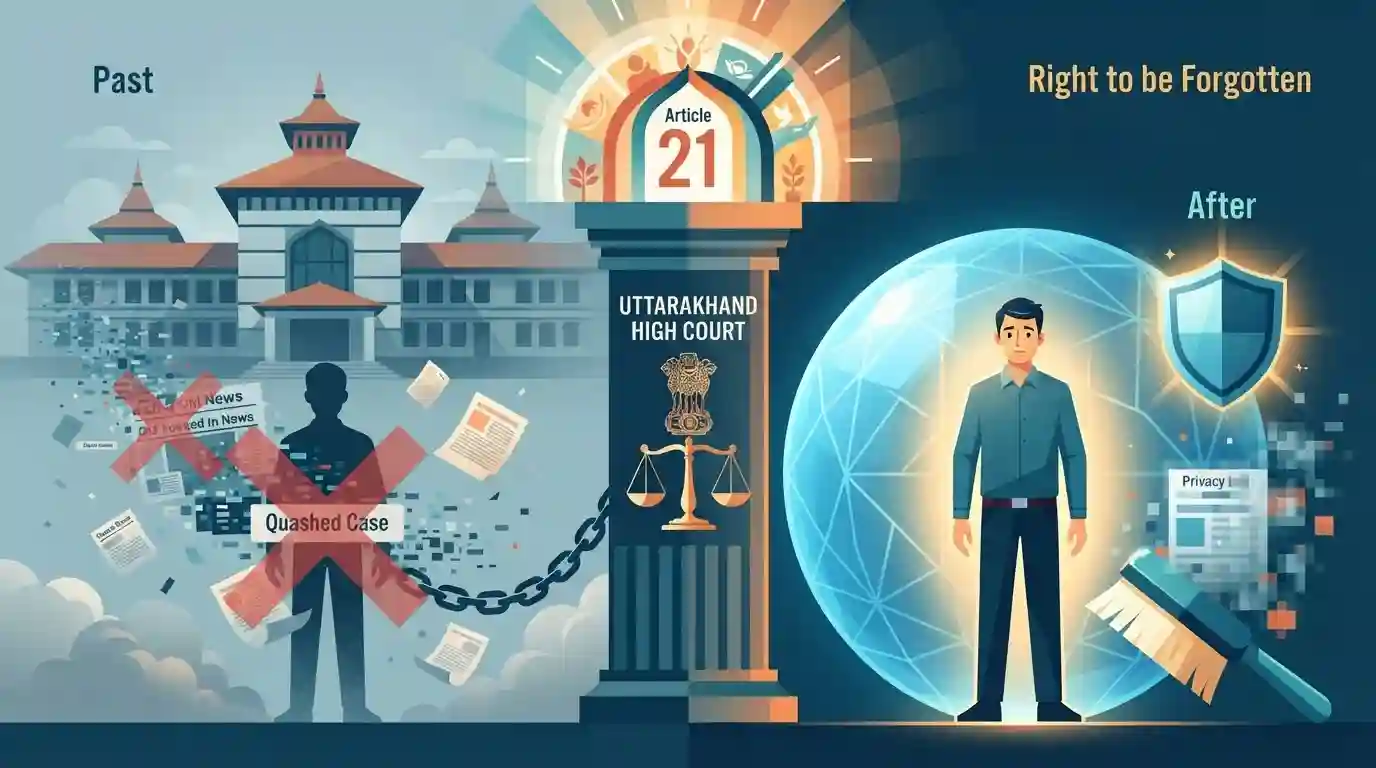
Uttarakhand HC Upholds Right to be Forgotten by Masking Accused Name
Source:supremetoday-ai ↗
Why It Matters
This judgment by the Uttarakhand High Court is vital for understanding the evolution of privacy jurisprudence and the Right to be Forgotten in Indian courts, impacting how digital records of quashed cases are managed.
Summary
The Uttarakhand High Court permitted the masking of an accused person's name in a quashed case, reinforcing the 'Right to be Forgotten' as an intrinsic part of the right to privacy and life under Article 21 of the Indian Constitution.
Key Points
- The Uttarakhand High Court allowed the masking of an accused's name in a quashed criminal case, upholding the 'Right to be Forgotten'.
- The ruling balances the digital footprint of individuals with privacy rights under Article 21, especially when proceedings have been quashed or ended in acquittal.
- It highlights the growing judicial recognition of the Right to be Forgotten in India amidst the absence of a comprehensive data protection statute.
Important Terms
Right to be Forgotten

A legal principle allowing individuals to have their personal information, identifiers, or names removed or masked from public digital records, protecting dignity, reputation, and livelihood.
UPSC context
Important for UKPSC Mains (Paper II - Polity & Governance) under Fundamental Rights and judicial pronouncements on the Right to Privacy.
Article 21 of the Constitution
Guarantees protection of life and personal liberty, which the judiciary has interpreted to encompass the right to privacy and the right to be forgotten.
UPSC context
Crucial for UKPSC Polity syllabus testing fundamental rights, judicial activism, and the expanding scope of personal liberty.
Uttarakhand High Court
The highest judicial body in Uttarakhand, which recently issued progressive directions to mask names of individuals in quashed cases on e-courts portals.
UPSC context
Essential for UKPSC Uttarakhand-specific legal developments, governance, and judicial precedents affecting state administration.
Prelims Trap
The Right to be Forgotten is explicitly codified under Section 21 of the Digital Personal Data Protection Act.
Aspirants often assume the Right to be Forgotten is explicitly codified under a specific central statute, whereas in India, it is currently a judicial derivation under Article 21.
Static Concepts Connected
What is the judicial genesis of the Right to be Forgotten in India?
- Puttaswamy Verdict: KS Puttaswamy (2017) judgment recognized privacy as a fundamental right under Article 21, laying the constitutional bedrock for the Right to be Forgotten.
- High Court Rulings: Several High Courts (Kerala, Delhi, Orissa, Uttarakhand) have invoked Article 21 to allow masking names in quashed or acquitted criminal cases.
- Statutory Context: DPDP Act contains provisions for data principal rights, but judicial masking specifically addresses the permanent digital footprint of court proceedings.
Cross-Topic Patterns
Privacy vs Open Justice in Digital Courts
The intersection of Article 21, the Right to be Forgotten, and digital court records reflects growing friction between open justice and individual privacy.
Judicial Activism & Data Protection Vacuums
High Court rulings in regional jurisdictions like Uttarakhand shape progressive jurisprudence in the absence of a fully operational data protection regime.

Expect questions pairing Article 21's expanded scope with the evolving judicial status of the Right to be Forgotten in India.
Linked PYQs · 2
Linked PYQs · 2
- 2021UKPSC_PRELIMSGS1
Right to Property belongs to which category amongst the following?
- 2024UKPSC_PRELIMSGS1
Who among the following has not been the Chief Justice of Uttarakhand High Court ?
