Tamil Nadu Panel Recommends Reforms for Federalism and Governors
Source:Indian Express ↗
Why It Matters
Committees appointed by states on federalism (like the historic Rajamannar Committee) provide critical arguments for Mains answers on Centre-State relations. The recommendations on the Governor's role and language policy address two of the most contentious contemporary issues in Indian federalism.
Summary
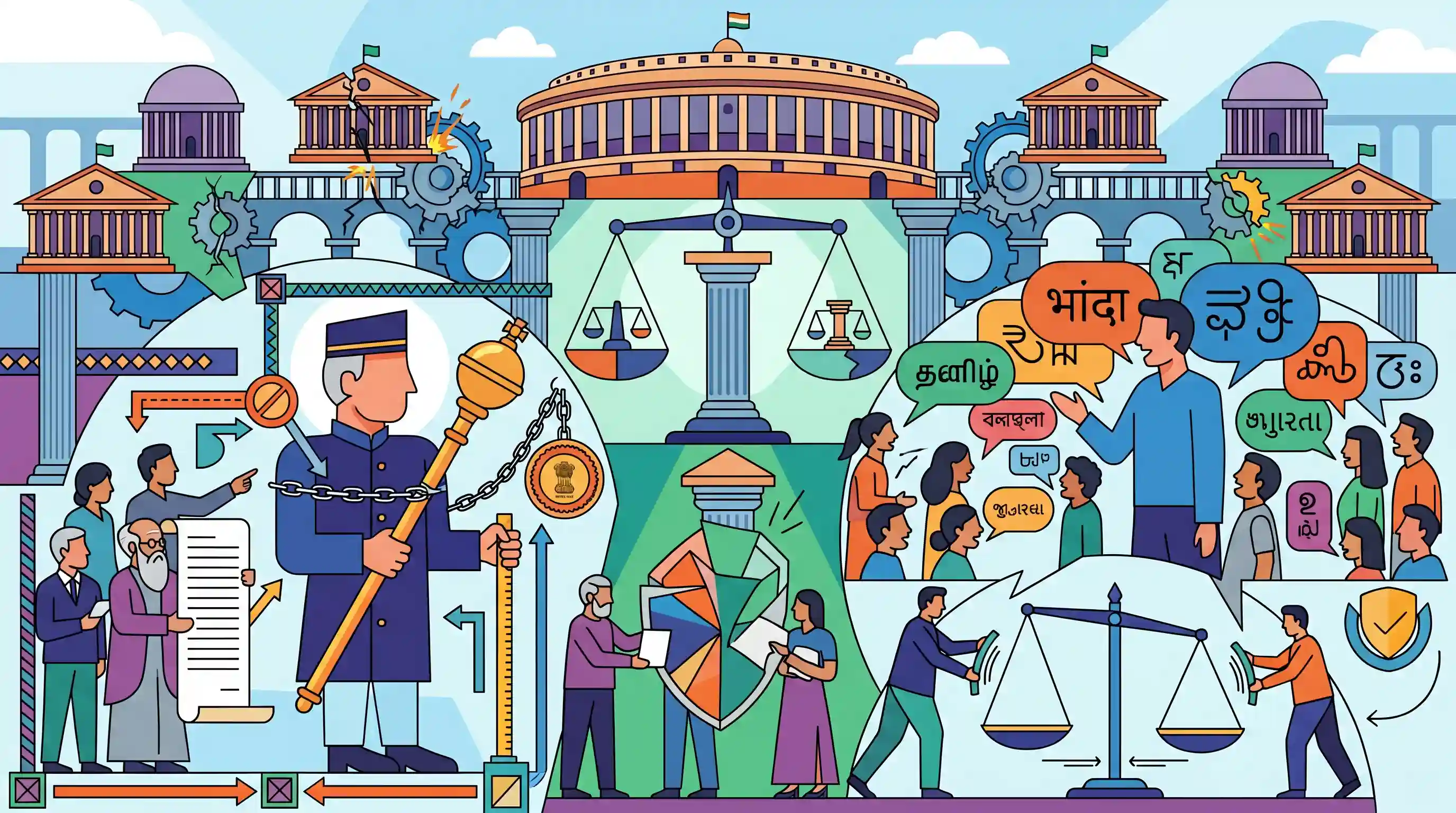
A Tamil Nadu state panel headed by former Supreme Court Justice Kurian Joseph has released recommendations focused on 'right-sizing' federalism in India. The committee's report addresses growing frictions between the Union and the States, particularly calling for systemic reforms to the post of the Governor to check discretionary overreach. Additionally, it advocates for a revised language policy to protect linguistic diversity against perceived Hindi imposition. The findings are highly relevant to ongoing debates on state autonomy and the constitutional balance of power.
Key Points
- A Tamil Nadu government-appointed panel headed by former Supreme Court judge Justice Kurian Joseph has proposed measures to 'right-size' federalism in India.
- The committee calls for significant changes to the Governor's post to prevent the office from being used to disrupt or override elected state governments.
- The panel recommends an overhaul of the language policy, emphasizing linguistic equality and opposing the imposition of Hindi on non-Hindi speaking states.
- The report underscores the ongoing friction in Centre-State relations, particularly highlighting the demands of regional parties for greater state autonomy.
Important Terms
Federalism

The constitutional division of power between a central Union and various state governments. The Kurian Joseph report calls for a 'structural reset' to prevent over-centralization and restore state autonomy.
UPSC context
GS Paper II: Essential for topics on Centre-State relations and 'Issues and challenges pertaining to the federal structure'.
Governor’s Discretionary Powers
Authority under Article 163 where a Governor acts without ministerial advice. The panel recommends curtailing these, specifically regarding bill assent (Article 200) and state assembly dissolution.
UPSC context
GS Paper II: Critical for 'Appointment and powers of the Governor' and 'Constitutional posts'.
Official Language Policy
Constitutional provisions (Articles 343-351) regarding the Union's official languages. The committee advocates making English a permanent official language to protect linguistic diversity against Hindi imposition.
UPSC context
GS Paper II: Relevant for 'Provisions regarding Official Languages' and federal tensions over culture/identity.
Article 3
Empowers Parliament to form new states or alter boundaries of existing ones. The report recommends requiring state consent for such changes to safeguard territorial integrity.
UPSC context
GS Paper II: Key for 'Union and its Territory' and federalism debates.
Article 368
The process by which the Constitution is modified. The panel proposes that major amendments require ratification by 2/3 of states representing 2/3 of India's population.
UPSC context
GS Paper II: Fundamental for 'Amendment of the Constitution' and Basic Structure doctrine.
Fiscal Federalism
The division of financial powers between the Union and States. The committee critiques the GST Council's centralized structure and suggests restoring state control over certain fiscal matters.
UPSC context
GS Paper II & III: Vital for 'Centre-state financial relations' and GST implementation issues.
Prelims Trap
Article 3 mandates the concurrence of the state legislature before Parliament can alter state boundaries.
Under the current Constitution (Article 3), the President only seeks the state's views, which are not binding. The panel merely RECOMMENDS changing this to mandatory concurrence.
Static Concepts Connected
Which major state-appointed committees have reviewed Centre-State relations historically?
- Rajamannar Committee (1969): Appointed by Tamil Nadu; recommended establishing an Inter-State Council and deleting Articles 356, 357, and 365 regarding President's Rule.
- West Bengal Memorandum: Adopted in 1977; demanded replacing the word 'Union' with 'Federal' in the Constitution and limiting the Centre's jurisdiction.
- Anandpur Sahib Resolution: 1973 Akali Dal resolution demanding restricting the Centre's role strictly to defense, foreign affairs, communications, and currency.
What are the Governor's current options under Article 200 for state bills?
- Assent or Withhold: Can give assent (bill becomes law) or withhold assent (bill ends), though withholding is mostly used for private member bills or when governments change.
- Return for Reconsideration: Can return non-Money Bills. If the assembly passes it again with or without amendments, the Governor is constitutionally bound to give assent.
- Reserve for President: Mandatory if the bill derogates the High Court's powers. Discretionary if it opposes constitutional provisions, DPSPs, or broader national interests.
Cross-Topic Patterns
Article 200 and SC Judicial Review
The panel's strict 15-day limit echoes recent Supreme Court rulings (involving Punjab and Kerala) clarifying that Governors cannot sit on Bills indefinitely, treating constitutional silences as veto loopholes.
Official Language vs. Eighth Schedule
The push to make English a permanent official language under Article 343 intersects with recurring demands to conduct Union exams and administration in all 22 Eighth Schedule languages to ensure linguistic equity.

Expect a multi-statement question contrasting Sarkaria/Punchhi recommendations on Governor's role with this TN panel's 'deemed assent'.
Linked PYQs · 3
Linked PYQs · 3
- 2024MainsGS2
What changes has the Union Government recently introduced in the domain of Centre-State relations ? Suggest measures to be adopted to build the trust between the Centre and the States and for strengthening federalism.
- 2022MainsGS2
Discuss the essential conditions for exercise of the legislative powers by the Governor. Discuss the legality of re-promulgation of ordinances by the Governor without placing them before the Legislature.
- 2022MainsGS2
“While the national political parties in India favour centralisation, the regional parties are in favour of State autonomy.” Comment.
