Electoral Integrity and Transparency in Voting Data
Source:The Hindu ↗
Why It Matters
The credibility of the Election Commission and the integrity of the electoral process are foundational to India's democracy. Allegations of manipulated voter turnout, lack of transparency (e.g., withholding CCTV footage), and questions regarding the political neutrality of the ECI highlight critical areas for structural and procedural electoral reforms, which are recurring themes in GS2 (Polity and Governance).
Summary
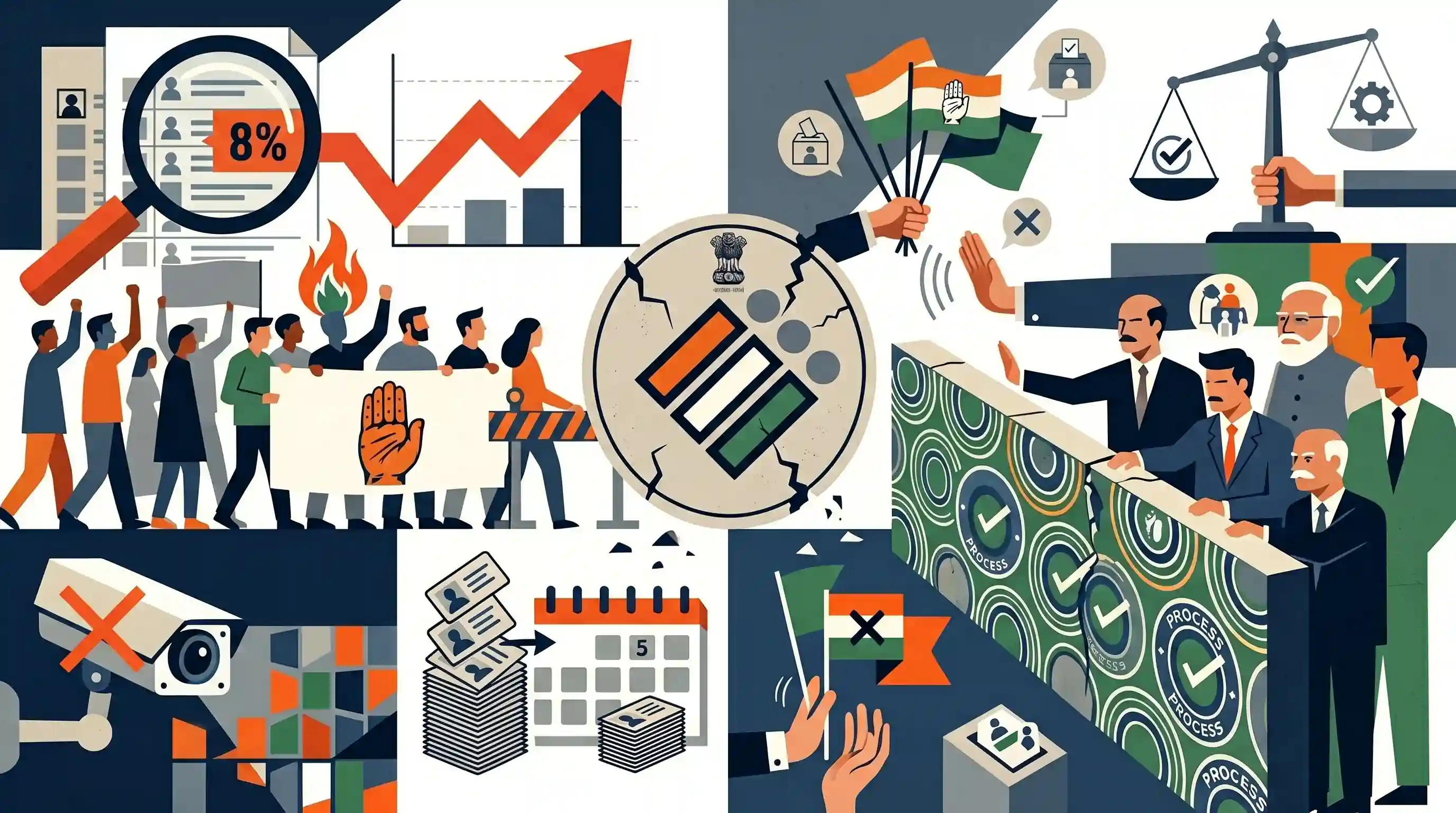
The Indian National Congress has announced state-wide 'voter awareness' processions in Maharashtra to protest alleged irregularities in the 2024 Assembly elections. Key concerns raised include a highly unusual 8% jump between preliminary and final voter turnout figures, the suspicious addition of 41 lakh new voters within a five-month span, and a perceived lack of transparency from the Election Commission of India (ECI) regarding the withholding of CCTV footage. While the opposition warns that similar tactics might be employed in upcoming elections, the ECI and ruling BJP leaders have dismissed these claims as unfounded responses to an electoral defeat. The controversy underscores ongoing debates about the credibility, independence, and transparency of India's electoral processes.
Key Points
- The Congress plans to launch 'voter awareness' torchlight processions in Maharashtra on June 12 to protest an alleged 'vote theft pattern' during the 2024 Assembly elections.
- Opposition leaders highlighted anomalies such as an unprecedented 8% jump between preliminary and final voter turnouts (58.22% to 66.5%) and the addition of 41 lakh voters in just five months.
- Concerns were raised over the Election Commission's transparency, specifically the amending of rules to allegedly withhold CCTV footage and video recordings of strongrooms.
- The ECI and ruling BJP dismissed the allegations as baseless and an absurd reaction to electoral defeat, pointing to the ruling coalition's decisive lead in absolute vote counts.
Important Terms
Election Commission of India (ECI)

Autonomous constitutional authority under Article 324 responsible for administering Union and State election processes in India, including Parliament, State Legislatures, and the offices of President and Vice-President.
UPSC context
GS Paper II: Constitutional bodies, powers and functions, and electoral reforms to ensure democratic integrity.
Mahayuti
The ruling political alliance in Maharashtra, led by the BJP and including the Eknath Shinde-led Shiv Sena and the Ajit Pawar-led Nationalist Congress Party (NCP).
UPSC context
GS Paper II: Functioning of political parties and the impact of coalition politics on state-level governance.
Maha Vikas Aghadi (MVA)
An opposition political coalition in Maharashtra comprising the Indian National Congress (INC), Shiv Sena (UBT), and the Nationalist Congress Party (Sharadchandra Pawar).
UPSC context
GS Paper II: Role of political alliances and the Representation of People’s Act in democratic elections.
Indian National Congress (INC)
One of India's oldest national political parties and a principal opposition entity. It led recent protests alleging data inconsistencies in the 2024 Maharashtra elections.
UPSC context
GS Paper II: Significance of national parties and the role of the opposition in parliamentary democracy.
Bharatiya Janata Party (BJP)
A major national political party in India that leads the ruling coalitions at both the central (NDA) and state (Mahayuti) levels.
UPSC context
GS Paper II: Ideological shifts in political parties and the dynamics of majoritarian governance in India.
Prelims Trap
The Election Commission of India has the final authority to adjudicate and void elections over alleged poll rigging.
Under Article 329(b) and RPA 1951, electoral disputes can only be challenged via an Election Petition filed in the respective High Court, not before the ECI.
Static Concepts Connected
What is the statutory framework governing Electoral Rolls in India?
- RPA 1950: The Representation of the People Act, 1950 governs the allocation of seats, delimitation, and the preparation or revision of electoral rolls.
- Freeze Period: Voters can continuously apply to be added to the rolls. However, no additions or deletions are permitted after the last date for filing nominations for an election.
- Qualifying Dates: Recent amendments introduced four qualifying dates (Jan 1, Apr 1, Jul 1, Oct 1) in a year for 18-year-olds to register, replacing the single Jan 1 date.
What is an Election Petition under Indian law?
- Sole Remedy: Under Article 329(b) of the Constitution, results of parliamentary or state assembly elections can only be challenged via an Election Petition.
- Jurisdiction: These petitions are filed directly in the respective State High Court, with appeals lying exclusively to the Supreme Court of India.
- Statutory Backing: Under Section 100 of RPA 1951, courts can void an election due to proven corrupt practices or the material impact of improper reception/rejection of votes.
Cross-Topic Patterns
Form 17C & Voter Data Transparency
Discrepancies in turnout data frequently invite Supreme Court petitions demanding the ECI publicly upload Form 17C within 48 hours, highlighting the tension between Conduct of Elections Rules and the RTI framework.
ECI Appointments & Institutional Independence
Allegations of ECI bias are often linked in GS-2 Mains answers to the CEC Act 2023, which altered the ECI selection committee by replacing the CJI with a Union Cabinet Minister.

Expect a 2026 prelims multi-statement question distinguishing RPA 1950 (electoral rolls) from RPA 1951 (election disputes & petitions).
Linked PYQs · 3
Linked PYQs · 3
- 2022MainsGS2
Discuss the role of the Election Commission of India in the light of the evolution of the Model Code of Conduct.
- 2024MainsGS2
Examine the need for electoral reforms as suggested by various committees with particular reference to "one nation one election" principle.
- 2017PrelimsGS1
Right to vote and to be elected in India is a
