Supreme Court Directives on Black Money Eradication in Elections
Source:The Hindu ↗
हे का महत्त्वाचे आहे
Highlights the ongoing debate on the extent of the Election Commission's powers under Article 324 and the critical issue of money power in Indian elections. It is directly relevant to GS Paper 2 topics on statutory and constitutional bodies, electoral reforms, and the Representation of the People Act.
सारांश
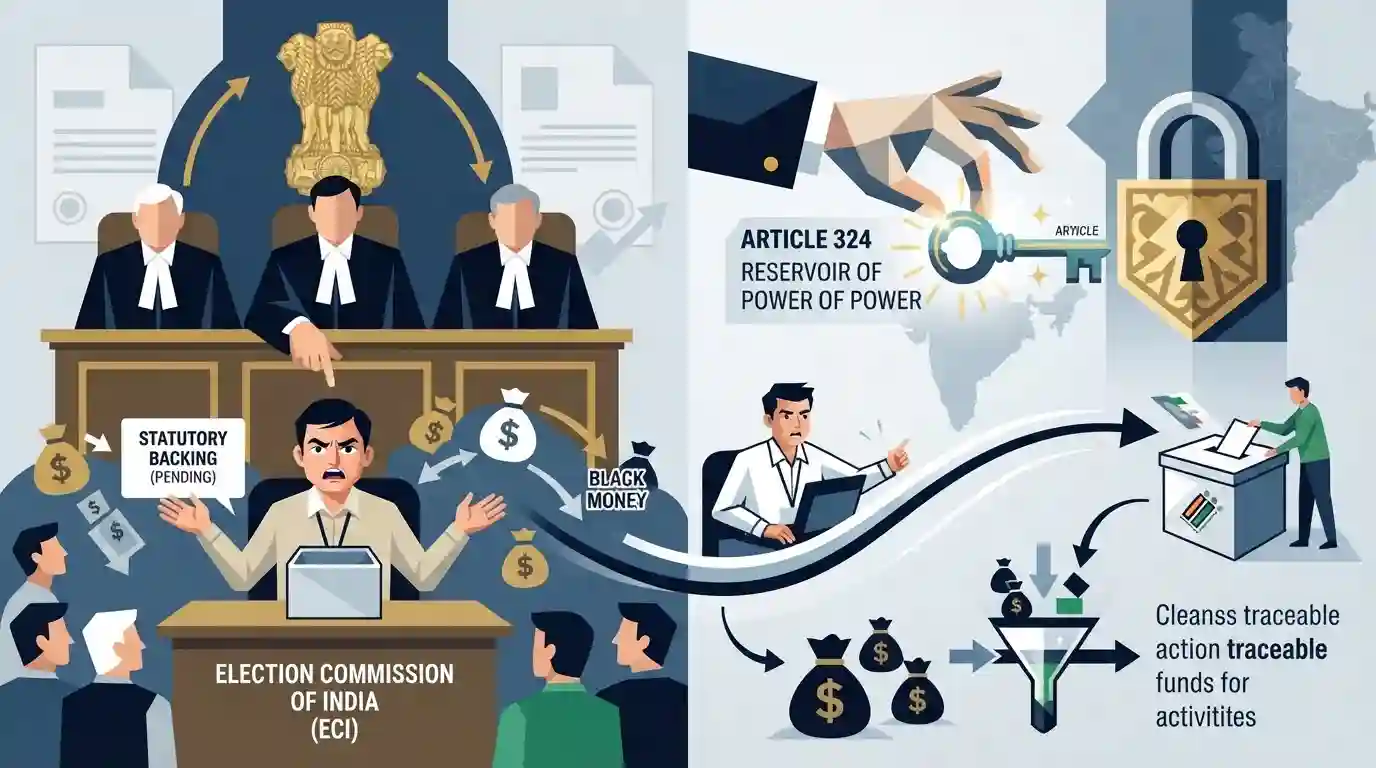
The Supreme Court of India has asserted that it is the constitutional responsibility of the Election Commission of India (ECI) to cleanse the electoral process of black money. Hearing a petition, the apex court rejected the ECI's claim of helplessness due to a lack of statutory backing to penalize candidates or parties for using unaccounted funds. Relying on the 'Mohinder Singh Gill' judgment, the Court reminded the ECI that Article 324 is a 'reservoir of power', authorizing the Commission to take necessary steps for free and fair elections even in the absence of specific parliamentary legislation.
मुख्य मुद्दे
- The Supreme Court reminded the Election Commission of India (ECI) that it is constitutionally mandated under Article 324 to ensure free and fair elections, which includes eradicating black money in the electoral process.
- The ECI expressed helplessness, arguing that it lacks the statutory power to disqualify candidates or derecognise political parties for using unaccounted money, as current laws enacted by Parliament are insufficient.
- The Supreme Court cited the landmark 'Mohinder Singh Gill' judgment, reiterating that Article 324 acts as a 'reservoir of power' for the ECI to act where the law is silent, provided its actions do not contravene existing laws.
- The Court emphasized that the ECI cannot wait for Parliament to enact new laws to address the issue of black money and must proactively utilize its constitutional powers.
महत्त्वाच्या संज्ञा
Article 324 of the Constitution

A constitutional provision vesting the superintendence, direction, and control of national and state elections in the Election Commission of India, serving as a plenary reservoir of power.
UPSC context
GS Paper II (Polity & Governance). Critical for questions on electoral integrity, institutional independence, and the extent of ECI's administrative powers.
Election Commission of India (ECI)
An autonomous constitutional body established under Article 324 to conduct and regulate free, fair, and transparent elections to Parliament, State Legislatures, and top offices.
UPSC context
GS Paper II (Constitutional Bodies). Vital for analyzing democratic governance, electoral reforms, campaign funding, and the Model Code of Conduct.
Representation of the People Act (RPA), 1951
A landmark parliamentary legislation that provides the statutory framework for the actual conduct of elections, candidate qualification/disqualification criteria, electoral offenses, and dispute resolution.
UPSC context
GS Paper II (Salient features of RPA). Tested extensively regarding candidate eligibility, decriminalization of politics, and electoral transparency.
Supreme Court of India
The apex judicial authority of India, acting as the ultimate interpreter of the Constitution and the final court of appeal, safeguarding the democratic rule of law.
UPSC context
GS Paper II (Judiciary). Crucial for questions on judicial review, landmark cases, and the judiciary's role in enforcing free and fair elections.
Parliament
The supreme legislative body of India, consisting of the President and two Houses (Lok Sabha and Rajya Sabha), empowered to enact statutory laws governing electoral processes.
UPSC context
GS Paper II (Parliament). Essential for questions on legislative oversight, lawmaking powers, and electoral statutory reforms.
पूर्वपरीक्षा सापळा
Article 324 enables the ECI to override existing statutory laws passed by Parliament to ensure free and fair elections.
Article 324 acts as a reservoir of power only when legislative laws are silent; it cannot override or act contrary to existing statutory provisions.
संबंधित स्थिर संकल्पना
What is the scope of Article 324 under the Mohinder Gill precedent?
- Plenary reservoir: Article 324 contains a plenary reservoir of power enabling the ECI to take necessary actions where statutory law is silent.
- Subservient to statute: These executive powers cannot override or run contrary to explicit laws enacted by Parliament (such as the RPA, 1951).
- Subject to principles: Administrative actions taken under Article 324 are subject to judicial review and must comply with natural justice principles.
Does the Election Commission have the power to de-register political parties?
- No statutory power: The RPA, 1951 contains provisions for registering political parties under Section 29A, but does not grant explicit statutory power to de-register them.
- Judicial limitation: The Supreme Court has ruled that ECI cannot de-register parties except in extreme cases, such as fraud, unconstitutional ideology, or cessation of existence.
आंतर-विषय नमुने
Judicial activism vs Legislative silence
The SC directing the ECI to act despite legislative gaps tests the classic separation of powers boundary, shifting electoral sanitisation enforcement from Parliament to constitutional bodies.
Electoral surveillance and Federal dynamics
Mandating local surveillance teams to report directly to federal Income Tax authorities highlights how electoral integrity mechanisms bypass traditional federal-state administrative silos during code-of-conduct periods.

Statements on Article 324 limits, ECI de-registration powers, and RPA-based disqualifications are highly likely in a multi-statement MCQ.
संबंधित PYQ · 3
संबंधित PYQ · 3
- 2022MainsGS2
Discuss the role of the Election Commission of India in the light of the evolution of the Model Code of Conduct.
- 2017MainsGS2
To enhance the quality of democracy in India the Election Commission of India has proposed electoral reforms in 2016. What are the suggested reforms and how far are they significant to make democracy successful?
- 2025MainsGS2
Discuss the 'corrupt practices' for the purpose of the Representation of the People Act, 1951. Analyze whether the increase in the assets of the legislators and/or their associates, disproportionate to their known sources of income, would constitute 'undue influence' and consequently a corrupt practice.
