Rhistotope Project Employs Radioisotopes Against Rhino Poaching
Source:Indian Express ↗
Why It Matters
It showcases a highly innovative, cross-disciplinary approach to tackling poaching by repurposing nuclear security infrastructure and isotope technology for environmental conservation. This is highly relevant for GS-3 questions combining Science & Technology with Environment.
Summary
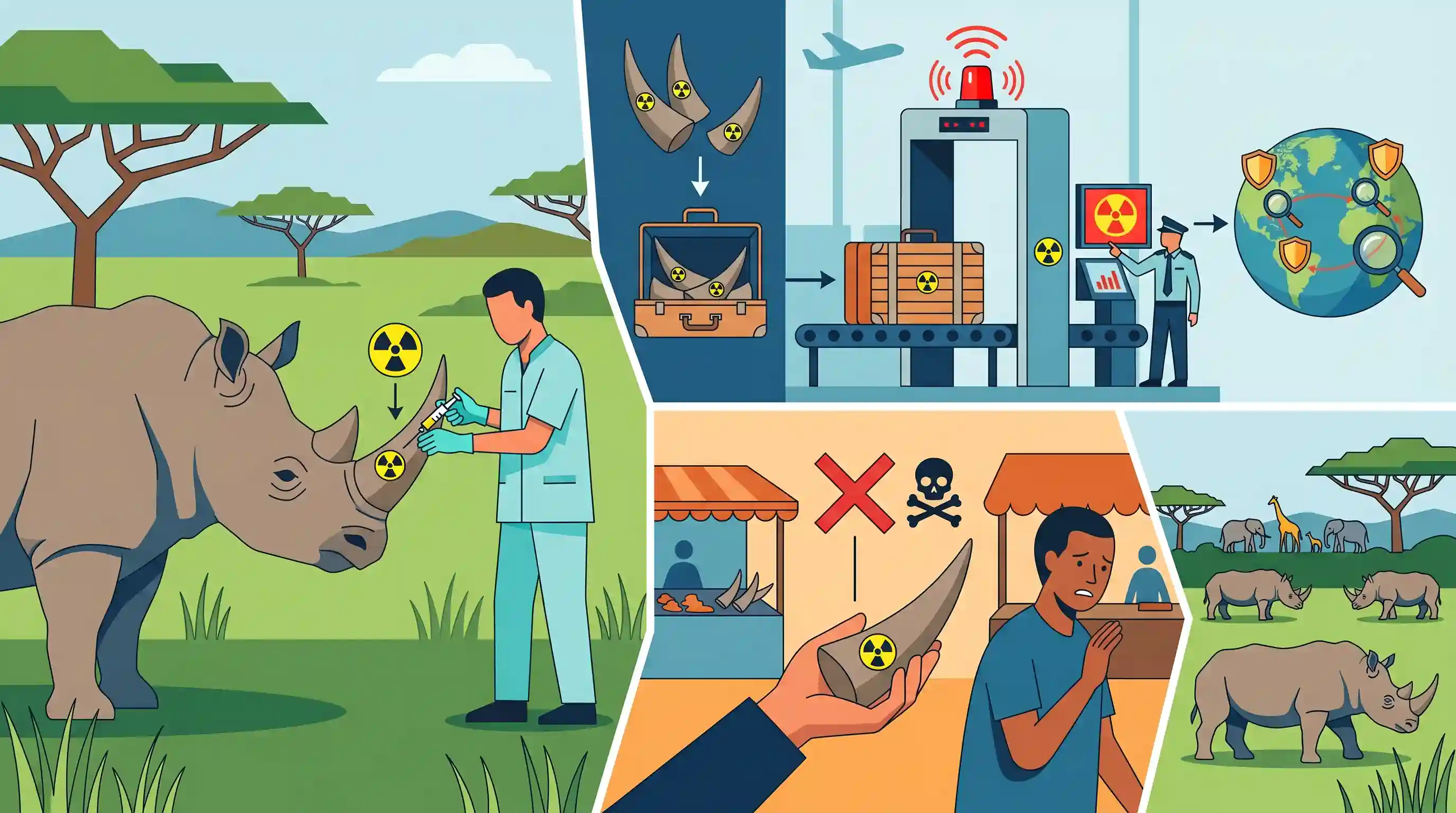
The Rhisotope Project in South Africa is an innovative conservation initiative that involves injecting small, harmless quantities of radioactive isotopes into the horns of rhinoceroses. This technology aims to curb poaching and the illegal wildlife trade by making rhino horns easily detectable at global transit hubs equipped with radiation monitors (originally installed for national security purposes). Additionally, the process devalues the horn for illegal markets by rendering it toxic for human consumption, thus targeting the demand for rhino horn in traditional medicine. This dual strategy—increasing global detectability and destroying end-user demand—offers a novel application of nuclear science in wildlife protection.
Key Points
- The Rhisotope Project in South Africa injects harmless quantities of radioactive isotopes into rhinoceros horns to deter poaching.
- The radioactive signature leverages existing global security infrastructure, triggering radiation portals at borders, airports, and seaports to prevent smuggling.
- The injected isotopes render the rhino horn toxic for human consumption, aiming to destroy demand in traditional medicine markets.
- The procedure represents an innovative, cross-disciplinary application of nuclear technology towards wildlife conservation.
Important Terms
The Rhisotope Project

A South African conservation initiative injecting low-dose radioactive isotopes into rhino horns to facilitate detection at borders and deter consumption by rendering horns toxic for humans.
UPSC context
GS Paper III (Environment/S&T). Tests knowledge of innovative technological solutions for biodiversity protection and wildlife security.
Radioisotopes
Atoms with unstable nuclei that emit radiation; in this project, they act as permanent markers detectable by global security scanners without harming the animal.
UPSC context
GS Paper III (S&T). Important for understanding the diverse applications of nuclear science beyond power generation.
Radiation Portal Monitors (RPM)
Detection devices at international borders and ports used to find radioactive materials; they are repurposed by conservationists to identify smuggled rhino horns tagged with isotopes.
UPSC context
GS Paper III (Security/Tech). Relevant for border management and leveraging existing global security infrastructure for conservation.
Illegal Wildlife Trade (IWT)
The unlawful trade of wild animals and plants; a multi-billion dollar criminal industry that threatens biodiversity and is the primary target of the Rhisotope Project.
UPSC context
GS Paper III (Environment). A major threat to ecosystem stability and a core topic for wildlife protection laws.
CITES (Convention on International Trade in Endangered Species)
An international treaty ensuring wildlife trade does not threaten species survival; its Appendix I listing provides the legal basis for the global rhino horn ban.
UPSC context
GS Paper III (Environment). Fundamental for understanding international environmental law and species-specific protection mechanisms.
International Atomic Energy Agency (IAEA)
An international body that promotes the peaceful use of nuclear energy; its support for this project demonstrates nuclear science's role in solving environmental crises.
UPSC context
GS Paper II/III (International Relations/S&T). Tests understanding of the role of international organizations in scientific conservation.
Prelims Trap
The radioactive isotopes injected into rhinoceros horns are absorbed into the animal's bloodstream, acting as a permanent systemic deterrent.
The isotopes are injected directly into the horn (which is dead keratin, like hair). The procedure is localized, entirely non-invasive, and completely safe for the rhino.
Static Concepts Connected
What is the conservation and legal status of the Greater One-Horned Rhino in India?
- IUCN Status: Listed as Vulnerable on the IUCN Red List. Its habitat is primarily restricted to the tall grasslands of Assam, West Bengal, and Uttar Pradesh.
- Legal Protection: Protected under Schedule I of the Wildlife Protection Act (WPA), 1972, which accords it absolute protection and prescribes the highest penalties for offenses.
- State Ownership: Under the WPA, wild animals and their parts/derivatives (including naturally shed horns) are solely government property, making any private trade strictly illegal.
What are the major non-energy applications of radioactive isotopes in India?
- Medicine: Used heavily in diagnostics (e.g., Technetium-99m) and targeted radiotherapy (e.g., Cobalt-60) to destroy malignant cancer cells.
- Agriculture & Food: Applied in mutation breeding to develop pest-resistant crop varieties and for food irradiation to safely prolong shelf life.
- Industry & Security: Used for non-destructive testing in manufacturing, detecting underground pipeline leaks, and triggering radiation monitors at international transit hubs.
Cross-Topic Patterns
Nuclear tech + Transnational organized crime
Leverages existing national security infrastructure (Radiation Portal Monitors) to intercept ecological contraband. Interpol and FATF increasingly treat wildlife trafficking as a complex, organized transnational crime requiring such advanced countermeasures.
Demand destruction vs. Supply protection
Rather than exclusively guarding the live animal (supply), this intervention destroys the economic value of the contraband itself, directly attacking traditional medicine demand markets.

Expect a multi-statement question merging WPA 1972 state-ownership rules of animal derivatives with novel S&T conservation tech in 2026.
Linked PYQs · 2
Linked PYQs · 2
- 2022PrelimsGS1
With reference to Indian laws about wildlife protection, consider the following statements : 1. Wild animals are the sole property of the government. 2. When a wild animal is declared protected, such animal is entitled for equal protection whether it is found in protected areas or outside. 3. Apprehension of a protected wild animal becoming a danger to human life is sufficient ground for its capture or killing. Which of the statements given above is/are correct?
- 2021MainsGS3
What are the research and developmental achievements in applied biotechnology? How will these achievements help to uplift the poorer sections of the society?
