Wildlife Protection Amendment Act implementation for primates
Source:Indian Express ↗
ఇది ఎందుకు ముఖ్యం
It highlights the ongoing challenges of human-wildlife conflict management in urban-rural fringes, statutory changes in wildlife laws (such as the 2022 amendments to the Wild Life Protection Act), and the administrative complexities of handling nuisance animals like rhesus macaques.
సారాంశం
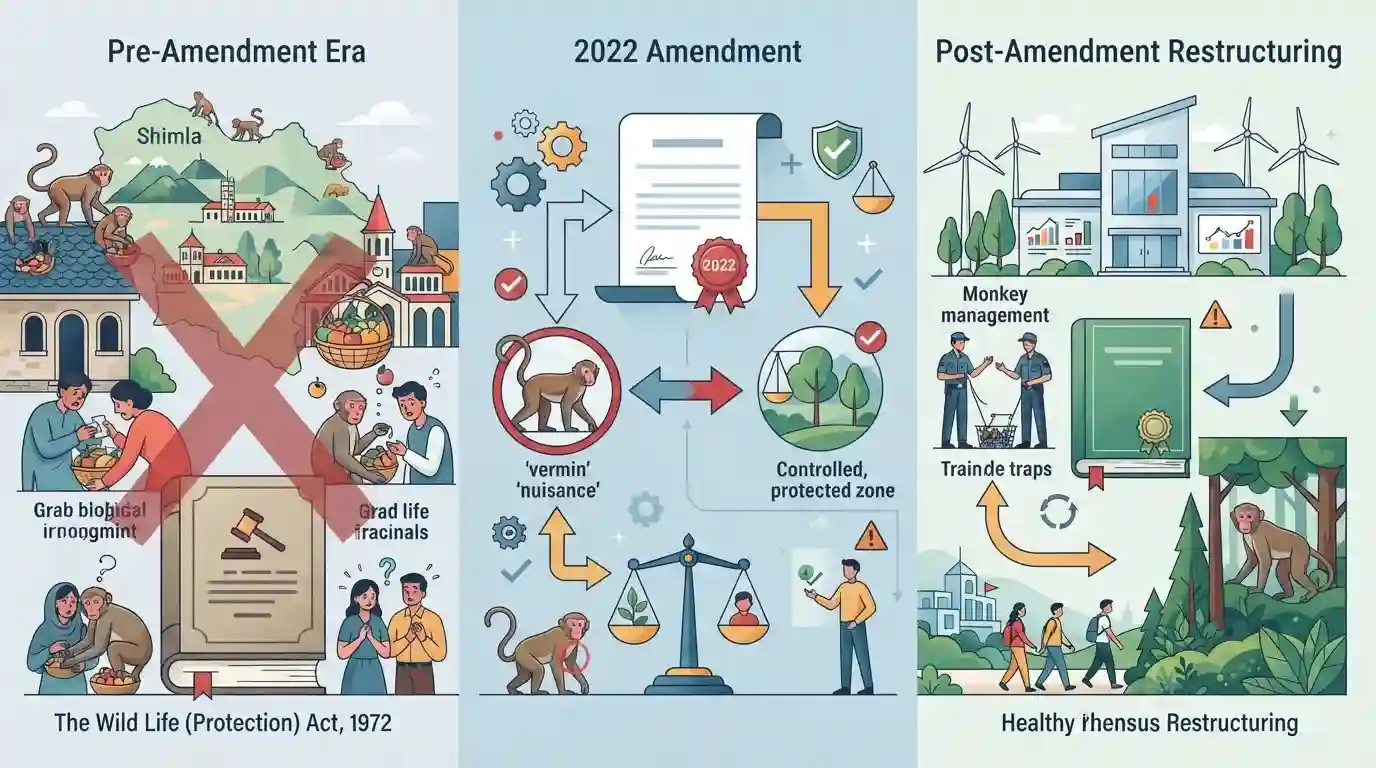
The article discusses the legal and administrative evolution surrounding rhesus monkeys in Shimla under the Wild Life (Protection) Act, 1972, particularly following the 2022 amendments which restructured how conflict and nuisance species are managed.
ముఖ్య అంశాలు
- The Wild Life (Protection) Amendment Act, 2022 restructured schedules, replacing the old Schedule V ('vermin') mechanism with a new system involving management of species causing damage to life and property.
- In Shimla and surrounding areas, rhesus macaques (monkeys) have been a major source of human-wildlife conflict, crop raiding, and attacks on humans.
- The legal and administrative framework governing nuisance or conflict wildlife has evolved, shifting away from simple 'vermin' declarations towards more nuanced management protocols under central and state oversight.
ముఖ్యమైన పదాలు
Wild Life (Protection) Act, 1972

A crucial legislation enacted in 1972 providing the legal framework for the protection of wild animals, birds, and plants, and establishing national parks and wildlife sanctuaries across India.
UPSC context
UPSC Prelims/Mains (GS Paper III): Essential for questions on environmental legislation, biodiversity conservation, and protected area management.
Wild Life (Protection) Amendment Act, 2022
An amendment that restructured India's wildlife schedules, implemented CITES provisions, rationalized vermin classifications, and increased penalties for wildlife offenses.
UPSC context
UPSC Prelims/Mains (GS Paper III): Tests dynamic updates to wildlife laws, international treaty compliance, and human-wildlife conflict management.
Ministry of Environment, Forest and Climate Change
The nodal central government ministry responsible for planning, promoting, and implementing environmental, forestry, and wildlife conservation policies and legislation in India.
UPSC context
UPSC Prelims/Mains (GS Paper II & III): Important for institutional frameworks governing environmental policy, statutory bodies, and administrative implementation.
Supreme Court of India
The apex judicial authority in India, frequently adjudicating on environmental PILs, balancing developmental needs with ecological preservation and wildlife protection laws.
UPSC context
UPSC Mains (GS Paper II & III): Evaluates judicial activism, environmental jurisprudence, and landmark rulings on wildlife conservation and human-animal conflicts.
అనుసంధానమైన స్థిర భావనలు
How were wildlife schedules and the 'vermin' category restructured under the Wild Life (Protection) Amendment Act, 2022?
- Schedule Reduction: Reduced from six schedules in the 1972 Act to four streamlined schedules, including separate schedules for CITES species and general protected animals.
- Vermin Replacement: The old Schedule V listing 'vermin' animals was replaced with a targeted mechanism allowing specific management of species causing severe damage to human life or property.
- Central Notification: Central Government retains the authority to notify certain species as causing damage under specific conditions, balancing conservation with human safety.
అంతర-అంశ నమూనాలు
Wildlife Act Amendments + Conflict Mitigation
Human-wildlife conflict is increasingly addressed through legislative schedule restructuring and localized mitigation protocols rather than blanket culling permissions.

Wild Life (Protection) Amendment Act 2022 schedule changes and vermin provisions will feature in a direct multi-statement prelims Q.
అనుసంధాన PYQలు · 1
అనుసంధాన PYQలు · 1
- 2024PrelimsGS1
Consider the following statements : Statement-I: The Indian Flying Fox is placed under the "vermin" category in the Wild Life (Protection) Act, 1972. Statement-II : The Indian Flying Fox feeds on the blood of other animals. Which one of the following is correct in respect of the above statements ?
