RGHS Introduces Artificial Intelligence Monitoring and Telemedicine
Source:udaipurtimes ↗
Why It Matters
The application of Artificial Intelligence and telemedicine in a state-run health scheme is a crucial development in Rajasthan's e-governance and public health infrastructure. It is highly relevant for RPSC Prelims questions focusing on technological interventions in administration, state health initiatives, and digital health accessibility.
Summary
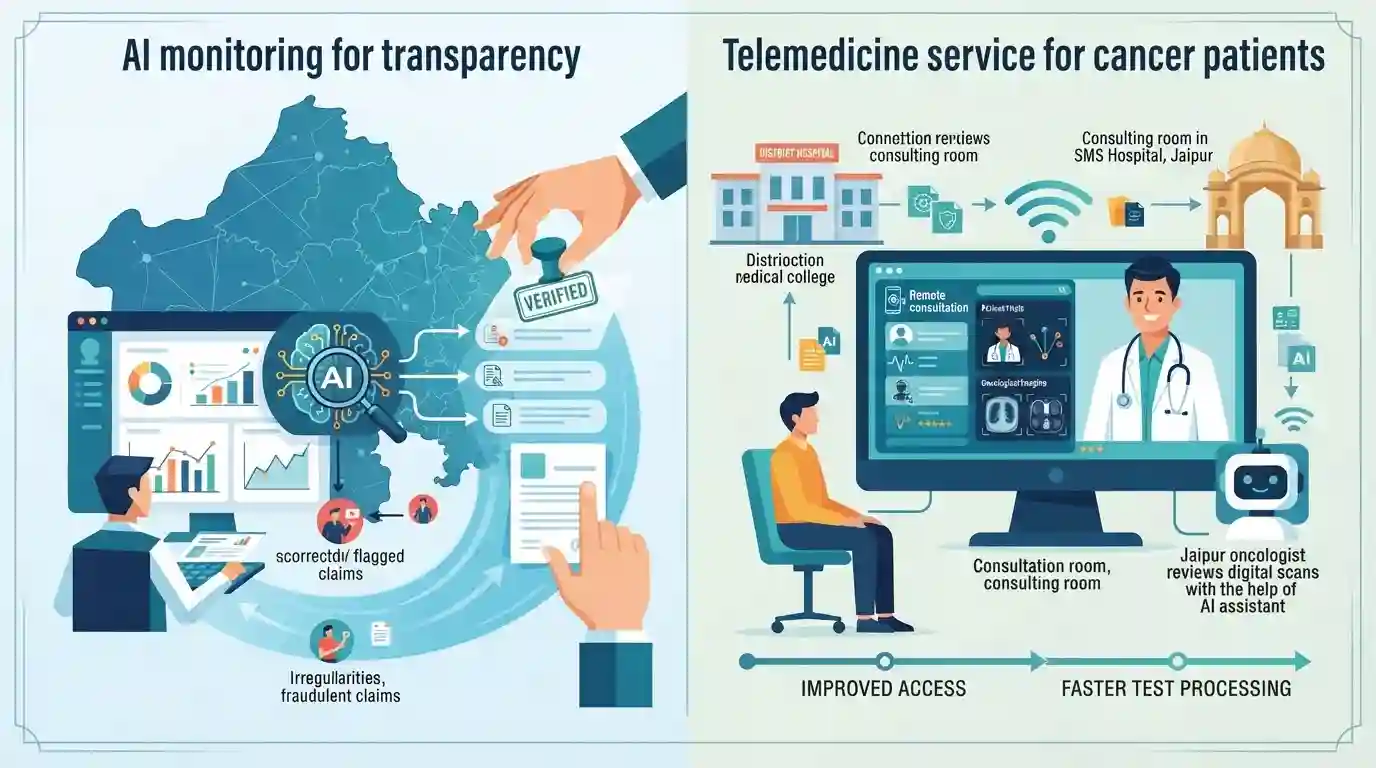
The Rajasthan Government Health Scheme (RGHS) has introduced Artificial Intelligence (AI) monitoring to curb irregularities and ensure transparency. Additionally, it has launched a telemedicine service enabling cancer patients at district medical colleges to consult with expert oncologists from SMS Hospital, Jaipur, thereby improving specialized healthcare access and processing times for critical tests.
Key Points
- The Rajasthan Government Health Scheme (RGHS) has implemented AI monitoring to identify and prevent irregularities and ensure transparency.
- A new telemedicine initiative allows cancer patients in district medical colleges to receive consultations from specialist oncologists at SMS Hospital, Jaipur.
- The system expedites the processing of medical tests costing over Rs 2000, bringing the turnaround time down to 30-35 minutes.
- The integration of technology aims to enhance healthcare accessibility and improve governance in state health schemes.
Important Terms
Rajasthan Government Health Scheme (RGHS)

A state-sponsored health insurance program offering cashless, comprehensive medical care to Rajasthan government employees, pensioners, and dependents through a network of empanelled hospitals and pharmacies.
UPSC context
Relevant for GS2 (Governance/Health Schemes); highlights decentralized public healthcare financing, e-governance, and state-led social security models.
Rajasthan Medical Services Corporation Limited (RMSCL)
A centralized public procurement agency in Rajasthan that ensures the availability of generic medicines, surgical sutures, and medical equipment free of cost at government healthcare institutions.
UPSC context
Covers GS2 (Governance); serves as a model for efficient public procurement and ensuring universal access to essential medicines.
SMS Hospital
Sawai Man Singh (SMS) Hospital is a premier state-run tertiary care teaching hospital in Jaipur, Rajasthan, serving as a primary referral center for advanced treatments.
UPSC context
Useful for GS2 (Public Health) as a case study for tertiary healthcare infrastructure, capacity challenges, and integrating telemedicine into public systems.
Telemedicine
The remote delivery of healthcare services, including diagnosis and clinical consultations, via telecommunications infrastructure. It bridges the geographic gap between rural patients and urban medical specialists.
UPSC context
Crucial for GS2 (Health) and GS3 (Science & Tech); tests knowledge of digital health interventions addressing the urban-rural healthcare divide in India.
Artificial Intelligence (AI) in Healthcare
The application of machine learning and data analytics to health systems, used here to audit medical schemes, flag irregularities, and process administrative approvals rapidly.
UPSC context
Relevant for GS3 (IT & AI) and GS2 (E-Governance); illustrates how emerging tech promotes transparency, cuts red tape, and curbs scheme corruption.
Prelims Trap
"RGHS is a universal health insurance scheme for all citizens of Rajasthan."
RGHS is specifically designed for state government employees, pensioners, and legislators, mirroring the Central Government Health Scheme (CGHS), not the general public.
Static Concepts Connected
How is AI utilized to prevent leakages in public health schemes?
- Fraud Detection: Algorithms analyze billing patterns in real-time to identify ghost claims, duplicate bills, and unnatural spikes in high-value diagnostics.
- Automated Approvals: Automated systems can process historical health data to pre-approve genuine high-value tests rapidly, reducing manual bureaucratic bottlenecks.
- Audit Trails: Continuous monitoring creates a secure audit trail that flags non-compliant hospitals or beneficiaries for physical verification.
What is the Hub-and-Spoke model in India's telemedicine framework?
- Hubs (Specialty Centers): Medical colleges and large hospitals act as hubs, providing specialized medical advice (like oncology) to remote locations.
- Spokes (Primary Care): District hospitals or Ayushman Arogya Mandirs (HWCs) act as spokes where patients visit for initial screening and tele-consultation setup.
- Decentralized Access: This model decentralizes specialized healthcare, reducing out-of-pocket expenditure and travel time for rural patients seeking expert care.
Cross-Topic Patterns
AI Audits in Welfare Schemes
The use of AI to detect ghost claims in RGHS mirrors the Centre's use of algorithms to weed out duplicate beneficiaries in PDS and PM-KISAN.
Tele-oncology & NCD Management
Rising Non-Communicable Diseases necessitate shifting from centralized tertiary care to decentralized district-level screening, leveraging telemedicine frameworks like eSanjeevani.

AI in governance (fraud detection) + telemedicine expansion likely to form a mixed GS-2/GS-3 multi-statement question in Prelims 2026.
Linked PYQs · 2
Linked PYQs · 2
- 2018RPSC_PRELIMSGS1
The Rajasthan government has released a new software to monitor trends in seasonal and non-communicable diseases, as well as diseases found in specific areas. What is the name of this software?
- 2023RPSC_PRELIMSGS1
Where will the “Artificial Intelligence of Things Innovation Hub” be established in Rajasthan?
