Kailash Mansarovar Yatra Revival and India China Ties
Source:The Hindu ↗
Why It Matters
Provides an updated perspective on the evolving trajectory of India-China relations, highlighting the role of cultural exchanges and connectivity in rebuilding trust after military border tensions. Relevant for IR questions on bilateral diplomacy and soft power.
Summary
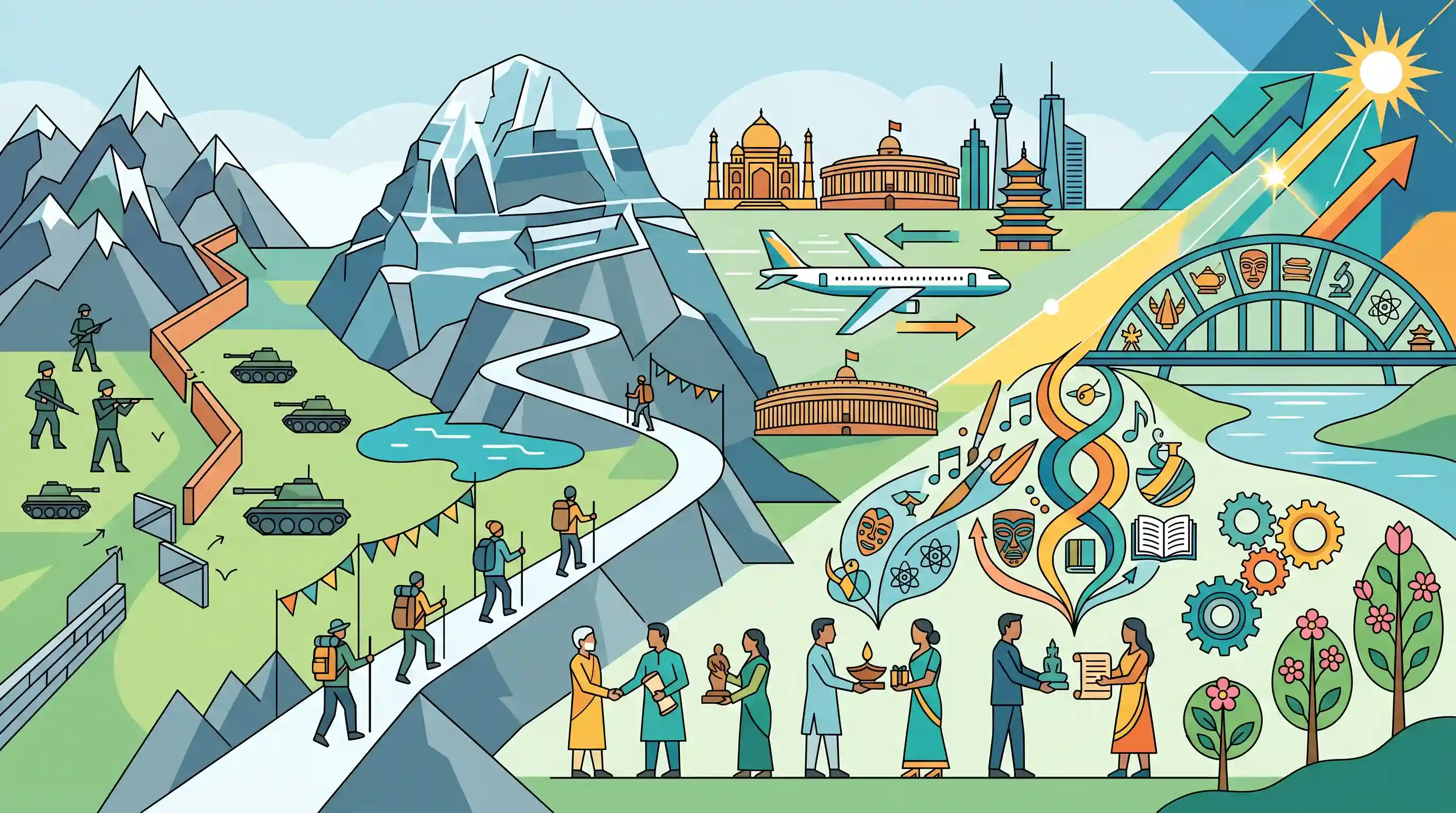
The Chinese Ambassador to India emphasized that reviving the Kailash Mansarovar Yatra and resuming direct flights will inject new momentum into India-China ties. Following disengagement efforts along the LAC, the focus is shifting towards cultural diplomacy and people-to-people exchanges to rebuild mutual trust and stabilize the bilateral relationship.
Key Points
- The resumption of the Kailash Mansarovar Yatra and direct flights are identified as significant steps to revitalize India-China bilateral relations.
- Focusing on cultural diplomacy and people-to-people exchanges aims to rebuild mutual trust following prolonged military standoffs along the Line of Actual Control (LAC).
- These initiatives mark a thaw in relations and an effort to stabilize ties through soft power and enhanced connectivity.
Prelims Trap
"Lipulekh pass is a bi-junction border post located exclusively between India and China."
Lipulekh is actually a strategic tri-junction between India (Uttarakhand), Nepal, and China (Tibet), making it central to recent India-Nepal cartographic disputes.
Static Concepts Connected
What are the key Himalayan passes connecting India and China for trade and pilgrimage?
- Lipulekh Pass: Located at the Uttarakhand-Nepal-China tri-junction; acts as a traditional and direct route for the Kailash Mansarovar yatra.
- Nathu La: Located in Sikkim; an offshoot of the ancient Silk Route, a major border trade post, and an official Border Personnel Meeting (BPM) point.
- Shipki La: Located in Himachal Pradesh; serves as a major trade post and marks the entry point of the Sutlej river into India from Tibet.
How do Confidence-Building Measures (CBMs) function along the LAC?
- Military CBMs: Protocols designed to avoid tactical miscalculations, such as maintaining distance between patrols and holding regular talks at established Border Personnel Meeting (BPM) points.
- Civilian CBMs: Reopening traditional pilgrimage routes (like Mansarovar) and resuming direct flights to rebuild mutual trust, alleviate distrust, and foster soft power linkages.
Cross-Topic Patterns
Lipulekh: Pilgrimage vs Cartography
The Lipulekh route for the Yatra directly intersects with the Kalapani territorial dispute with Nepal, linking India-China cultural diplomacy with neighborhood boundary sensitivities.
Cultural Thaw vs Economic Security
While cultural ties and flights resume, India maintains strict Press Note 3 FDI restrictions against China, highlighting a dual-track strategy of cultural engagement and economic de-risking.

Expect a 2026 map-matching question on Sino-Indian passes (Lipulekh, Nathu La) or a Mains prompt on decoupling economic vs cultural ties.
Linked PYQs · 4
Linked PYQs · 4
- 2014MainsGS2
With respect to the South China sea, maritime territorial disputes and rising tension affirm the need for safeguarding maritime security to ensure freedom of navigation and over flight throughout the region. In this context, discuss the bilateral issues between India and China.
- 2012MainsGS2
Do you think that China's emergence as one of the largest trading partners of India has adversely affected the settlement of the outstanding border problem?
- 2015MainsGS2
Terrorist activities and mutual distrust have clouded India-Pakistan relations. To what extent the use of soft power like sports and cultural exchanges could help generate goodwill between the two countries? Discuss with suitable examples.
- 2016MainsGS3
Border management is a complex task due to difficult terrain and hostile relations with some countries. Elucidate the challenges and strategies for effective border management.
